
Lieferung heute & morgen

Qualitätsgarantie

Willkommens-Angebote freischalten: KOSTENLOSE Lieferung | Bis zu 80 % RABATT | Kostenlose 30-Tage-JoyPlus-Testphase
App herunterladen
A baby walker can provide a practical activity during the transition from sitting to standing and walking. At the same time, the models differ considerably: a wooden push-along baby walker serves a different purpose from an activity centre for babies or a stroller board with a seat for an older sibling.
Many disappointing purchases are not caused by the price, but by unsuitable product features. Before buying, parents should therefore compare the child’s age, the product design, the space required and the intended environment.
“From 12 months” is not a general recommendation for every child. What matters is whether the child can sit independently, stand securely and hold on to suitable objects. Some products are intended only for children who can already maintain an upright sitting position. A baby walker does not replace supervision and should only be used on suitable, level surfaces.
It is also important to distinguish between a push-along baby walker and a seated walking device. The models presented here are designed for pushing or activities. They should not automatically be compared with traditional seated walkers, in which a child sits and moves around using their feet.
Lots of functions may look appealing, but they do not automatically make a product more useful in everyday life. Check the following:
A baby walker with a play tray may be appealing to families if their child wants to push the walker as well as play while standing. For smaller rooms, however, a compact model with fewer, easy-to-reach activities may be more suitable.
A stroller board with a seat is not a baby walker, but an accessory for a pushchair. Before buying, parents should check the attachment points, the width of the frame and whether the wheels can move freely. A design described as “universal” will not necessarily fit every pushchair.
The age and weight limit, a correctly fastened safety harness and a non-slip standing area are also important. The child should only ride under supervision.
Pay attention to the specific manufacturer’s recommendation rather than just the product category. A wooden baby walker in the “baby walkers from 12 months” category is designed for a child with a different height and level of motor development than a stroller board with a seat from 15 months.
For products with a seat, the maximum load and the design of the harness are particularly important. When pushing, the frame’s stability is the key factor. Children should be able to grip the walker independently without leaning too far forwards.
Wheels containing rubber or PU can reduce noise on hard floors. However, this does not mean that every model performs equally well on parquet, tiles or carpet. Check the wheels regularly for signs of wear and make sure there are no cables, thresholds or stairs in the way.
A walker with very free-running wheels may be more difficult for beginners to control. Higher rolling resistance or an adjustable design may be useful in everyday situations, provided the manufacturer gives the relevant information.
Rounded edges, smooth surfaces and securely fitted components are basic selection criteria. With wooden models, parents should look for neatly finished surfaces and an easy-care coating. Plastic models can often be cleaned with a damp cloth; cleaning the entire product in water is only permitted if the manufacturer expressly states that this is suitable.
Before each use, check the wheels, handle, play modules and fastenings. A CE mark may indicate compliance with relevant EU requirements, but it does not replace checking the specific instructions for use.
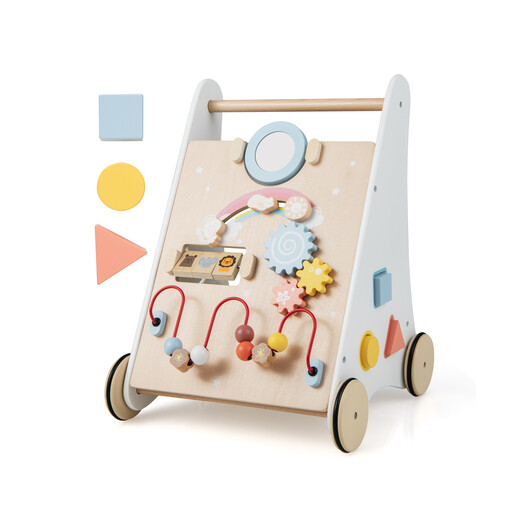
Why this product suits this profile: This push-along baby walker combines a wooden design with several activity elements and, according to the product information, is suitable from 12 months. It is an appealing option for families looking for a versatile baby walker for standing, pushing and playtime.
The age recommendation, dimensions of 34.5 × 32.5 × 45 cm and materials—lime wood plus MDF—are clearly specified. Rubberised wheels and rounded edges address common selection criteria, but they should still be checked before use.
Several activities, a storage basket and a stated weight of 2.2 kg. Assembly is carried out using step-by-step instructions.
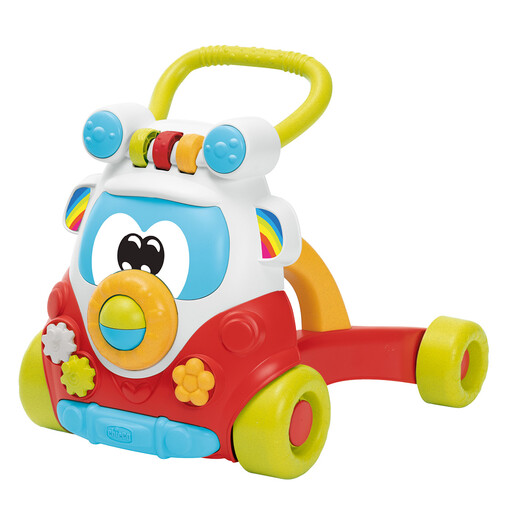
Why this product suits this profile: This 2-in-1 model combines a push-along aid with an activity centre for babies. According to the product information, it is suitable for 9 to 24 months and features five manual activities.
The product information specifies the age range, dimensions, materials and care instructions. It also expressly states that the product should be used on level surfaces and that supervision is required.
Four large wheels, five manual activities, polypropylene and ABS plastic, and a stated weight of 1.4 kg.
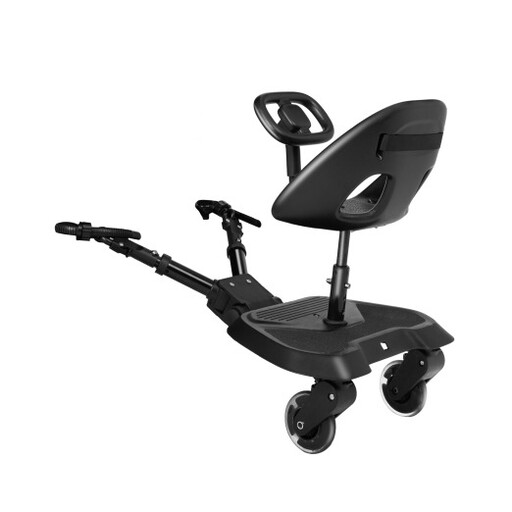
Why this product suits this profile: This model is designed for families with two young children, when an older sibling needs to ride along on the pushchair. According to the product information, it is suitable from 15 months up to a maximum weight of 20 kg.
Adjustability is clearly described, with three positions for the adapter length and eight for the adapter height. Before buying, you should still check whether your pushchair model is compatible.
Removable, reversible seat with a 2-point harness, non-slip footrest, 360-degree swivel wheels with suspension and a net weight of 3.1 kg.
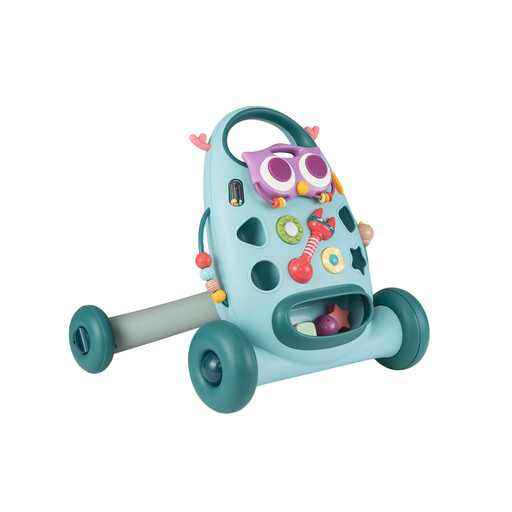
Why this product suits this profile: This model is aimed at families looking for a baby walker with a removable oval play tray and shape-sorting toy. The removable design can be practical for use while sitting or standing.
The product name already states that the play tray is removable. Before ordering, parents should check the full age, dimension and safety information on the product page.
A removable oval play tray and shape-sorting toy are listed features.
We have put together a complete, regularly updated list of products that fully meet these strict selection criteria and the safety regulations applicable in the EU.
This depends on the particular model and the child’s developmental stage. Product information may specify suitability from 9 or 12 months, for example; according to the description, the Chicco model is suitable for 9 to 24 months, while the wooden baby walker is suitable from 12 months. Children should be able to sit independently and should only play with the walker under supervision.
The period of use depends on the age recommendation, the child’s height, weight and interest. Once the child reaches the stated weight limit, can no longer grip the walker safely or is already walking independently, use should be stopped or reassessed. A stroller board with a seat has its own limits; the Kikka Boo Ally XL, for example, is suitable up to a maximum weight of 20 kg.
A baby walker is pushed around the home or on suitable level surfaces and may include activities. A stroller board with a seat is attached to a pushchair and gives an older sibling somewhere to stand or sit during a walk. The two products have different attachment, age and safety requirements.