
Lieferung heute & morgen

Qualitätsgarantie

Willkommens-Angebote freischalten: KOSTENLOSE Lieferung | Bis zu 80 % RABATT | Kostenlose 30-Tage-JoyPlus-Testphase
App herunterladen
A good night's sleep is the foundation of any outdoor adventure. An inflatable sleeping pad promises comfort and insulation, but the market is flooded with models whose marketing promises often fall short in practice. Before you make a decision, it's crucial to understand the typical pitfalls that can lead to restless nights and a regrettable purchase.
As your Joybuy Product Recommendation Officer, I'll help you identify the key features and find a sleeping pad that fits your needs. We'll focus on the facts, not the hype.
The 3 most common pitfalls when buying an inflatable sleeping pad:
To avoid these pitfalls, you should carefully examine three technical aspects. These are the primary determinants of your pad's comfort, durability, and practicality.
The material determines the pad's durability, weight, and noise level. Common materials are polyester or nylon, often with a TPU (Thermoplastic Polyurethane) coating. This coating makes the pad airtight and more resistant to moisture and abrasion. Look for material thickness ratings like 50D (Denier)—a good compromise between durability and weight.
Even more important is the internal structure. Instead of simple longitudinal or transverse baffles, modern pads often feature a honeycomb or dot-weld structure. These smaller, interconnected air chambers distribute body weight more evenly and prevent "bottoming out." This allows even a relatively thin trekking pad to provide stable support.
Comfort starts with the setup. There are several systems available:
A crucial detail is the valve. Models with dual-layer valves have an advantage here. One layer serves as a one-way valve for inflation, while opening both layers allows for extremely rapid deflation (often in seconds).
For hikers and backpackers, an ultralight sleeping pad and a small pack size are essential. For car camping, where weight is less of a concern, the sleeping pad can be larger and heavier.
An often overlooked but critical metric is the R-value. It indicates the thermal resistance and measures how well a pad insulates against ground cold.
A self-inflating pad often contains a foam core that increases insulation, resulting in a higher R-value, but this usually leads to a larger pack size.
Here are some models that represent a considered choice for specific user profiles based on their objective features.
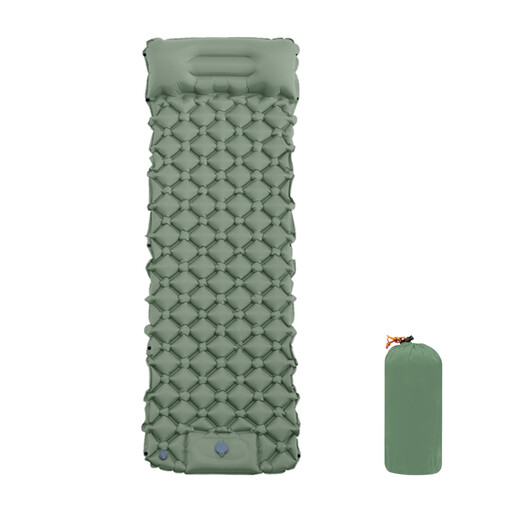
Why this model fits: Weighing just 690g with a pack size comparable to a water bottle, this pad is designed specifically for backpackers who count every gram.
The egg-crate air cell structure provides stable support despite the lightweight design, preventing the hammock effect. The integrated foot pump is efficient and eliminates the need for a separate pump.
The dual-layer valve allows for extremely rapid deflation in about 1 second, significantly speeding up breakdown on the trail.
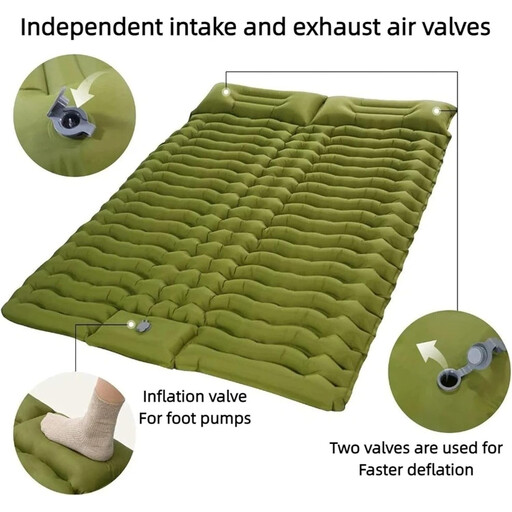
Why this model fits: With a 200 x 160 cm sleeping surface, this pad offers ample space for two people, making it a great choice for car camping where comfort outweighs minimal weight.
The 8 cm thickness is combined with a honeycomb structure that stably supports the weight of two people. The integrated foot pump is designed to fill the large volume in under 3 minutes.
The pad features integrated pillows, which saves packing separate items. The 50D Polyester Pongee material with TPU is durable and low-noise.
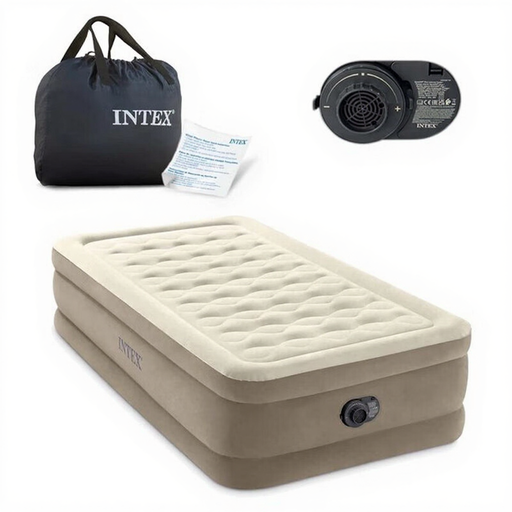
Why this model fits: Ideal as a comfortable guest bed or for "glamping" at festivals where a power outlet is available. Its 46 cm height and electric pump offer maximum comfort with no physical effort.
The integrated 220V pump completely eliminates the problem of inefficient manual pumps. The patented Fiber-Tech construction, using thousands of polyester fibres, ensures structural stability and prevents the hammock effect.
The bed-like height of 46 cm makes getting in and out significantly easier. According to the manufacturer, setup is complete in about 3 minutes.
We have compiled a complete, up-to-date list of products that fully meet these strict selection criteria and relevant safety standards.
The R-value is a physical unit of measurement for thermal resistance. For sleeping pads, it indicates how well the pad insulates against cold from the ground. The higher the R-value, the better the insulation performance. For summer camping, an R-value of 1-2 is sufficient, while a value of 2-4 is recommended for spring or autumn trips. For winter tours, R-values of 4 or higher are necessary.
Most high-quality sleeping pads come with a repair kit. The procedure is usually as follows:
Yes, but only if it is designed for it. The crucial factor here is the aforementioned R-value. A sleeping pad for winter use should have an R-value of at least 4, or preferably 5 or higher. Pads without sufficient insulation will cause body heat to be quickly lost to the frozen ground, which can lead to dangerous hypothermia. It's also common in winter to combine two pads, for example, a foam pad (for protection and extra insulation) underneath a well-insulated inflatable pad.