
Lieferung heute & morgen

Qualitätsgarantie

Willkommens-Angebote freischalten: KOSTENLOSE Lieferung | Bis zu 80 % RABATT | Kostenlose 30-Tage-JoyPlus-Testphase
App herunterladen
An LED bathroom mirror with lighting combines a mirror and a light source in one wall-mounted unit. This saves space and can make daily grooming, shaving and applying make-up easier. However, models vary considerably in light quality, installation, IP rating and controls.
Three common buying mistakes can lead to unnecessary costs:
First, measure the available wall width, the height above the basin, and the distance from taps and wall cabinets. A rectangular LED bathroom mirror makes efficient use of the wall above a wide basin. A round LED bathroom mirror, on the other hand, can look more harmonious in smaller or asymmetrically designed bathrooms.
Also check whether the mirror can be mounted horizontally, vertically or only in a specific orientation. Dimensions such as 50 × 70 cm, 80 × 60 cm or 100 × 60 cm don’t necessarily indicate the same mounting orientation across different listings.
Light colour is measured in kelvins:
A dimmable bathroom mirror gives you more ways to adjust the lighting. Check whether the brightness can be adjusted continuously or only in set steps, and whether your last setting is saved. A bathroom mirror with a touch switch is convenient, but needs an easy-to-reach control area that’s clearly marked.
The IP rating indicates the level of protection. IP44 generally means protection against solid objects measuring 1 mm or more, and against splashing water from any direction. IP54 offers additional protection against dust. However, the IP rating is no substitute for proper installation. Follow the bathroom installation zones, the manufacturer’s instructions and, for a hardwired connection, the relevant electrical regulations.
An LED mirror with demisting function may have a heated section. Check:
A clock and temperature display are useful extras, but they’re no substitute for accurate room or outdoor temperature readings. If you regularly apply make-up or shave, a magnifying mirror with 3× magnification could be useful. You should still plan for an additional bathroom light for general illumination.
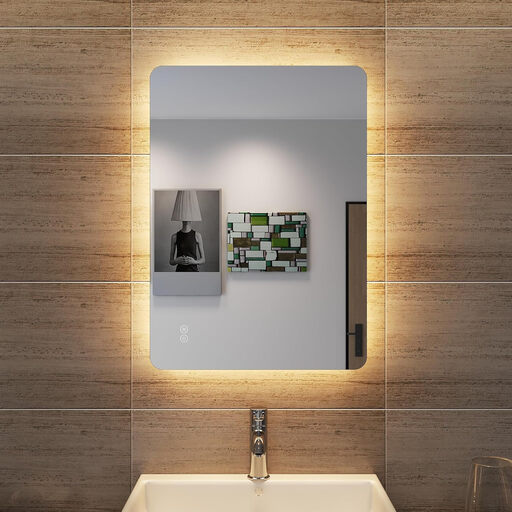
Why this product suits this profile: Its compact rectangular design is well suited to smaller bathrooms, with three light colours, dimming and touch controls.
The product information lists a separate demisting function, three light colours and dimming from 5 to 100 per cent. This makes it easy to check the key features before you buy.
50 × 70 cm, IP44, touch switch, memory function and a 30 × 40 cm heated section, according to the product description.
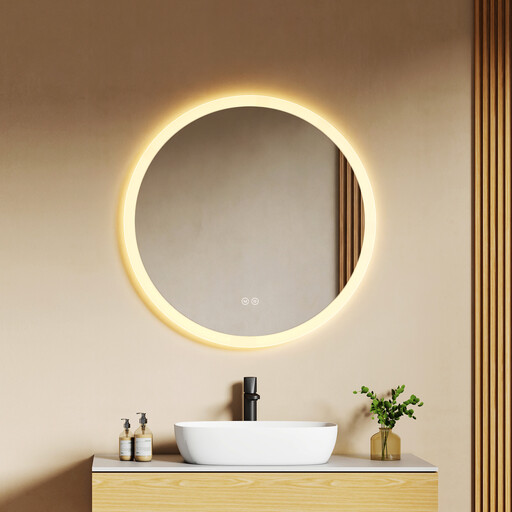
Why this product suits this profile: Its 70 cm diameter and round shape make a clear design statement, combined with several adjustable features.
The lighting isn’t limited to a single colour temperature. You can adjust the brightness and light colour, and control the demisting function separately or via the touch controls.
Three light colours, dimming from 10 to 100 per cent, memory function, automatic switch-off after three hours and wall-mounting accessories, according to the description.
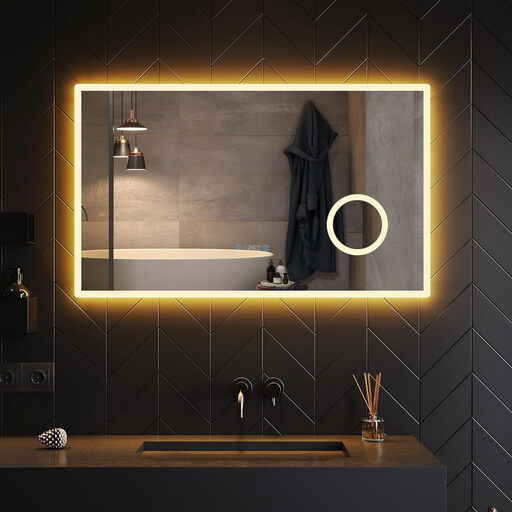
Why this product suits this profile: Its larger mirror and extra features are designed for households, hotels or salons where detailed grooming is part of the regular routine.
The product details list the light colours, adjustable brightness, IP44, a separate demisting function and a note that the LEDs are for supplementary lighting only.
100 × 60 cm, three light colours, clock and temperature display, plus an integrated 3× magnifying mirror, according to the manufacturer.
We’ve put together a complete, regularly updated list of products that meet these strict selection criteria and fully comply with the safety regulations in force in the EU.
Generally, no. Many models are designed to provide supplementary lighting. You should plan for a separate ceiling or wall light to illuminate the whole room evenly.
The lifespan depends on the LED module, power supply, usage and surrounding conditions. Some listings state a lifespan of around 50,000 operating hours. This is a manufacturer’s figure, not a guarantee of how long the mirror will last in your home.
Running costs depend on the power consumption and how long you use the mirror each day. The calculation is simple: power in kilowatts × operating hours × electricity price per kilowatt-hour. Dimming or automatic switch-off can reduce consumption, but you should still check the specific energy data sheet.