
Lieferung heute & morgen

Qualitätsgarantie

Willkommens-Angebote freischalten: KOSTENLOSE Lieferung | Bis zu 80 % RABATT | Kostenlose 30-Tage-JoyPlus-Testphase
App herunterladen
A bagged vacuum cleaner can be a practical choice for the home when you want to dispose of dust in a contained way and need one appliance for different types of flooring. Families, households with carpets and users with high filtration standards often pay particular attention to bag capacity, filter technology and ease of use.
However, some common marketing claims can lead to the wrong choice. A high wattage, for example, does not by itself indicate actual cleaning performance. Terms such as “HEPA” or “particularly quiet” should always be considered alongside specific technical details.
The wattage primarily indicates the motor’s electrical power consumption. On its own, it does not show how effectively the appliance picks up dust from carpets or hard floors. Airflow, the floorhead, filters and the condition of the bag are also important.
An energy-efficient vacuum cleaner should therefore not be chosen solely on the basis of motor power. Look for clear information about energy consumption, suitable floorheads and a design that keeps the airflow as stable as possible as the bag fills.
A hygiene filter or HEPA vacuum cleaner may be of interest to users who place importance on filtering the exhaust air. However, these labels do not automatically indicate a particular level of overall performance. The specific filter class, how it is fitted in the appliance and how well the system is sealed are the decisive factors.
If a brand states a particle-retention figure, this should be understood as manufacturer information. According to the manufacturer of the Rowenta RO6136, the HEPA filtration achieves at least 99.98 per cent filtration for particles up to 0.3 µm. No medical or therapeutic benefit should be inferred from this.
A compact cylinder vacuum cleaner is easier to store in a cupboard or utility room. However, a short cable, a small vacuum bag or a limited operating radius can reduce everyday convenience. As well as checking the appliance dimensions, you should therefore consider the cleaning radius, hose length, telescopic tube and cable length.
Capacity affects how often the vacuum bag needs to be replaced. According to the product data, the Rowenta RO3950 has a 3-litre capacity. When choosing suitable bags, the model number is more important than a general brand description.
For the RO3950, for example, the Swirl R39 vacuum cleaner bags may be suitable. According to the product description, the 4-pack of Swirl R39 MicroPor Plus is also listed for the Rowenta RO3953 Compact Power, RO6383 Silence Force Compact and RO6441 Silence Force. Even so, check the compatibility list for the specific bag before buying.
Depending on the offer, the Rowenta RO3950 vacuum bag may be listed as either original or compatible accessories. What matters is that the holder and opening fit correctly and that the seal is sufficient.
A vacuum cleaner for hard floors and carpets should have a switchable combination floorhead or several specialist floorheads. A parquet floorhead is often made with softer bristles and may be more suitable for delicate hard floors than a dedicated carpet floorhead.
Also check the width of the cleaning head and whether you can adjust the suction power to suit the flooring. According to the product data, the Rowenta RO3950 has three power settings, a parquet/floorhead and a cleaning width of 28 cm.
A quiet vacuum cleaner should be compared using a specific decibel value. The Rowenta RO3950 is listed at 79 dB, while the Rowenta RO6136 reaches 65 dB(A) according to the manufacturer. The values should be considered under their respective testing conditions and cannot necessarily be compared directly.
Weight also matters if you need to carry the appliance up and down stairs. For larger homes, a cleaning radius of 8 to 12 metres can reduce the need to change sockets. The RO3950 is listed with 8.8 metres, while the RO6136 has 12 metres.
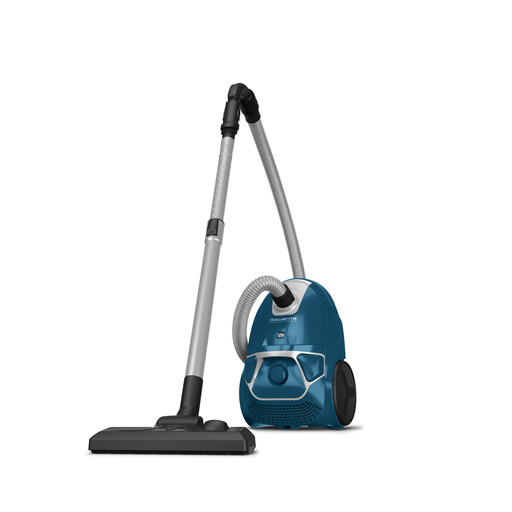
Why this product suits this profile: This compact cylinder vacuum cleaner combines bagged operation with a parquet floorhead and accessories for hard floors and carpets. With a 3-litre capacity and an 8.8-metre cleaning radius, it is suitable for regular cleaning in small to medium-sized homes.
The choice is not based solely on motor power: the filter type, bag capacity, floorhead selection and operating radius are all clearly specified.
750-watt Effitech motor according to the product data, 3-litre bag, HygieneFilter and parquet floorhead.
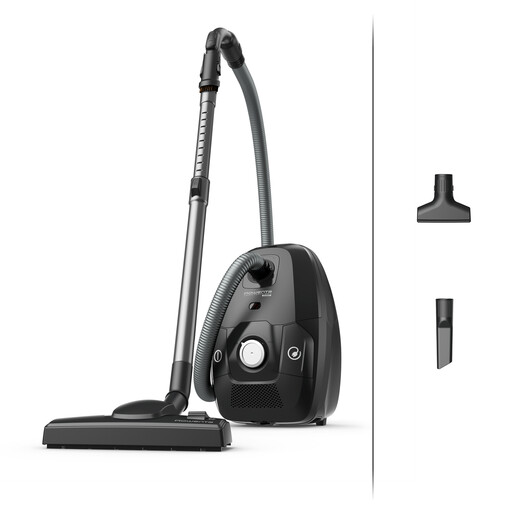
Why this product suits this profile: This model is aimed at households that prefer a longer cleaning radius and a lower stated noise level than many standard appliances. HEPA filtration and the Hygiene Plus bag system are listed as product features.
The noise level is clearly stated as 65 dB(A). Filter performance, bag replacement and cleaning radius are also considered separately.
4.5-litre dust bag, 12-metre cleaning radius and HEPA filtration according to the manufacturer.
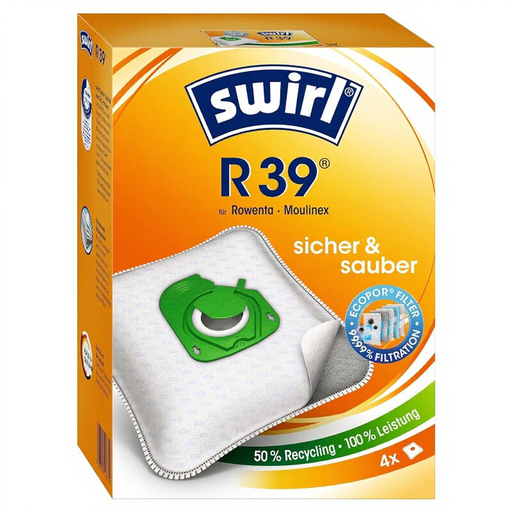
Why this product suits this profile: This set is intended for users who already own a compatible Rowenta model and want to buy replacement vacuum bags with a contained disposal mechanism. Compatibility should be checked against the specific appliance before ordering.
Compatibility is not assumed for all Rowenta vacuum cleaners as a general rule. The bag must fit the holder and the intake opening.
Four bags, MicroPor Plus filtration according to the product description and a Dirtlock closure for contained disposal.
We have put together a complete, regularly updated list of products that fully meet these strict selection criteria and the safety regulations applicable in the EU.
This depends on the bag capacity, floor area, level of dirt and frequency of use. The appliance’s fill indicator is the key guide. An overfilled bag can restrict the airflow and therefore affect cleaning performance. If you have pets or vacuum carpets frequently, the bag may need to be replaced sooner.
An appliance with a sealed bag system can make disposal easier, as the dust is designed to remain inside the bag when it is removed. Specific information about the filter, sealing and suitable bag is essential when assessing filtration. No medical suitability or effect can be inferred from this.
Running electricity consumption depends, among other things, on motor power, operating time and the selected power setting. Wattage should therefore not be assessed in isolation. It is more useful to compare an energy-efficient vacuum cleaner based on its actual power consumption and the cleaning time required. Bags and filters should be replaced regularly so that the appliance is not operated unnecessarily for long periods with restricted airflow.