
Lieferung heute & morgen

Qualitätsgarantie

Willkommens-Angebote freischalten: KOSTENLOSE Lieferung | Bis zu 80 % RABATT | Kostenlose 30-Tage-JoyPlus-Testphase
App herunterladen
By a Joybuy Product Recommendation OfficerAugust 29, 2026
Anyone who loves to bake knows that the right tools are half the battle. But the market for bakeware is crowded and full of promises. All too often, a supposedly high-quality cake tin turns out to be a bad investment after just a few uses. Before you expand your kitchen collection, it helps to know the common pitfalls that lead to frustration and unnecessary expense.
Many products look convincing at first glance, but only reveal their weaknesses with use. Pay special attention to these three points to avoid disappointment:
To avoid making a bad purchase, you should focus on objective, verifiable criteria. The following three aspects are crucial for the functionality and durability of your bakeware.
The material is a key determinant of a pan's baking performance and durability.
A good non-stick coating is the core feature of many modern baking tins. Pay attention to the maximum temperature resistance specified by the manufacturer (e.g., up to 220°C or 240°C). A high-quality coating allows for baking with little to no extra fat and makes cleaning significantly easier. Information about the absence of substances like PFOA is also a key indicator of quality.
Not every pan is suitable for every recipe. A basic set will cover most needs:
Based on these objective criteria, we have identified several products that represent a considered choice for different needs and use cases.
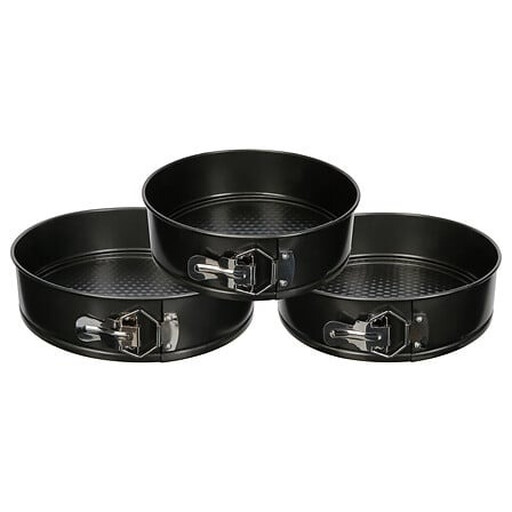
Why It's a Good Fit: This set offers three common springform sizes (22, 24.5, and 26 cm), covering a wide range of standard recipes. It's a practical starter kit for anyone who wants to begin baking cakes without immediately investing in expensive individual pans.
The set avoids the pitfall of impractical sizes by offering three coordinated standard diameters. The hinge mechanism is designed for easy release, and the steel construction provides more stability than very thin-walled alternatives.
The pans are stackable, allowing for space-saving storage in the kitchen. According to the manufacturer, they are temperature-resistant up to 280°C.
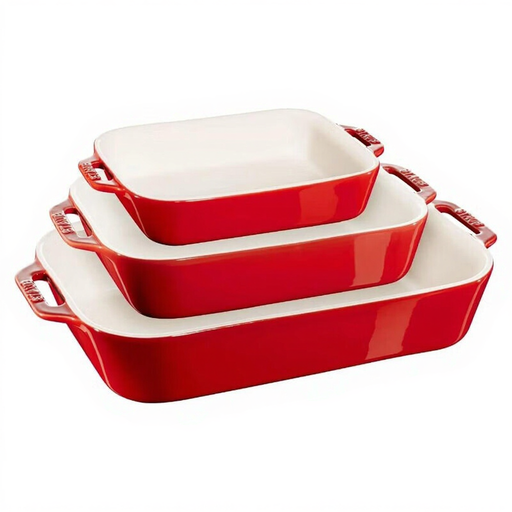
Why It's a Good Fit: For those who regularly bake, roast, and gratinate and who value durability and versatility. These baking dishes are suitable for sweet and savoury meals and can be taken straight from the oven to the table thanks to their elegant design.
High-quality ceramic is extremely dimensionally stable and does not warp, even at high temperatures (avoids Pitfall 2). The enamelled surface is scratch-resistant and more durable than many basic non-stick coatings (avoids Pitfall 1).
The material retains heat exceptionally well, ensuring even cooking. The dishes are dishwasher-safe, nestable for storage, and, according to the manufacturer, heat-resistant up to 260°C.
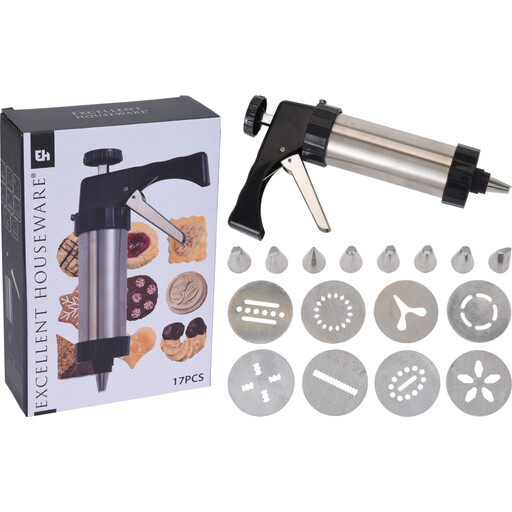
Why It's a Good Fit: Ideal for making spritz cookies and decorating cakes. This set is aimed at bakers who value precision and variety in their shapes and are looking for a reliable tool for recurring occasions like Christmas.
The stainless steel construction is robust and durable, unlike cheap plastic presses that can break under pressure. This avoids the pitfall of unstable materials and ensures reliable performance.
The set includes 16 interchangeable discs, allowing for a wide variety of patterns. The ergonomic handle simplifies operation and helps produce consistent results.
We have compiled an up-to-date list of products that fully meet these strict selection criteria and rigorous safety standards.
1. How do you properly clean non-stick bakeware to extend its lifespan? After it has cooled, clean the pan with warm water, a mild washing-up liquid, and a soft sponge. Always avoid using metallic or abrasive cleaning tools like steel wool, as they can damage the coating. Most manufacturers advise against cleaning in the dishwasher, even if the product is advertised as "dishwasher-safe," because harsh detergents can degrade the coating over time.
2. Are silicone baking moulds safe? High-quality silicone moulds intended for food contact are considered safe. Look for labels like "food-grade" or certifications such as LFGB (German Food, Commodities and Feed Code). These products are tested to ensure they do not release any harmful substances into food. It is recommended to clean or "temper" the mould according to the manufacturer's instructions before its first use.
3. Do I need a complete bakeware set to get started? A complete set can be a cost-effective solution for beginners to get a basic collection. However, functionality is more important than the number of pieces. A set of three different-sized springform pans or a combination of a springform pan, a loaf pan, and a muffin tin already covers most common baking projects. Check whether the sizes of the pans included in the set are suitable for your usual recipes and your oven size.