
Lieferung heute & morgen

Qualitätsgarantie

Willkommens-Angebote freischalten: KOSTENLOSE Lieferung | Bis zu 80 % RABATT | Kostenlose 30-Tage-JoyPlus-Testphase
App herunterladen
A baking dish with a lid can handle several kitchen tasks: baking, cooking, serving and storing food. That’s why it’s worth checking the material, temperature range and dimensions carefully. An attractive dish isn’t necessarily suitable for every heat source, and a lid included with the dish may not be oven-safe.
As a Joybuy Product Recommendation Officer, I look for clear product information rather than relying on marketing claims alone. The points below will help households, home bakers and keen cooks avoid buying the wrong dish.
Many models have a dish made from glass, cast iron or stoneware, while the lid is made from plastic. This type of lid may be intended for storage in the fridge or freezer, but not for use in the oven. Always check whether the temperature rating applies to the dish, the lid or both.
A measurement such as 27 or 30 cm usually refers to the diameter or an external dimension. In practice, though, usable capacity is what matters. A round cake tin with a capacity of 2.9 litres is suited to different quantities from a small 0.35-litre mini casserole dish. You should also consider the height, footprint and clearance under the lid.
A glass baking dish may be suitable for the oven and microwave, while a cast-iron baking dish may also be used on various types of hob. On the other hand, not every ovenproof dish with a lid is suitable for hob use. Avoid exposing glass and stoneware to sudden temperature changes, too, as this can create stress in the material.
Borosilicate glass is often used for baking and casserole dishes. It’s transparent, food-safe and, where approved by the manufacturer, suitable for use in the oven and microwave. Even so, always follow the care instructions when moving it between very hot and cold conditions.
Enamelled cast iron retains heat and, depending on the model, is approved for use on gas, electric, ceramic and induction hobs, as well as in the oven. One example is the STAUB Round Baking Dish with Lid, with a 20 cm diameter, a capacity of 0.75 litres and oven-safe up to 230 °C. At around 2 kg, it’s worth considering its weight when handling and storing it.
Stoneware is suitable for the oven, microwave, fridge and freezer where approved by the manufacturer. According to the product information, the Le Creuset mini dish is designed for temperatures from -18 °C to 260 °C. Here, too, don’t place a hot dish directly on a cold or wet surface.
Also check whether the stated measurements refer to the inside or outside dimensions. If the dish has a lid, make sure there’s enough room to store it in your kitchen or fridge.
The claim that a baking dish is dishwasher-safe isn’t enough on its own to make it the right choice. Check whether this applies to both the dish and the lid. Plastic lids can warp at high temperatures. Metal utensils and abrasive cleaners are often unsuitable for coated or enamelled surfaces.
If you’re looking for a cake storage dish, check for a sturdy, close-fitting lid and enough internal height. To protect glass dishes, avoid sudden changes in temperature.
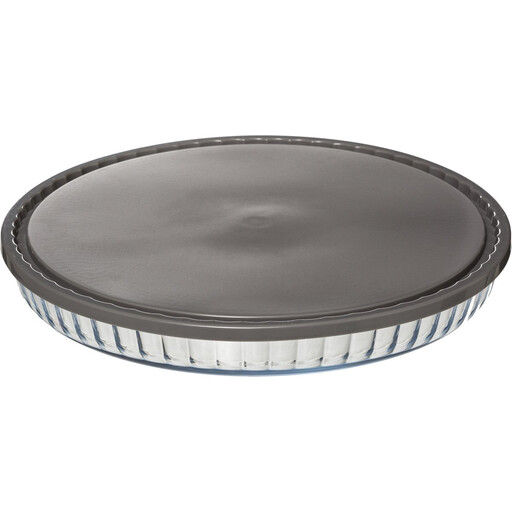
Why it suits this profile: This round glass dish combines baking and storage. Its 2.9-litre capacity is a practical size for cakes and casseroles.
The stated capacity makes it easier to plan quantities. The product information confirms that it’s suitable for the oven, microwave and dishwasher, and that the plastic lid is for storage.
Borosilicate glass, 30 cm diameter and 2.9 l usable capacity; lid for storage.
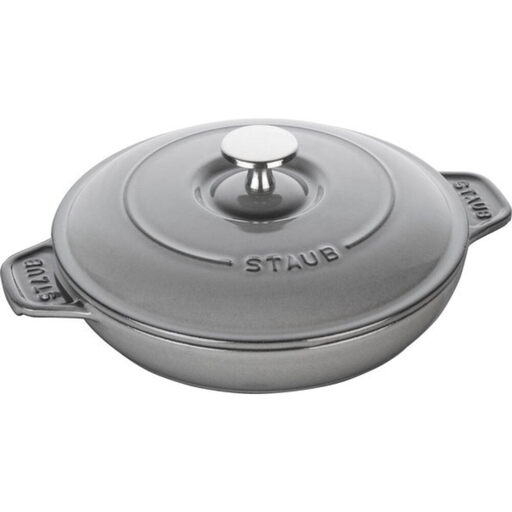
Why it suits this profile: This cast-iron dish is a good option if you want one piece of cookware for oven use, hob cooking and serving.
The manufacturer’s information gives the maximum oven temperature of 230 °C and confirms that it’s suitable for gas, electric, ceramic and induction hobs.
Enamelled cast iron, 0.75 l capacity and a lid; dishwasher-safe according to the product information.
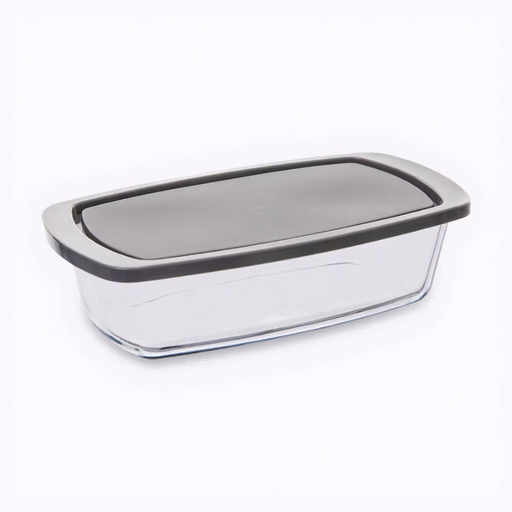
Why it suits this profile: Its oblong shape is suitable for bread, loaf cakes and smaller casseroles, making it a good choice when you need a compact storage solution.
The product description lists the dish and lid separately as glass and polypropylene. This makes it clear which part is for oven use and which is for storage.
2.3 l usable capacity, 27.4 × 14.3 × 7.3 cm; suitable for the oven, microwave and dishwasher according to the product information.
We’ve put together a complete, regularly updated list of products that meet these strict selection criteria and fully comply with the safety regulations in force in the EU.
Plastic lids are generally not designed to withstand oven temperatures. Remove the lid before heating unless the manufacturer explicitly states that it is safe at a specified temperature. Once the dish has cooled, you can use the lid for storage.
A baking dish for the microwave and oven made from borosilicate glass or suitable stoneware may be suitable, provided the product information confirms it can be used in both. Metal components and cast-iron dishes must not be used in the microwave.
Its lifespan depends on the material, how you care for it and how often it experiences temperature changes. Avoid knocks, sudden changes in temperature and unsuitable cleaning products. Don’t continue to use glass, stoneware or enamelled surfaces if they’re damaged.