
Lieferung heute & morgen

Qualitätsgarantie

Willkommens-Angebote freischalten: KOSTENLOSE Lieferung | Bis zu 80 % RABATT | Kostenlose 30-Tage-JoyPlus-Testphase
App herunterladen
Whether it’s cake, lasagne, quiche or bread: baking dishes and casserole dishes need to suit the recipe, your oven and your preferred cleaning method. Many poor purchases happen not because of the price, but because of unclear measurements, delicate coatings or a dish that is too shallow or too deep for its intended purpose.
This buying guide from the Joybuy Product Recommendation Officer helps home bakers, families and frequent users compare relevant product features in a practical way.
A specification of “30 × 40 cm” does not always describe the actual usable baking surface. The rim height, handles and rounded corners can reduce the internal measurement. Before buying, you should therefore check:
In an oven with limited space, even an overhanging rim can make using the dish difficult.
Although coated dishes may be labelled as dishwasher-safe by the manufacturer, frequent cleaning with harsh detergents can still wear down the surface more than gentle hand washing. Other products are explicitly not dishwasher-safe.
It is therefore important to cross-check the product description with the care instructions. For a non-stick coated baking dish, the following is usually recommended:
A non-stick coating can make it easier to release cakes or casseroles. However, it does not automatically replace greasing or using baking paper. With a springform tin, you should also check that the latch closes properly. Otherwise, runny batters can leak out at the join.
A metal baking dish is suitable for many standard recipes and is available in different wall thicknesses. Steel dishes are dimensionally stable and are available for cakes, bread or casseroles. An aluminium baking dish is often lighter; aluminium is also valued for its heat conductivity. What ultimately matters are the specific manufacturer’s details regarding oven suitability, coating and temperature range.
Coatings make releasing and cleaning easier, but are more susceptible to scratches. With an uncoated dish, you may need to use baking paper, greasing or suitable batter preparation.
An oven-safe dish cannot automatically be used on hobs, in the microwave or in the freezer. These areas of use must be explicitly stated in the product specifications.
For a small household, a casserole dish with around 2 to 3 litres may be sufficient. For family meals, larger models of around 4 to 5 litres are more practical. The capacity should always be considered alongside the rim height: a shallow dish is suitable for gratins or traybakes, while a deeper lasagne dish can accommodate more layers.
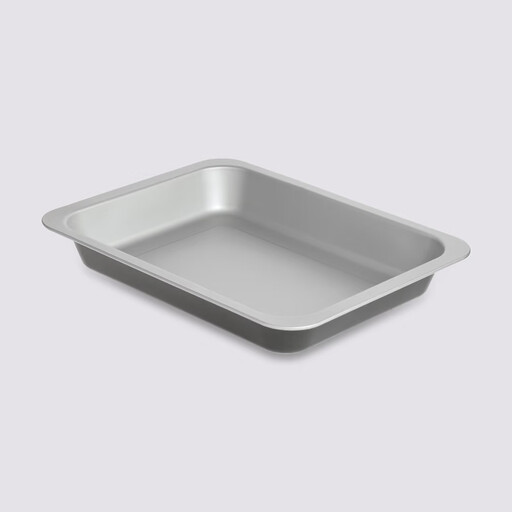
Why this product fits the profile: This rectangular metal dish is designed for classic oven-baked meals and, with its stated dimensions, offers a generous surface area for family portions.
The dish is not labelled as a flat baking tray, but as an oven dish with a stated height of 5.2 cm. This makes it easier to identify as suitable for casseroles and gratins.
Metal construction, 39.5 × 30 × 5.2 cm according to product data and a weight of 490 g.
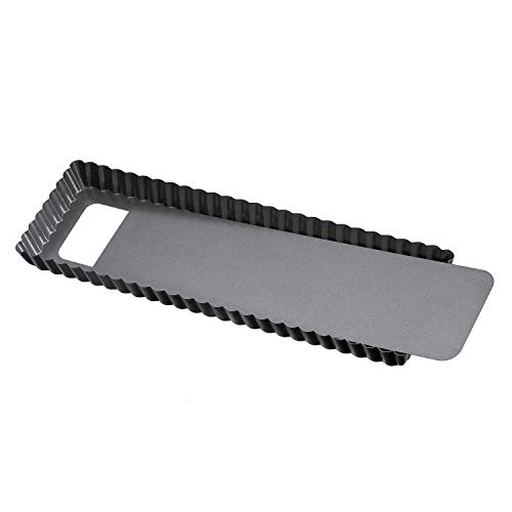
Why this product fits the profile: This dish is aimed at users who regularly make quiches, tarts and shallow cakes and prefer a removable base.
The product data states a removable base, a height of 2.5 or 3 cm and heat resistance up to 250 °C. This makes it easier to check its intended use.
Steel with coating, enamelled base, 35 × 13 cm and a stated capacity of 1 litre.
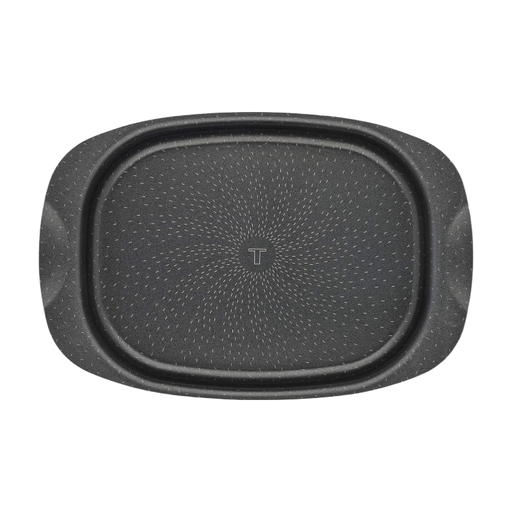
Why this product fits the profile: The stated capacity of 4.75 litres is designed for larger lasagnes, gratins and family meals.
The product description explicitly states oven suitability, capacity and a lid. This helps distinguish the dish from a flat baking tray and smaller casserole dishes.
Recycled aluminium, 36 × 24 × 5.5 cm, lid and according to the product data a capacity of 4.75 litres.
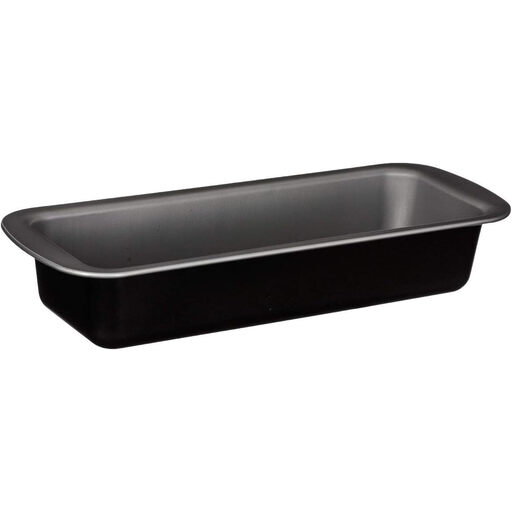
Why this product fits the profile: This narrow, deeper tin is intended for loaf cakes, sponge cakes and similar recipes with a round or rectangular cross-section.
The tin is specified as 35 × 13 × 6.2 cm with a capacity of 1.65 litres. This allows buyers to better match the size to their recipe quantity and oven.
Metal tin, suitable for the oven, not intended for the microwave and with a capacity of 1.65 litres.
We have put together a complete, regularly updated list of products that fully meet these strict selection criteria and the safety regulations in force in the EU.
The lifespan of a baking dish depends heavily on the material, wall thickness, coating and care. For coated dishes, wooden, plastic or silicone utensils are usually more suitable than metal. For dishes that are not dishwasher-safe, you should follow the manufacturer’s instructions and wash them by hand.
Before buying, it is also worth checking:
For lasagne, a deep casserole dish with sufficient capacity is a good choice. A rim height of around 5 cm or more makes it easier to layer pasta sheets, sauce and cheese. For multiple portions, you should also make sure the base area fits your oven and the desired quantity.
This depends on the individual product. Some aluminium dishes are stated as dishwasher-safe in the product information, while others should be cleaned by hand. Coated surfaces can last longer with gentle hand washing.
The tin should be prepared according to the instructions. Depending on the material, light greasing, flour, baking paper or a suitable coating may be appropriate. After baking, the cake should be left to cool briefly before being turned out. With a springform tin, it is also important that the rim is properly closed.