Bakers making small batches of dough
If you’re dividing a recipe and want to weigh small amounts of salt separately for each batch, check the lower weighing range and the graduation of the specific model.


A precision scale is ideal for weighing small amounts of salt for each batch of dough. A kitchen scale with a tare function makes it easier to weigh ingredients in stages in the same mixing bowl. A combination scale can handle both tasks, provided you pay attention to its separate precision and higher-capacity ranges. A display that measures in 0.1 g increments alone does not prove that the measurement error is no more than 0.1 g.
If you’re dividing a recipe and want to weigh small amounts of salt separately for each batch, check the lower weighing range and the graduation of the specific model.
If you’re adding ingredients for several batches to the same bowl one after another, the tare function and the maximum capacity, including the weight of the bowl, are important factors to consider.
If you’re making several batches together in a larger quantity, compare the total weight with the maximum capacity and check that the weighing platform and display suit your bowl.
A good fit if: you weigh small amounts of salt separately for individual batches and don’t need to put a heavy mixing bowl on the scale.
Bear in mind: Soehnle specifies a maximum capacity of 500 g for the Cooking Star, so this limit matters if you want to weigh a whole bowl.
A good fit if: you weigh ingredients one after another in the same bowl and the stated graduation suits the quantities you plan to measure.
Bear in mind: Tare makes it easier to add ingredients one by one, but it doesn’t increase the maximum capacity for the bowl and ingredients combined.
A good fit if: you want to weigh both small amounts of salt and a larger bowl of dough with one device.
Bear in mind: CASO Design specifies separate ranges for the KitchenDuo: up to 1 kg in 0.1 g increments and up to 15 kg in 1 g increments.
| What matters | What to check when buying | Who is it important to? |
|---|---|---|
| Weighing small amounts of salt | Compare the graduation and stated lower weighing range with the amount you need to weigh each time; check the container’s maximum capacity. | If I weigh salt separately for each batch of dough, the scale needs to work with small amounts within its stated range. Around 36% of consumers put this concern first. |
| Weighing ingredients in a bowl | Check the tare function with the bowl you plan to use, and make sure the display remains visible while weighing. | Anyone who wants to weigh several ingredients or batches in one bowl without transferring them will pay particular attention to tare and easy-to-read measurements. Around 29% of consumers prioritise weighing ingredients in stages this way. |
| Bowl and large batches | Compare the combined weight of the bowl and your largest planned batch with the maximum capacity; consider the platform size and how easy the display is to read. | If I weigh a large batch of dough in its bowl, the total load needs to stay within the appropriate range. Around 21% of consumers focus on weighing a heavy combined load. |
| Cleaning and operation | Follow the care instructions for the specific model and check that the display is easy to read while weighing. | When preparing ingredients repeatedly, I want to read the measurements easily and clean any parts that come into contact with ingredients appropriately. Around 14% of consumers put ease of use and care first. |
Manufacturer information about graduation and weighing range does not automatically tell you the measurement error for the smallest amount of salt you need to weigh.
Check the stated weighing ranges and accuracy information for the specific model. Don’t infer the measurement error from the decimal place on the display alone.
If the recipe quantity you need falls outside the suitable range, you may need an additional weighing solution.
The maximum capacity applies to the actual combined weight of the bowl and ingredients. The precision and higher-capacity ranges of a combination scale also have different limits.
Compare the bowl and your largest planned batch together with the maximum capacity of the relevant weighing range.
Soehnle states that the Cooking Star’s removable spoon is dishwasher-safe, but warns against exposing the electronic device to moisture.
Clean the removable part and the electronic base according to their respective care instructions.
Cleaning the device incorrectly can damage its electronic base.
According to CASO Design, the KitchenDuo combines a precision range with a separate range for heavier loads.
The models mentioned are designed for different tasks: the Cooking Star for small quantities and the Page Profi 300 for heavier loads.
According to WMF, its digital kitchen scale, with a 20 × 20 cm weighing platform, is designed for weighing ingredients in a bowl.
According to Tefal, the Optiss BC50U0 has different display increments for different weight ranges.
According to Beurer, the KS 19 Black is a slim household scale designed for weighing ingredients in a bowl.
Digital kitchen scales for weighing baking ingredients for several batches of dough.
 No image available
The stated tare function is useful when weighing baking ingredients in a container.
The product name specifies a 10 kg capacity and 1 g accuracy; this doesn’t indicate the measurement error for very small amounts of salt.
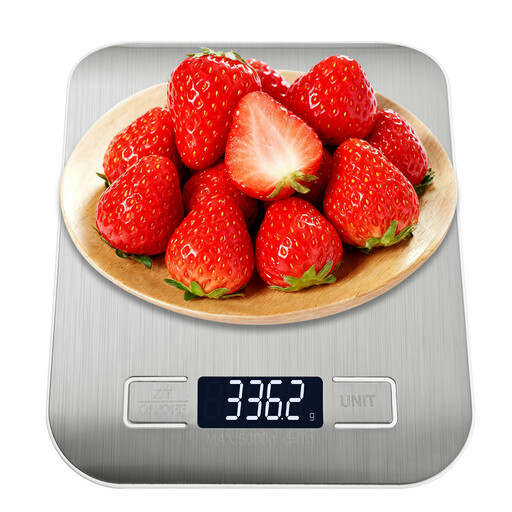
According to the product name, it has an LCD display and is made from stainless steel and plastic. Its dimensions are 21 × 15,5 × 2,9 cm.
 No image available
The product description lists baking and ingredient preparation among its uses.
The product name specifies a 5 kg capacity, 1 g accuracy and the option to switch between several units of measurement.
The model is also listed as having an LCD display and a stainless steel weighing platform. The stated accuracy doesn’t indicate the measurement error for very small amounts of salt.
Compare the amount you need to weigh with the stated weighing range of the specific model. CASO Design specifies a precision range for the KitchenDuo starting at 0.3 g; Soehnle states that the Cooking Star measures in 0.1 g increments up to a maximum of 500 g. The graduation alone doesn’t tell you the measurement error.
Place the bowl on the scale and tare it before adding more ingredients. First, check that the bowl and your largest planned batch together are within the model’s maximum capacity.
According to Soehnle, the Cooking Star’s removable weighing spoon is dishwasher-safe; the electronic device shouldn’t be exposed to moisture. Clean both parts according to their respective care instructions.
Germany’s National Metrology Institute (Physikalisch-Technische Bundesanstalt) states that there are no statutory minimum requirements for household scales; this doesn’t mean that home baking is generally subject to a legal verification requirement. This doesn’t automatically apply to uses governed by law, such as weighing goods for sale in a business.
According to the Verbraucherzentrale, for an online consumer contract you generally have a 14-day right to withdraw from the contract after receiving the goods. You must notify the retailer that you wish to withdraw; check the terms for your specific purchase.