
Lieferung heute & morgen

Qualitätsgarantie

Willkommens-Angebote freischalten: KOSTENLOSE Lieferung | Bis zu 80 % RABATT | Kostenlose 30-Tage-JoyPlus-Testphase
App herunterladen
A baking tin must suit the recipe, your oven and how you intend to use it. Many disappointing purchases are not caused by the price, but by unclear dimensions, unsuitable coatings or a tin that has limited everyday uses. By checking a few technical details before buying, you can choose more confidently between a loaf tin, bread tin, cake tin and baking dish.
A tin described as a “30 cm baking tin” is not necessarily 30 cm long in terms of usable interior space. The width of the rim, handles and height of the tin all affect its actual capacity. When planning a recipe, the most important details are therefore the internal dimensions or volume in litres.
Depending on its width and height, a 30 cm loaf tin may be designed for around 1 kg or 1.5 kg of dough or bread. For a rectangular baking dish for bakes, it is also important to check whether the dish fits in your oven and leaves enough room for the door and the shelf height.
A non-stick baking tin makes it easier to remove cakes or bread. However, the coating can be damaged by metal knives, forks, abrasive sponges or sudden temperature changes. Even if a product is described as dishwasher-safe, washing it by hand with a soft sponge can help protect the coating over the long term.
Look for clear information about:
Not every baking tin is also suitable as a roasting tin or baking dish. A classic loaf tin is suitable for loaf cakes and bread, but not necessarily for large lasagnes. A shallow cake tin is suitable for quiche, but offers little capacity for deep mixtures. An ovenproof dish made from cast iron, on the other hand, can often also be used on suitable hobs, although it is considerably heavier.
Coated steel is dimensionally stable and is often used for loaf tins and bread tins. A ceramic or other non-stick coating can make it easier to release your bake. Even so, check the care instructions and permitted temperature.
Aluminium conducts heat quickly and evenly. Tins made from recycled aluminium are comparatively lightweight and are suitable for gratins, bakes and roasts. The coating should not come into contact with sharp or metal kitchen utensils.
Silicone is flexible and saves space. However, placing very soft moulds in the oven can be more difficult. For runny mixtures, a sturdy baking tray is recommended as a support.
Cast iron retains heat for a long time and distributes it evenly. The material is robust, but adds considerable weight. Before buying, check that the lid, handles and dimensions of the dish are suitable for your oven.
The volume affects the baking time and the height of the mixture. A smaller loaf tin with a capacity of around 1.3 litres is suitable for smaller households or compact cakes. For families, 2.4 litres or more may be a sensible choice. A baking dish with a capacity of 4.5 to 4.75 litres can be used to prepare larger portions for several people.
As a general rule, never fill baking tins right to the rim. Cakes made with creamed mixtures, yeast dough and bread all need enough room to rise. Use the recipe instructions as your guide rather than relying solely on the stated length.
A baking tin is not automatically suitable for use in a microwave, on a hob or over an open flame. The product description should clearly state how it is intended to be used. With coated tins, wooden, plastic or silicone utensils are usually the safer choice. Allow hot tins to cool before cleaning them to prevent material stress caused by a sudden change in temperature.
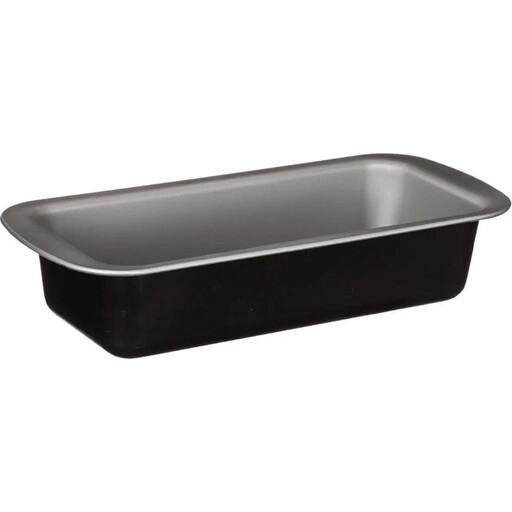
Why this product suits this profile: With a compact metal design, a length of 29 cm and a stated capacity of 1.3 litres, this tin is suitable for smaller cakes, loaves and households with limited storage space.
The dimensions and capacity are clearly stated. It is also explicitly noted that the tin is not dishwasher-safe.
Metal construction, oven suitability and a low product weight of around 230 g.
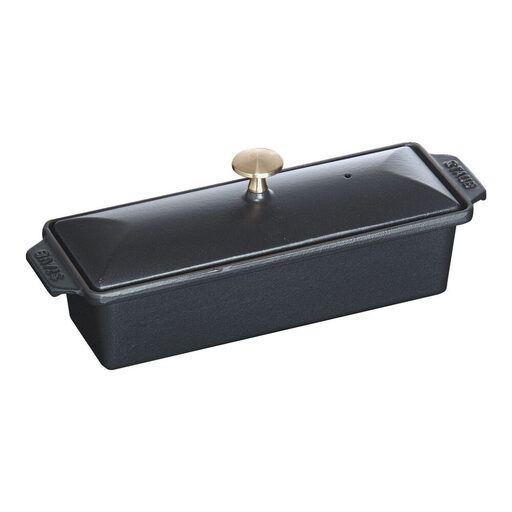
Why this product suits this profile: This rectangular cast-iron dish with a lid and a capacity of 1.45 litres is ideal for anyone looking for a heavy, ovenproof dish for terrines and covered dishes.
The material, temperature limit of up to 240 °C and compatibility with all hobs, including induction, are clearly stated. Its weight of 3.32 kg should be taken into account before buying.
Cast iron with glossy black enamel on the inside, a lid, side handles and a steam vent.

Why this product suits this profile: With a steel body, KAIRAMIC coating and enamelled base, this tin is designed for loaves weighing up to 1 kg and can also be used for sweet or savoury cakes.
The tin is oven-safe up to 250 °C. The care instructions recommend hand washing and avoiding metal utensils, helping to protect the coating.
Dimensions of around 30 × 10 × 8.5 cm, an enamelled base and the manufacturer's stated suitability for 1 kg loaves.
If you are looking for a baking dish, roasting tin or baking tray for several people, choose a larger capacity and secure handles. The Tefal Success Gratin Dish measures 36 × 24 × 5.5 cm and has a stated capacity of 4.75 litres. It has a lid and a non-stick coating. With dimensions of 37 × 27 × 4.5 cm, the Tefal Success Professional Oven Dish holds around 4.5 litres and features side handles and a temperature indicator.
The Tefal Success Roasting Dish, measuring 39 × 27 cm, may also be a good choice for roasts, vegetables or larger gratins. All three dishes are designed for use in the oven. Allow the dish to cool before cleaning; with coated surfaces, hand washing is recommended despite the stated dishwasher suitability if you want to preserve the coating for as long as possible.
We have put together a complete, regularly updated list of products that fully meet these strict selection criteria and the safety regulations applicable in the EU.
For bread, a bread tin with sufficient height and sturdy sides is a sensible choice. Check the stated bread weight, internal dimensions and temperature limit. Depending on its capacity, a 30 cm tin may be designed for different loaf sizes.
That depends on the individual product. Some tins can go in the dishwasher, while others explicitly cannot. Even when a tin is dishwasher-safe, hand washing with mild detergent and a soft sponge can help protect the surface. Always follow the manufacturer's care instructions.
Its lifespan depends on the material, coating, temperature changes and cleaning method. Uncoated or enamelled surfaces are generally less sensitive to certain cleaning methods than non-stick coatings. Avoid scratches, open flames with tins not designed for them, and cooling a hot tin rapidly with cold water.