
Lieferung heute & morgen

Qualitätsgarantie

Willkommens-Angebote freischalten: KOSTENLOSE Lieferung | Bis zu 80 % RABATT | Kostenlose 30-Tage-JoyPlus-Testphase
App herunterladen
A baking tin needs to suit your recipe, oven and cleaning preferences. Many disappointing purchases aren’t down to the price, but to unclear information about dimensions, coating or heat resistance. For example, a small loaf tin won’t necessarily hold a large quantity of dough, while a deep casserole dish may not be practical for delicate tart bases.
A measurement of “30 cm” doesn’t always describe the usable baking area. Handles, reinforced rims and sloping sides can reduce the internal dimensions. When choosing a tin, check its length, width, height and capacity.
With a loaf tin, you also need to consider the dough quantity. A tin for a loaf weighing around 1,000 g will be a different size from one for a 1,500 g loaf. If you overfill it, the dough may spill over or bake unevenly.
A non-stick baking tin makes it easier to release cakes, bread and casseroles. However, it isn’t automatically resistant to metal knives, forks or abrasive cleaning products. Even if a product is described as cut-resistant, this often applies only to certain surfaces, such as an enamelled base.
Silicone baking tins are flexible and usually make it easy to release baked goods. However, without a stabilising frame, they can warp when you carry them to the oven. A combination of steel and silicone may provide greater stability.
Some products are explicitly described as dishwasher-safe, while others are recommended for hand-washing even if they may be suitable for the dishwasher. This is particularly important with coated tins. Check the care instructions from the manufacturer and use mild washing-up liquid and soft sponges.
A steel baking tin is sturdy and suitable for bread, cakes and savoury oven dishes. Steel can help food brown evenly, but coated steel needs to be handled with care.
Aluminium is lightweight and heats up quickly. According to the product details, the Tefal models in this selection are made from recycled aluminium and have a non-stick coating. Ceramic retains heat for comparatively long periods, making it suitable for casseroles, gratins and serving food straight at the table. A ceramic baking dish should be protected from sudden changes in temperature.
Check the stated maximum temperature. An ovenproof baking tin isn’t automatically suitable for hob rings, open flames or induction hobs. According to their product descriptions, the Kaiser tins in this selection are heat-resistant up to 250 °C and are intended for conventional ovens only.
Depending on the model, ceramic dishes may also be suitable for use in the microwave, under the grill or in the freezer. These features should always be stated explicitly in the product details. Only use a dish within its specified temperature limits.
For families, rectangular dishes with a capacity of around 2 to 5 litres are practical for lasagne, pasta bakes and vegetable gratins. A small casserole dish with a capacity of around 1 litre is better suited to smaller portions or compact households.
For quiches, tarts and shallow cakes, the height of the sides and the shape of the base are important. A quiche tin with a removable base makes it easier to release your bake, but should be placed carefully on a flat surface.
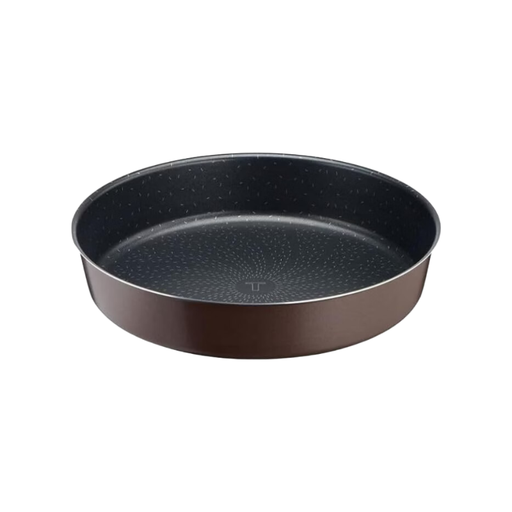
Why this product suits this profile: This round 26 cm tin is designed for everyday cakes, tarts and smaller baking projects. Its low weight makes it easy to handle.
The diameter is clearly stated, and the product details also specify the material, coating and oven suitability. This makes it easier to compare the tin with the recipe you have in mind.
Made from recycled aluminium, with a ProBaking non-stick coating and, according to the product details, dishwasher-safe. Hand-washing is recommended to help protect the coating.

Why this product suits this profile: This loaf tin is designed for loaves weighing up to around 1,000 g. It combines steel with a coated interior and an enamelled base.
The capacity information helps you check that the tin is right for the amount of dough. Its stated temperature limit of 250 °C helps prevent use beyond the intended oven conditions.
30 cm long, with coated steel and an enamelled base. The product description also states that the non-stick coating has a ten-year guarantee. Not dishwasher-safe.
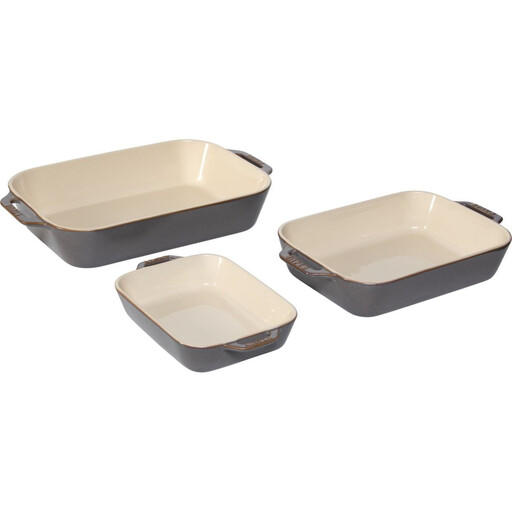
Why this product suits this profile: Three rectangular ceramic dishes measuring 20 × 16 cm, 27 × 20 cm and 34 × 24 cm cater for different portion sizes.
Having three sizes helps you avoid buying a single dish that doesn’t suit your needs. Even so, avoid sudden temperature changes and check the ceramic for cracks before use.
According to the product details, suitable for the oven, grill, microwave, freezer and dishwasher; temperature range from -20 °C to 300 °C.
We’ve put together a complete, regularly updated list of products that meet these strict selection criteria and fully comply with the safety regulations in force in the EU.
For bread, a loaf tin with a suitable capacity is a good choice. The amount of dough, internal dimensions and temperature limit are all important. A 30 cm tin may be suitable for a loaf of around 1,000 g; larger quantities of dough need a correspondingly larger tin.
That depends on the model. Some aluminium and ceramic dishes are described as dishwasher-safe. Hand-washing is often recommended for coated steel tins. Always follow the specific product description rather than making assumptions based on the material.
A baking tray is suitable for flat cakes, biscuits, pizza and larger quantities spread out evenly. A casserole dish has higher sides, making it better for lasagne, gratins, braised dishes and saucy bakes. Choose according to the height, amount of liquid and portion size required by your recipe.