
Lieferung heute & morgen

Qualitätsgarantie

Willkommens-Angebote freischalten: KOSTENLOSE Lieferung | Bis zu 80 % RABATT | Kostenlose 30-Tage-JoyPlus-Testphase
App herunterladen
Whether you are making a cake, quiche, tart, lasagne or vegetable gratin, baking tins and oven dishes need to suit the recipe, your oven and your household. An eye-catching colour or advertised non-stick coating says little about whether a dish is practical for everyday use. The key factors are its dimensions, material, care instructions and how you actually intend to use it.
A baking tin listed as 36 × 24 cm will not automatically fit every baking tray and does not necessarily provide that much usable internal space. The rim height, handles and rounded corners reduce the available area. Before buying, compare the internal space, external dimensions and shelf width of your oven.
With a rectangular baking tin, it is also important to consider whether you want to prepare individual portions, a cake base or a family meal. A shallow tin is better suited to traybakes and biscuits, while a deeper oven dish offers more capacity for lasagne or potato dishes.
A non-stick baking tin can make it easier to remove cakes or baked dishes. However, it remains susceptible to metal utensils, abrasive sponges and excessively high temperatures. Even if a product is described as dishwasher-safe, washing it by hand can help protect the coating in the long term.
Look for specific information about heat resistance, cleaning and use on hobs. An oven dish is not automatically suitable for gas, electric or induction hobs.
Ceramic and stoneware dishes are often suitable for both baking and serving. A slate serving board, on the other hand, is generally intended for presenting food and should not be placed in the oven. If you need both functions, check the relevant manufacturer’s instructions and do not choose materials based solely on their design.
For cakes, quiches and tarts, low rims and, where applicable, a removable base are practical features. For baked dishes, depth and capacity are more important. A 2.4-litre dish is suitable for small to medium-sized portions, while 4.75 litres may be useful for larger households.
A quiche tin or tart tin with a lift-out base makes it easier to transfer delicate bases. Check whether the base is knife-resistant and whether the tin is approved for use only in the oven or with other heat sources too.
Check the following before placing your order:
With ceramic dishes in particular, do not place hot dishes directly on cold or damp surfaces. Coated metal tins should be cleaned gently, even if the manufacturer permits machine washing.
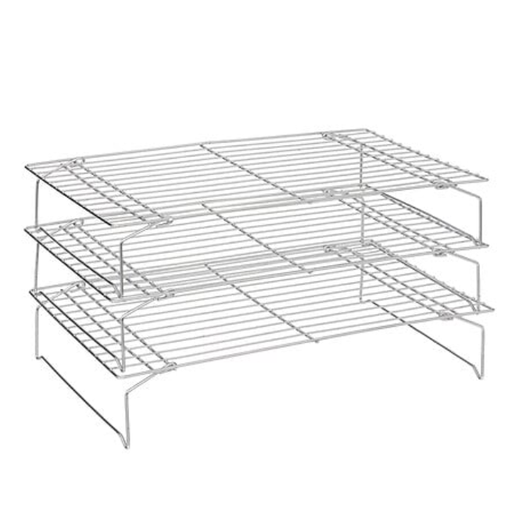
Why this product suits this profile: Three stackable cold-rolled steel trays provide a simple basic set-up for biscuits, pastries and multiple baking sessions.
The dimensions of 40 × 25 cm for each tray are clearly stated. This makes it easy to check in advance whether the trays will fit in your oven.
Three pieces; stackable design; steel construction for direct heat conduction.
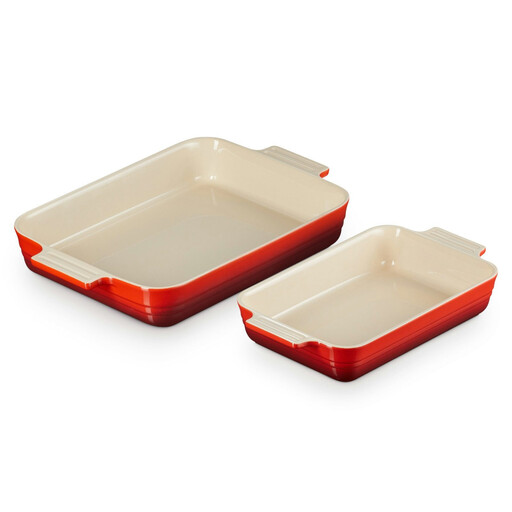
Why this product suits this profile: Two rectangular stoneware dishes measuring 25 and 32 cm cover different portion sizes and, according to the product information, can be used for baking and serving.
The temperature range from −23 °C to 260 °C, along with information on use in an oven, microwave, freezer and dishwasher, is clearly stated.
Two sizes; stoneware with scratch-resistant enamel; dishwasher-safe according to the product information.
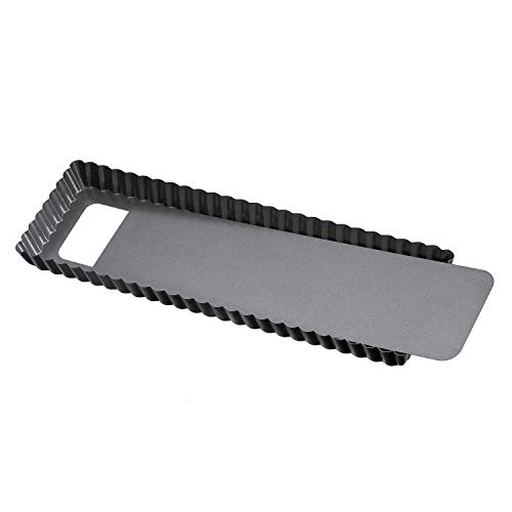
Why this product suits this profile: Measuring 35 × 13 cm, this rectangular quiche and tart tin has a removable base and a 1-litre capacity, making it ideal for households that regularly bake tarts and quiches.
The maximum heat resistance of 250 °C and the restriction to conventional ovens are clearly stated.
Removable base; knife-resistant enamel base; stated 10-year guarantee on the non-stick coating.
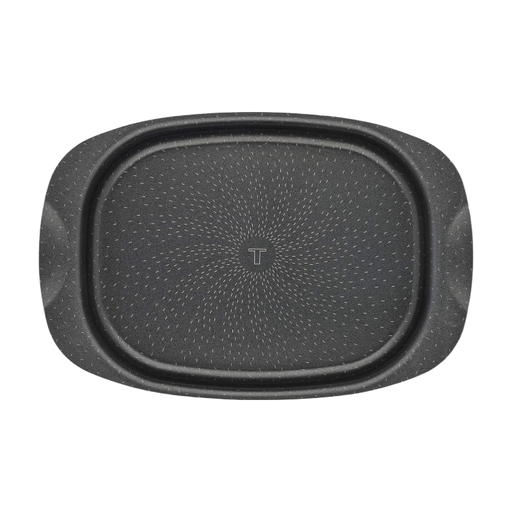
Why this product suits this profile: With a capacity of 4.75 litres, this rectangular oven dish is designed for lasagne, pasta bakes, vegetable gratins and larger meals.
The capacity, dimensions and suitability for use in a standard oven are clearly documented. The included lid adds versatility for storage and transport.
4.75-litre capacity; lid included; recycled aluminium with a non-stick coating according to the product information.
For everyday use, a baking tray set may be more practical than several individual trays. Shallow trays are suitable for biscuits and pastries, while deep oven dishes are needed for baked dishes. If you want to combine baking and presentation, you could also add a slate serving board.
According to the product information, the Secret de Gourmet Slate Serving Board measuring 30 × 40 cm is made from grey slate, has a non-slip design and weighs 1.5 kg. The smaller anthracite-coloured board measuring 24 × 32 cm is intended for snacks, cheese and tapas. Neither board is listed as dishwasher-safe. You can find a selection on the rectangular cake boards category page.
We have put together a complete, regularly updated list of products that fully meet these strict selection criteria and the safety regulations applicable in the EU.
For several people, a deep, rectangular oven dish with sufficient capacity is a practical choice. As well as the litre capacity, check the usable internal dimensions and the height of your oven shelf. For very large portions, a dish with a capacity of around 4 to 5 litres may be suitable.
Its lifespan depends on the material thickness, temperature, cleaning method and utensils used. Avoid metal utensils, harsh cleaning products and abrasive scouring sponges. Even when a tin is dishwasher-safe, washing it by hand can help protect the surface. Once the coating starts to visibly peel or becomes damaged, the tin should no longer be used.
This depends on the individual product. According to the product information, the Le Creuset dishes in this selection are suitable for use in the microwave, oven, freezer and dishwasher. With other ceramic dishes, you must check the manufacturer’s instructions. Suitability cannot be determined from the material alone.