
Lieferung heute & morgen

Qualitätsgarantie

Willkommens-Angebote freischalten: KOSTENLOSE Lieferung | Bis zu 80 % RABATT | Kostenlose 30-Tage-JoyPlus-Testphase
App herunterladen
A balance bike for children can be a useful step before moving on to a children’s bicycle. However, colour and brand name are not the only things that matter. Seat height, weight, tyres, build quality and where the bike will be used are all crucial.
Three avoidable pitfalls commonly arise when buying one:
A height-adjustable saddle is only useful if its lowest setting suits the child’s height. When seated, both feet should be able to reach the ground securely. This makes inside leg measurement a more useful guide than age alone.
As a rough guide:
Always compare the manufacturer’s recommendations with the child’s actual inside leg measurement. A saddle that is too high makes stopping more difficult and can cause insecurity.
A lightweight balance bike is particularly practical if it is regularly carried around the home, in the car or on walks. Specific figures such as 2 kg or 3 kg provide a useful indication. A low centre of gravity, non-slip grips and handlebars that are easy to reach also affect how easy the bike is to handle.
You should also look for:
A balance bike without pedals primarily develops pushing off, steering and rolling skills. It does not replace a bicycle with a brake and is not intended for use on public roads.
A balance bike with EVA tyres usually rolls quietly, is puncture-proof and does not need inflating. This is practical for indoor use, smooth pavements and short journeys. Pneumatic tyres can provide a more cushioned ride on suitable, varied surfaces, but require regular checks of air pressure, valves and tread.
Tyre width, bearings and the steering angle should also be taken into account. A limited steering angle can reduce sudden, very tight steering movements on beginner models. It must not be altered or removed.
The CE mark alone is not a way to compare quality. Also check whether the product comes with instructions in German, manufacturer or importer details, and specific safety warnings. For toys, information relating to EN 71 may be relevant; for the individual product, these details should be verifiable in the description or instructions.
Before every use:
A wooden balance bike should also be checked regularly for cracks, splinters and moisture damage. With pneumatic tyres, air pressure and valves also need to be maintained. By contrast, EVA and polyurethane tyres are described in the supplied product information as low-maintenance or puncture-proof.
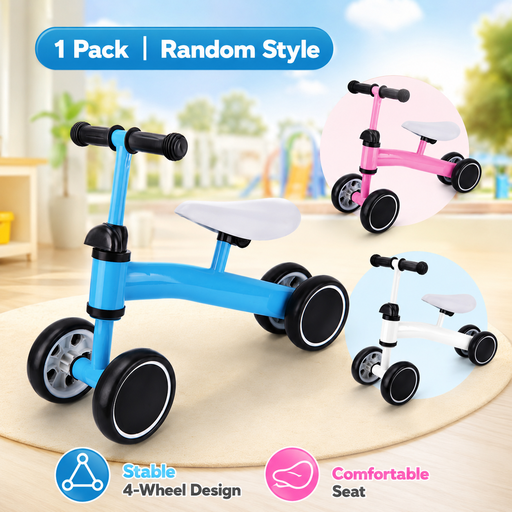
Why this product suits this profile: The four-wheel design is intended to provide stable, straightforward handling and can be an uncomplicated gift for a child’s first riding experiences.
The product information explicitly states that it has a stable four-wheel construction. As the style is selected at random, you should not expect a particular colour when ordering.
Four wheels, a comfortable seat and supplied as a single item. Suitable for supervised play on appropriate surfaces.
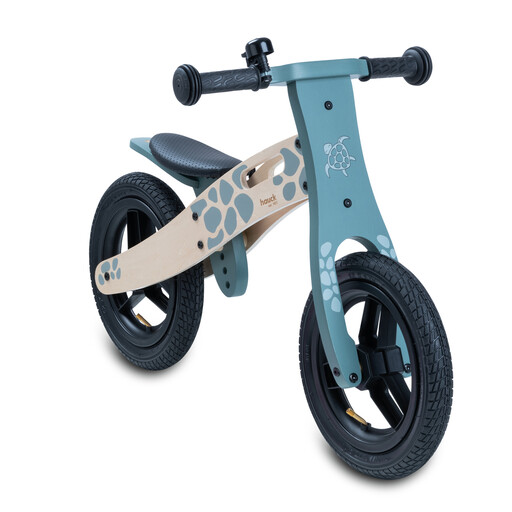
Why this product suits this profile: According to the product information, this wooden model features a four-position adjustable saddle, 12-inch pneumatic tyres and FSC-certified wooden components.
The saddle adjustment accommodates several heights. With pneumatic tyres, the maintenance requirements are clear: air pressure and connections should be checked regularly.
2.95 kg weight, integrated carry handles, four saddle positions and 12-inch pneumatic tyres. The product information states that it is suitable from 18 months.
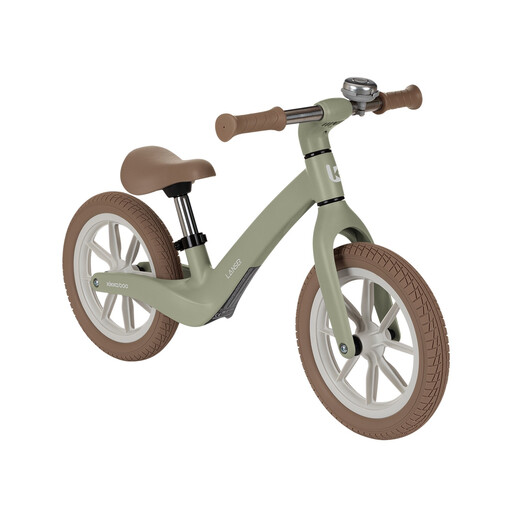
Why this product suits this profile: For families that frequently carry or use a children’s balance bike while out and about, this model offers a stated weight of 3 kg, an adjustable seat and 12-inch polyurethane wheels.
The product description specifies the weight, seat adjustment and tyre material. This makes it easier to assess carrying and maintenance requirements before buying.
12-inch polyurethane wheels that never need inflating, a height-adjustable saddle, non-slip grips and a weight of 3 kg. The stated age range is from 3 to 6 years.

Why this product suits this profile: According to the product information, this compact model is designed for children aged 1 to 3 years and weighs 2 kg. It is therefore suitable for short journeys and use on smooth surfaces.
The seat and steering angle are described as adjustable or limited features. Before buying, compare the compact dimensions of 58 × 27 × 38.5 cm with the child’s size.
Lightweight aluminium frame, adjustable seat, limited steering angle, non-slip grips and puncture-proof EVA wheels.
We have put together a complete, regularly updated list of products that fully meet these strict selection criteria and the safety regulations applicable in the EU.
A balance bike for children aged 1+ may be suitable for some children if they can walk confidently, the seat height is appropriate and they can move the bike in a controlled manner. Other children may not start until they are two or three. Height, inside leg measurement and motor skills are more important than the minimum age alone.
This depends on the saddle adjustment range, frame dimensions and weight limit. A model with a height-adjustable saddle can remain suitable for longer, provided the child can still place both feet securely on the ground. Check regularly that the seat height, handlebar position and maximum load are still appropriate.
It depends on how the bike will be used. EVA tyres are quiet, puncture-proof and low-maintenance. Pneumatic tyres can provide a more comfortable ride on suitable paths, but they need to be inflated and checked. EVA wheels are practical for indoor use and smooth paths; if the bike is frequently used on varied surfaces, it is worth checking the tyre tread and recommended air pressure.