
Lieferung heute & morgen

Qualitätsgarantie

Willkommens-Angebote freischalten: KOSTENLOSE Lieferung | Bis zu 80 % RABATT | Kostenlose 30-Tage-JoyPlus-Testphase
App herunterladen
A balance bike for children can support the transition to riding a bicycle later on, as children can focus on pushing off, steering and balancing without pedals. However, the choice can be overwhelming: terms such as “ultra-light”, “grows with your child” or “puncture-proof” are only helpful when the technical details match.
For parents in Germany, three typical purchasing challenges are particularly relevant:
When seated, your child should be able to place both feet securely on the ground. As a practical guide, the lowest seat height should match the child’s inside leg measurement. Measure this barefoot from the floor to the crotch and compare the result with the manufacturer’s specifications.
A balance bike with an adjustable seat can be used for longer. The setting should be checked after every adjustment and locked securely in place. An adjustable handlebar can also be helpful, although it is not available on every model. For a balance bike from 1 year, a low seat position, compact dimensions and a limited steering angle are particularly important.
A lightweight balance bike is easier for small children to move and for parents to carry. The selected models provide the following examples for comparison:
The frame material affects weight, care requirements and appearance. Wooden frames can offer a natural finish and need protection from prolonged exposure to moisture. The Hauck Balance N Ride is specified as featuring FSC-certified wood. Aluminium and magnesium frames are often designed to keep weight low; however, the actual stability depends on the overall construction, the connections and the permitted load.
You should consider the intended surface when choosing the tyres:
A children’s bicycle without pedals is generally not intended for use on public roads. Suitable locations include clear, level areas away from traffic. Before every ride, check the screws, handlebars, seat, tyres and frame for secure fitting and visible damage. A helmet, sturdy shoes and, depending on the situation, additional protective equipment are advisable. Children must be supervised directly by an adult while riding.

Why this product suits this profile: This model is described as suitable for children aged 3 to 6 and combines an adjustable seat with air-free tyres. It could appeal to families looking for an uncomplicated children’s balance bike for level paths.
The seat is adjustable according to the product name, while the Air-Free tyres eliminate the need for regular inflation. Check the seat height and weight limit before buying.
Adjustable seat, air-free tyres and a stand included according to the product name.
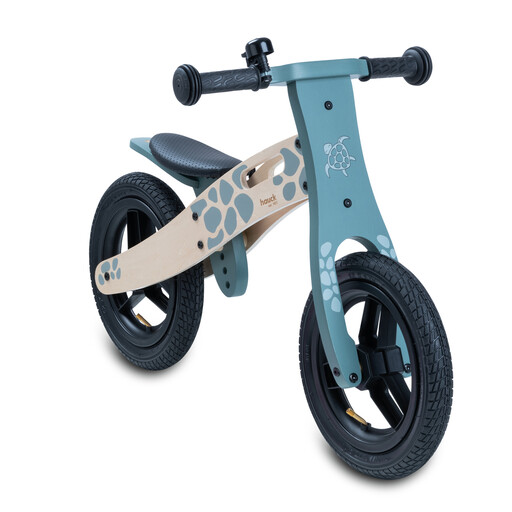
Why this product suits this profile: This wooden balance bike is specified for children from 18 months and features a seat with four height settings, 12-inch pneumatic tyres and an integrated carry handle.
The seat adjustment is specifically stated to offer four positions. As the tyres are pneumatic, regular maintenance is still required: the tyre pressure and screw connections should be checked regularly.
FSC-certified wooden components according to the product details, a weight of 2.95 kg and 12-inch pneumatic tyres.

Why this product suits this profile: This compact model is specified for children aged 1 to 3, weighs 2 kg and has a seat that can be adjusted in two directions. It is therefore suitable for families looking for a first bike for younger children.
The age recommendation and compact dimensions clearly define its intended use. The EVA wheels are described as puncture-proof and low-maintenance; however, check their suitability for gravel or uneven paths beforehand.
2 kg weight, limited steering angle, adjustable seat and removable basket according to the product details.

Why this product suits this profile: This balance bike for children aged 3 to 6 combines a stated weight of 3 kg with a height-adjustable seat and 12-inch polyurethane tyres.
The tyres are described as puncture-proof and low-maintenance. Nevertheless, the actual seat range should be compared with the child’s inside leg measurement before buying.
3 kg weight, height-adjustable seat, 12-inch polyurethane tyres and non-slip grips according to the product description.
A balance bike will last longer when stored in a dry place and checked regularly. With wooden models, pay attention to moisture, cracks and any splinters. Pneumatic tyres require pressure checks; air-free tyres should be inspected for cracks, heavy wear and lodged foreign objects.
The service life depends less on the advertised age range than on the seat height, inside leg measurement, weight limit and riding ability. A balance bike from 2 years may suit one child, while another child may only be ready to use one safely later on. With a balance bike from 3 years, the child’s actual height should also be the deciding factor rather than age alone.
We have put together a complete, regularly updated list of products that fully meet these strict selection criteria and the safety regulations applicable in the EU.
This depends on the individual model and the child’s height. Some products are suitable from 1 year, while others are intended from 18 months, 2 years or 3 years. The key consideration is whether the child can sit safely, control the handlebars and reach the ground with both feet.
Adjust the seat so that both feet are flat or firmly planted on the ground. The knees may be slightly bent. After every adjustment, the seat clamp and connecting elements must be securely fastened. The manufacturer’s specifications for the minimum and maximum positions, as well as the maximum load, are decisive.
Air-free tyres do not need inflating and are resistant to traditional punctures. However, they are not completely maintenance-free: the wheels, axles and fastenings should be checked regularly for wear, play and damage.