
Lieferung heute & morgen

Qualitätsgarantie

Willkommens-Angebote freischalten: KOSTENLOSE Lieferung | Bis zu 80 % RABATT | Kostenlose 30-Tage-JoyPlus-Testphase
App herunterladen
A balance bike for children should make the transition to a bicycle easier, work well in everyday life and support several stages of development. However, many products sound alike: lightweight, safe, puncture-proof or “for every child” are not sufficient buying criteria. What matters is whether the size, riding position, tyres and workmanship suit the child and the intended use.
The statement “balance bike from 2 years” is a useful initial guide, but it does not replace checking the child’s inside leg measurement. When seated, the child should be able to place both feet securely on the ground. If the seat is too high, getting on and off becomes unnecessarily difficult. If it is too low, the riding position may become impractical.
A lightweight balance bike is easier to carry and easier for children to control. You should therefore check the actual product weight in the technical specifications. However, even a very lightweight model is not automatically suitable if the handlebar width, seat height or frame geometry does not fit the child.
On a children’s balance bike without pedals, you will often see terms such as “puncture-proof”, “air-free” or “No-Puncture”. Air-free tyres generally do not require regular pressure checks and can be practical for journeys around the local area. Pneumatic tyres may feel different depending on their construction, but they do require the air pressure to be checked. The relevant product description should therefore be read carefully.
An adjustable seat and handlebar make it easier to adapt the bike to the child’s height. Look for:
Adjustability does not extend the usable life indefinitely. If the child rides with bent knees or the handlebar still seems too low at its maximum setting, a larger model would be more suitable.
The weight affects how well a child can control the balance bike when setting off, turning and supporting themselves. For parents, it is also important to consider whether the model fits on stairs, in the boot of the car or on public transport. An integrated stand can make parking easier, but it does not replace a safe place to leave the bike.
You should also check whether the edges have been finished smoothly and whether screws or small components could come loose. Before the first use, all connecting elements should be inspected.
For pavements, courtyards and short journeys, puncture-proof tyres or air-free tyres are practical because there is no inner tube that can be damaged. However, handling still depends on the tread, the material and the surface. For longer journeys on uneven ground, parents should pay particular attention to the stability of the wheels, fork and handlebar.
A balance bike is not a substitute for protective equipment. A properly fitting cycle helmet and use on traffic-free surfaces are part of age-appropriate equipment. The manufacturer’s age recommendations, warnings and information about the permitted load should be observed before buying and before use.
The following models mainly differ in their stated age range, tyre type, adjustability and design. Before buying, check the product pages for dimensions, weight, contents and assembly instructions.
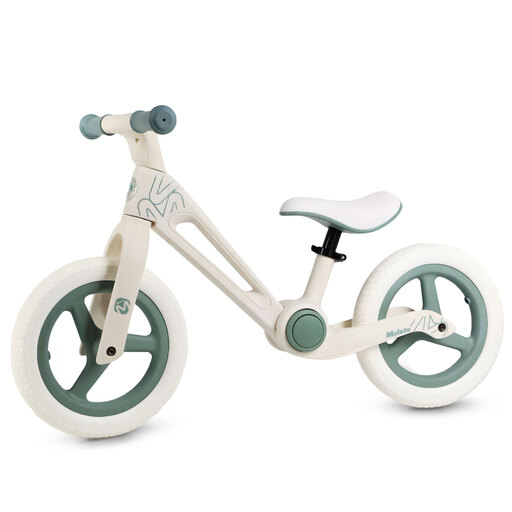
Why this product suits this profile: This model is designed for children aged 2 to 5 and combines an adjustable seat and handlebar with simple assembly. It is therefore suitable as an uncomplicated introduction to balance bikes or as a birthday present for boys and girls.
The product details specify clear age ranges and adjustment options rather than simply advertising a long usable life in general terms.
Adjustable seat, adjustable handlebar, low weight according to the product description and simple assembly.

Why this product suits this profile: The 12-inch version is designed for children aged 2 to 6 and features a soft seat and adjustable handlebar. It is a good fit for families who value adjustability and comfort features.
The details clearly state the wheel size, seat and handlebar. Air-free tyres and simple assembly are also listed.
12-inch wheels, soft seat, adjustable handlebar, air-free tyres and stated suitability for children aged 2 to 6.
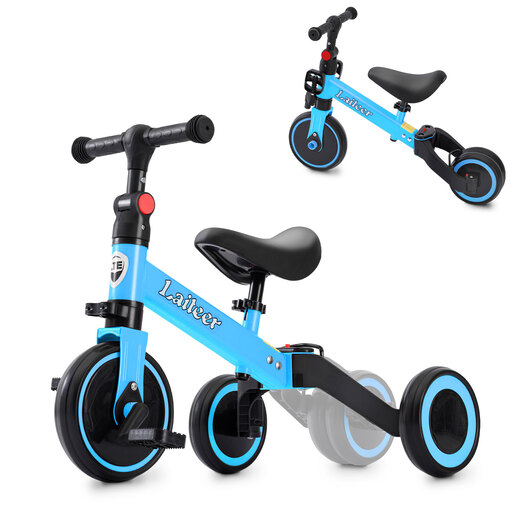
Why this product suits this profile: The combination of a balance bike and tricycle is aimed at families who want to use different riding configurations. According to the product details, the seat and pedals can be adjusted or removed.
The design makes it clear that this 2-in-1 model offers several functions. Before buying, parents should check how the conversion works and which parts need to be fitted.
Two ways to use it, foldable design, adjustable seat and removable pedals according to the product description.

Why this product suits this profile: This children’s pedal-free balance bike is specified for ages 2 to 6 and combines an adjustable seat and handlebar with puncture-proof tyres. It is suitable for regular journeys on appropriate, traffic-free surfaces.
The tyres are described as air-free or puncture-proof. This removes the need to check an inner tube regularly, although the dimensions and load specifications should still be checked.
Adjustable seat and handlebar, puncture-proof tyres, simple assembly and suitability for boys and girls.
Even a balance bike described as easy to assemble should be checked carefully before the first ride:
With a first bicycle for children, it is also important that the child can stop and get off the balance bike independently. Parents should not choose based solely on colour or design: a balance bike for boys and girls can meet the same technical requirements, regardless of the colour option.
We have compiled a complete, regularly updated list of products that fully meet these strict selection criteria and the safety regulations applicable in the EU.
Many models are described as a balance bike from 2 years. However, the child’s height, inside leg measurement and motor skills are the deciding factors. The child should be able to sit securely, reach the ground with both feet and control the weight of the model.
The usable life depends on the seat and handlebar adjustment, wheel size and the child’s growth. An age recommendation of 2 to 6 years is not a guarantee that the bike will fit properly throughout the entire period. Check regularly whether the lowest or highest setting is still suitable.
Air-free tyres do not require air pressure or, normally, inner tube replacement. Nevertheless, tyre materials, wheels or other components can wear out through intensive use. Parents should therefore regularly check the balance bike for cracks, loose parts and unusual play.