
Lieferung heute & morgen

Qualitätsgarantie

Willkommens-Angebote freischalten: KOSTENLOSE Lieferung | Bis zu 80 % RABATT | Kostenlose 30-Tage-JoyPlus-Testphase
App herunterladen
Rising electricity prices are a burden for many households in Germany. A balcony power plant offers a practical way to reduce your energy costs while contributing to the green energy transition. These systems, also known as plug-in solar systems or mini solar systems, make it easy for renters and homeowners alike to generate their own electricity on a balcony, terrace, or roof.
This article serves as a comprehensive guide. It explains the key criteria for selecting the right system and presents various solar solutions to help you make an informed decision.
Before making a decision, it's important to consider several technical and legal aspects. A thoughtful selection ensures the system fits your needs and on-site conditions.
Since 2024, simplified regulations for balcony power plants have been in effect in Germany. The critical factor is the inverter's output power, which must not exceed 800 watts. The total output of the connected solar modules (measured in Watt-peak, Wp) can and often should be higher. A higher module output, for instance 900 Wp, helps the inverter reach its maximum 800-watt capacity more efficiently, even in sub-optimal light conditions (e.g., on cloudy days or during morning and evening hours). Registering such a system is straightforward and only requires an entry in the Market Master Data Register (Marktstammdatenregister) of the Federal Network Agency (Bundesnetzagentur).
A functional balcony power plant consists of several core components that must be compatible with each other:
All-in-one kits are often a practical choice, as all components are pre-matched for compatibility.
The efficiency of a balcony solar system depends heavily on its orientation and location. A south-facing orientation with no shading from trees or adjacent buildings is ideal for maximising energy yield. East or west-facing orientations can also be effective for distributing power generation throughout the day. When mounting, ensure the installation is storm-proof and complies with all regulations.
Based on the criteria above, we have curated a selection of products for different use cases—from complete power generation systems to flexible individual components and decorative solar solutions.
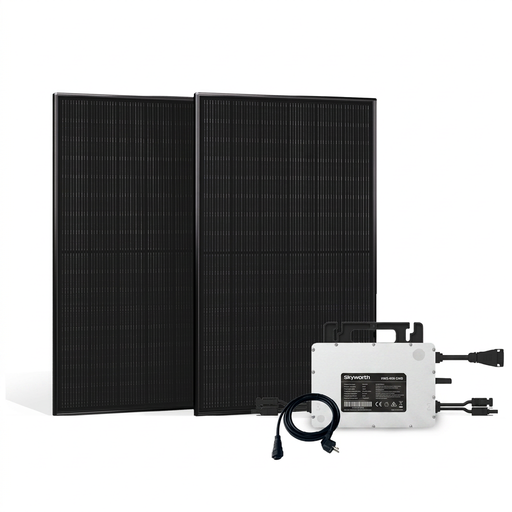
Why it stands out: This kit is a comprehensive solution for anyone looking to start generating power immediately. It includes two high-performance 450-watt solar modules and a matching microinverter with an 800-watt output. The combination of 900 Wp panel capacity and an 800-watt inverter is designed to fully leverage the legal limits and achieve a high energy yield.
Advantages:
Who it's for: Users looking for a straightforward and powerful balcony solar system to start reducing their electricity bill right away.
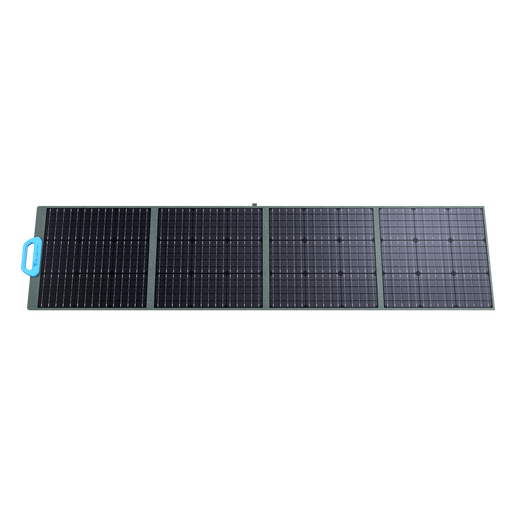
Why it stands out: The BLUETTI PV200 is a single, high-efficiency solar panel distinguished by its flexibility. Featuring monocrystalline solar cells with an efficiency of up to 23.4% (according to the manufacturer) and a foldable design, it is suitable for both fixed installations and mobile use.
Advantages:
Who it's for: Users seeking a flexible and powerful single panel to build a mobile power supply, expand an existing system, or create their own custom balcony power plant project.
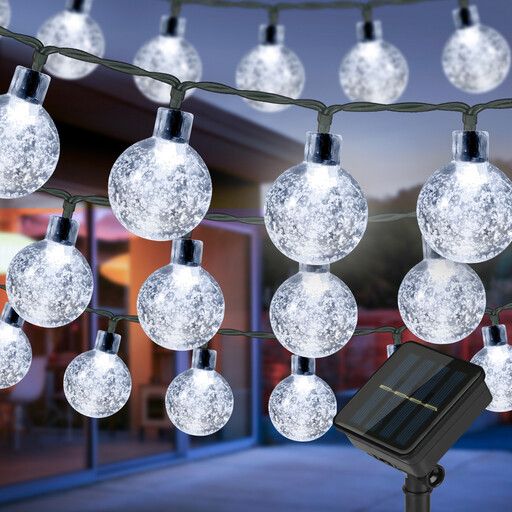
Why it stands out: Not all solar applications are for powering your home. These string lights use solar energy to create an ambient atmosphere on your balcony or in your garden. They operate completely off-grid, charging during the day and automatically turning on at dusk.
Advantages:
Who it's for: Anyone who wants to decoratively light their outdoor space without complex installation or extra electricity costs, taking a simple first step into using solar energy.
If you'd like to enhance your outdoor area with more atmospheric, solar-powered lighting, explore our selection of Solar Sunflower LED Lights for Outdoors.
The annual savings depend on several factors: location, module orientation and tilt, local solar irradiance, and your electricity consumption patterns. Under typical conditions in Germany, an 800W balcony power plant can generate between 600 and 800 kilowatt-hours (kWh) of electricity per year. At an electricity price of 30 cents/kWh, this translates to potential savings of €180 to €240 annually.
Generally, no. Balcony power plants are designed to be safely installed by non-professionals and connected via a standard household socket (Schuko plug). The only formal requirement is to register the system in the Market Master Data Register (Marktstammdatenregister) of the Federal Network Agency (Bundesnetzagentur), which can be done online in a few minutes. As of the 2024 legislative changes, prior registration with the grid operator is no longer necessary.
The power generated by your mini solar system is consumed directly by the appliances currently running in your home (e.g., refrigerator, router, standby devices). If the system produces more electricity than you are using at that moment, the surplus flows into the public grid without compensation. Therefore, it is most economical to maximise self-consumption by running energy-intensive appliances like washing machines or dishwashers preferably when the sun is shining.