
Lieferung heute & morgen

Qualitätsgarantie

Willkommens-Angebote freischalten: KOSTENLOSE Lieferung | Bis zu 80 % RABATT | Kostenlose 30-Tage-JoyPlus-Testphase
App herunterladen
Rising electricity prices and a desire for greater energy independence are leading many people in Germany to seek practical alternatives. A balcony power station, also known as a plug-in solar or mini-PV system, offers an accessible way to generate your own solar power and significantly lower your electricity bill. This article serves as a guide, presenting objective criteria to help you choose the right system for your needs.
As your Joybuy Product Recommendation Officer, I have compiled information to provide you with a factual basis for your decision, free from exaggerated marketing promises.
The decision to invest in a mini-PV system should be based on clear technical parameters and the legal framework. Here are three key points to consider.
Since 2024, a simplified regulation for balcony power stations has been in effect in Germany. The maximum power the inverter can feed into the home grid must not exceed 800 watts. However, many complete kits feature solar panels with a higher total output, such as 900 watts or more. This is advantageous because it allows the system to achieve a higher energy yield and get closer to the permitted 800 watts even in sub-optimal sunlight (e.g., on cloudy days or with less-than-ideal orientation). The crucial factor is the inverter's output power, which must be limited to 800W.
A complete balcony solar system kit is designed to make installation as straightforward as possible. Ensure that all essential components are included:
Additionally, check whether mounting hardware for your specific balcony railing, an exterior wall, or a flat-roof setup is included or needs to be purchased separately.
For many users, aesthetics are just as important as functionality. A solar panel for the balcony should blend harmoniously with the building's overall appearance. A black balcony power station featuring "all-black" modules offers a particularly discreet and modern aesthetic. In these modules, the solar cells, backsheet, and frame are all black, creating a uniform, elegant surface.
Based on the criteria mentioned, we are featuring a system that could be an attractive option for many users due to its technical specifications and design.
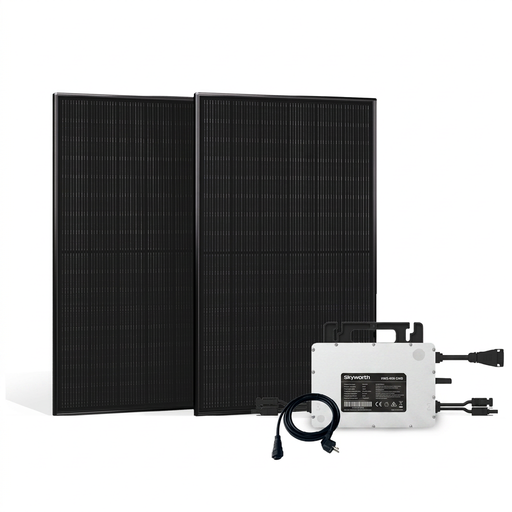
Why It Stands Out This system combines a high total panel output of 900W with a compliant 800W microinverter. The higher panel capacity allows for more efficient power generation throughout the day. The all-black design of the solar modules ensures an appealing and discreet look on your balcony.
Product Details
Who Is It For? This kit is aimed at users who want to achieve a high energy yield while also valuing a modern, unobtrusive appearance. It is an excellent choice for tech-savvy renters and homeowners looking to effectively cover their household's base load with self-generated power.
Besides generating power for your home, solar energy can also be used to create a pleasant atmosphere on your balcony or in your garden. Solar lights require no external power source and turn on automatically at dusk.
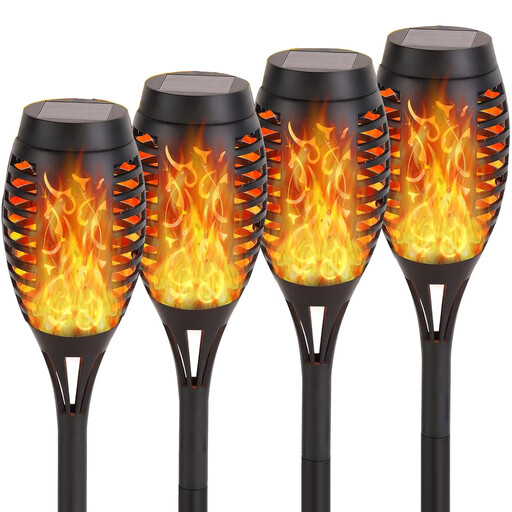
These solar torches, with 12 LEDs, imitate a flickering flame effect to create a warm ambiance. At a height of 51 cm and with an IP65 protection rating, they are weatherproof and suitable for year-round outdoor use. The automatic on/off function provides convenience without any manual intervention.
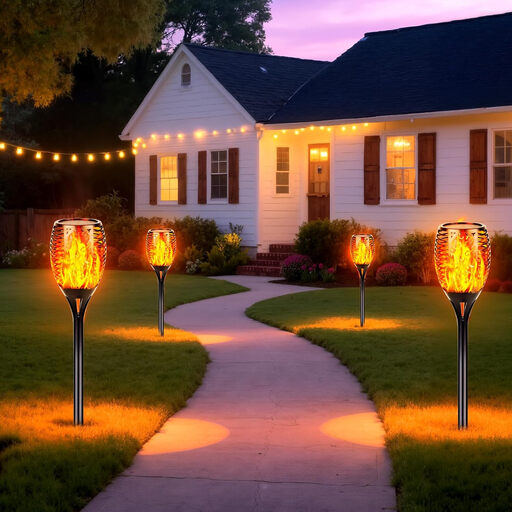
Equipped with 96 LEDs, these garden torches produce a realistic, dancing flame effect. They are also IP65 waterproof and feature a dusk-to-dawn sensor. They are ideal for illuminating pathways or adding decorative accents to a patio or balcony.
If you want to further enhance your outdoor space with energy-efficient and atmospheric lighting, you will find a wide selection in our category.
? Discover more flickering LED solar lights here.
Yes, the commissioning of a balcony power station must be reported. However, the process has been greatly simplified. Only a registration in the Market Master Data Register (MaStR) of the Federal Network Agency is required. The previous registration with the grid operator is no longer necessary for many systems, provided a modern electricity meter with a backstop is installed.
The panel output (measured in watt-peak, Wp) indicates the maximum power the solar modules can generate under ideal test conditions. The inverter output (in watts, W) specifies the maximum amount of power that can be fed into the home grid. A higher panel output ensures that the inverter can reach its maximum 800W output more consistently and for longer periods, even in less-than-optimal conditions (e.g., cloudy skies, diffuse radiation), which increases the total yield of generated electricity over the year.
The actual savings depend on many factors: your electricity consumption profile, the orientation and tilt of the panels, the number of sunshine hours at your location, and your current electricity price. An 800W balcony power station with optimal orientation can generate between 600 and 800 kilowatt-hours (kWh) of electricity annually. This power can cover your household's base load (e.g., the consumption of a refrigerator, router, and standby devices) during the day, thereby reducing your electricity bill. A precise forecast is specific to each individual, but the investment typically pays for itself within a few years.