
Lieferung heute & morgen

Qualitätsgarantie

Willkommens-Angebote freischalten: KOSTENLOSE Lieferung | Bis zu 80 % RABATT | Kostenlose 30-Tage-JoyPlus-Testphase
App herunterladen
A balcony or terrace extends your living space into the great outdoors. But to enjoy this space without interruption, privacy is essential. The right privacy screen not only shields you from prying eyes but can also serve as an effective balcony windbreak or balcony sunshade. The selection of materials, sizes, and mounting options is vast. This article introduces various solutions and provides guidance to help you find a functional and suitable balcony covering for your needs.
Before making a decision, a few practical considerations are helpful. The following points highlight the most important criteria for selecting a durable and functional solution.
The material is crucial for durability, aesthetics, and functionality. Two common options are:
The type of attachment depends on the structural conditions of your balcony or garden.
Measure the area to be covered precisely before ordering a balcony covering. Consider both the height and the length. Some products, especially HDPE material on a roll, can be cut to size with scissors if needed, without the edges fraying. Check the manufacturer's specifications regarding its cut-to-size properties.
Based on functionality and material properties, we have compiled a few products that cover different requirements.
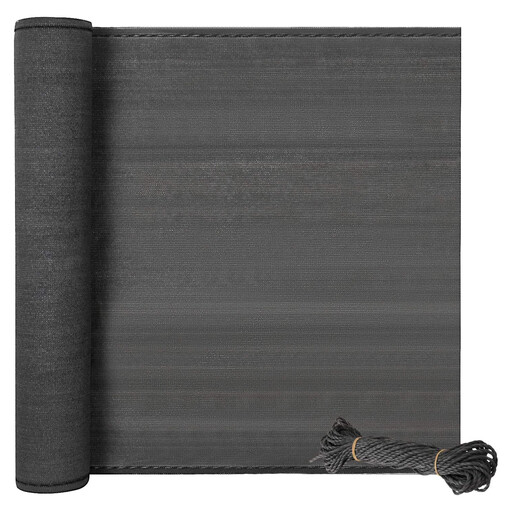
Why it stands out: With a length of 15 metres, this privacy screen is ideal for large balconies, long terraces, or as a continuous garden privacy screen along a fence. The reinforced top and bottom edges, along with the included 34-metre cord, allow for a continuous and stable attachment.
Advantages:
Who is it for? This product is a great choice for homeowners or renters who want to seamlessly cover a large area, whether on a balcony railing, a chain-link fence, or a pergola. The Anthracite colour blends discreetly into most environments.

Why it stands out: This privacy screen from Woltu is distinguished by its higher material density of 180 g/m? and associated high tear resistance (approx. 450–500 N/5 cm). According to the manufacturer, it offers a shade factor of over 85%, making it highly opaque. The 50 included zip ties make installation especially easy.
Advantages:
Who is it for? Ideal for users looking for an exceptionally durable and opaque solution for a standard balcony or a terrace privacy screen. The simple installation with zip ties makes it a practical option for DIY enthusiasts.
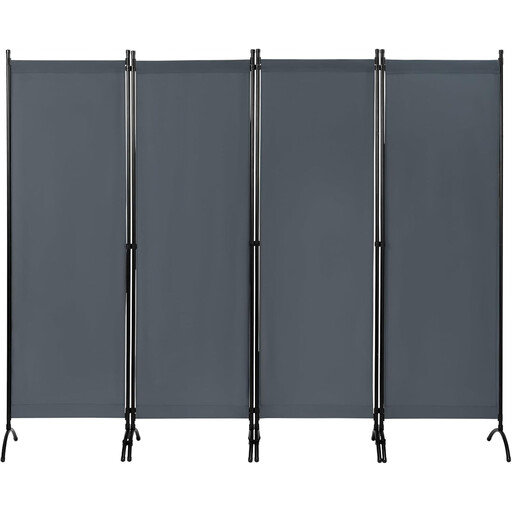
Why it stands out: This outdoor folding screen offers maximum flexibility. As a freestanding partition, it can be set up anywhere temporary or seasonal privacy is needed, without drilling or permanent installation. It is foldable and can be stored compactly when not in use.
Advantages:
Who is it for? Perfect for renters who are not allowed to make permanent installations, or for anyone looking for a mobile and versatile solution. It can serve as a privacy screen on the balcony, a partition in the garden, or even as a room divider indoors.
The products featured cover common use cases. However, if you need a different size, colour, or a special fastening system, numerous other alternatives are available.
Discover our full range of Hanging Patio Privacy Screens to find the perfect solution for your outdoor space.
The degree of opacity depends on the material density (g/m?) and the colour. A higher weight, such as 180 g/m?, generally offers more privacy than lighter versions. Dark colours like Anthracite absorb more light and thus appear more opaque than light tones. Products with a shade rating of 85% or more are considered largely opaque.
For a secure installation, all existing eyelets should be used to distribute the tensile forces evenly. Pull the balcony screening taut to minimise flapping in the wind. Use robust, UV-resistant zip ties or tear-proof cords. In very windy locations, a material with higher wind permeability, as is the case with some HDPE fabrics, can reduce the strain on the railing.
Many privacy screens made from HDPE fabric are designed to be cut to the desired size with sharp scissors or a utility knife without the cut edges fraying. However, it is important to check the manufacturer's product description, as this does not apply to all materials. Products like the EUGAD privacy screen are explicitly designated as trimmable.