
Lieferung heute & morgen

Qualitätsgarantie

Willkommens-Angebote freischalten: KOSTENLOSE Lieferung | Bis zu 80 % RABATT | Kostenlose 30-Tage-JoyPlus-Testphase
App herunterladen
A bamboo chopping board can be used for preparing, chopping and serving food. However, models vary considerably in terms of dimensions, thickness, handle design and care requirements. If you focus only on a natural appearance or terms such as “sustainable”, it is easy to overlook important details.
Three common buying mistakes occur particularly often:
Bamboo is a fast-growing raw material. This makes a bamboo board appealing to shoppers who consider material use when buying household products. However, this alone does not automatically mean that a product is sustainable. Its origin, processing, adhesives, packaging and service life also play a role.
A smooth, splinter-free surface is essential. It should neither flex excessively nor show visible cracks or open joints. A knife-friendly bamboo or wooden chopping board is more suitable for cutting than glass or very hard stone surfaces, as these can put greater strain on the knife blade.
For everyday use, dimensions between approximately 30 × 20 cm and 45 × 30 cm are common. A large wooden chopping board or bamboo board offers more space, but also requires a sufficiently large work surface and a suitable storage compartment.
Thickness affects stability and weight:
An integrated handle makes the board easier to carry and hang up. With a bamboo chopping board with handle, the joint between the handle and board should be sturdily made and should not get in the way on the work surface while chopping.
A chopping board with a juice groove is useful when cutting foods with a high water content or carving meat. Check whether the groove is sufficiently wide and deep, and whether it reduces the usable cutting surface too much.
A reversible design can make kitchen organisation easier. For example, the product description for the WMF Bamboo Cutting Board states that it has two usable sides. For hygienic food preparation, it is advisable to reserve one side for raw meat and fish and the other for vegetables, fruit or bread.
For almost all the wooden and bamboo boards mentioned here, the following applies: clean by hand with warm water and mild washing-up liquid, do not soak, and allow to dry completely. The manufacturer’s instructions take priority. Some models should occasionally be treated with food-safe care oil.
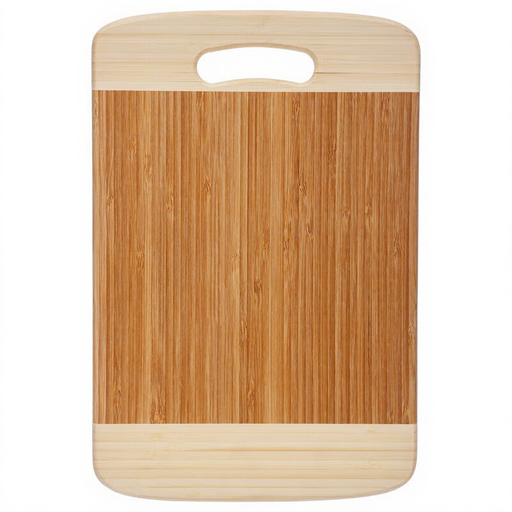
Why this product suits this profile: The compact format is ideal for small kitchens, individual ingredients and occasional serving. The integrated handle makes it easy to carry and hang up.
The dimensions are clearly stated, avoiding uncertainty about the available workspace. The care instructions require hand washing.
Bamboo, 30 × 20 cm, integrated handle and hand cleaning according to the product description.

Why this product suits this profile: Measuring 45 × 30 cm, this board combines a spacious work surface with a thickness of 1.9 cm. It can also be used as a bamboo serving board.
The product description specifies a juice groove, reversible design and clear dimensions. This makes it easier to assess how it can be used and how much space it requires before buying.
Reversible bamboo board, all-round juice groove, 45 × 30 × 1.9 cm and hand washing.
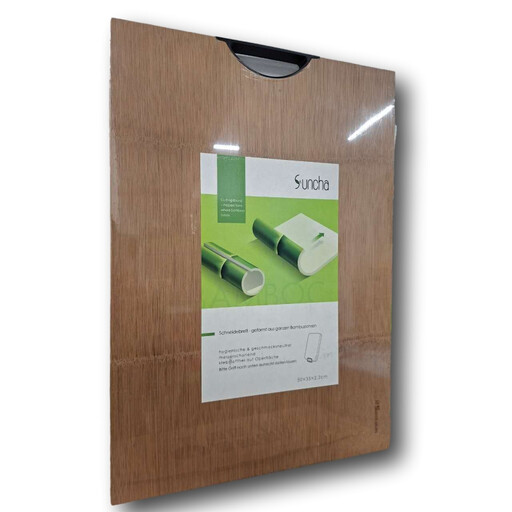
Why this product suits this profile: Measuring 50 × 35 cm and 26 mm thick, this board provides plenty of workspace for extensive food preparation, working with dough and serving bread or cheese.
The substantial thickness and precise dimensions make the weight and space requirements clear. According to the product information, it is not suitable for dishwashers.
A single piece of Moso bamboo according to the product description, 50 × 35 × 2.6 cm, handle, and suitable for chopping and working with dough.

Why this product suits this profile: Three sizes make it possible to assign boards to different tasks, such as vegetables, bread and serving. Juice grooves and handles support flexible use when serving multiple courses.
The set includes three specific sizes, so you do not have to use a single board for every task.
Three bamboo boards, juice grooves, integrated handles and hand washing according to the product information.
A wooden kitchen board remains usable for longer when cared for properly. After chopping, remove any residue promptly and wipe both sides dry. Stand the board upright wherever possible so that air can reach the surface. Direct heat, radiators and prolonged contact with water should be avoided.
A separate kitchen chopping board is advisable for raw foods. Replace a board if deep grooves, splinters, cracks or warping develop. A bamboo chopping block should also rest securely on the work surface; on slippery surfaces, a damp, non-slip mat can help.
If you mainly serve cheese, bread and snacks, you can choose a serving board or a bamboo chopping board set in various sizes. A two-tier model such as the Secret de Gourmet Bamboo Serving Board, on the other hand, is primarily designed for presentation and, according to the product description, is not suitable for dishwashers.
We have put together a complete, regularly updated list of products that fully meet these strict selection criteria and the safety regulations applicable in the EU.
In principle, bamboo can be used as a cutting surface for various foods. However, a separate side or board should be reserved for raw meat and fish. The care instructions provided by the relevant manufacturer are also important.
It is not possible to give a reliable fixed service life. It depends on cutting frequency, moisture, cleaning and material thickness. Hand washing, drying immediately and occasional treatment with a suitable food-safe oil can help extend its usable life. The board should no longer be used if it develops cracks or deep cuts.
For the models described here, dishwasher use is not intended. Bamboo and wooden boards should be cleaned by hand with mild washing-up liquid and then dried completely. The care instructions on the relevant product page are always binding.