
Lieferung heute & morgen

Qualitätsgarantie

Willkommens-Angebote freischalten: KOSTENLOSE Lieferung | Bis zu 80 % RABATT | Kostenlose 30-Tage-JoyPlus-Testphase
App herunterladen
A bamboo chopping board is a versatile choice for food preparation, plating and serving. However, models can vary considerably in size, construction, stability and care requirements. If you focus only on a natural look or claims that a board is ‘antibacterial’, you could overlook important buying considerations.
Three common pitfalls are worth watching out for:
Bamboo is a fast-growing material and is often used as an alternative to plastic. Even when choosing a sustainable chopping board, check whether it’s made from several bonded layers or, as stated for some Suncha models, from a single piece of bamboo. The construction affects the board’s weight, stability and how much moisture it may absorb.
A wooden chopping board made from beech or acacia can also be a good choice. However, different types of wood vary in hardness, weight and care requirements. Very hard surfaces, such as glass or certain metal surfaces, may be less suitable for knife blades. That’s why bamboo and wooden boards are often marketed as knife-friendly materials. This doesn’t automatically mean they’ll last for a particular length of time.
If you’re looking for an antibacterial chopping board, take marketing claims with a pinch of salt. The natural properties of a material don’t replace hygienic cleaning. After contact with raw meat or fish, it’s especially important to wash the board with warm water and a suitable mild cleaning product, then dry it thoroughly. Claims about antibacterial properties should be treated as statements from the manufacturer, not as medical or hygiene guarantees.
A large chopping board gives you more room to work in a busy family kitchen. Sizes around 40 × 28 cm or 45 × 30 cm are suitable for vegetables, bread and larger ingredients. A board that’s 26 mm thick will generally be heavier and may sit more firmly on your worktop than a particularly thin model.
By contrast, compact boards of around 26 × 26 cm are better suited to smaller worktops. Choose a thickness that suits how you’ll use the board: a lightweight model is easier to store and carry, while a thicker chopping board has more weight for regular food preparation.
Also look for:
A juice groove can catch liquid when you’re chopping fruit, meat or a roast. It’s useful, but takes up some of the working surface and needs to be cleaned carefully. A double-sided chopping board can help you keep ingredients separate, for example by using one side for vegetables and the other for bread or raw foods. This doesn’t automatically eliminate every hygiene risk: both sides need to be cleaned thoroughly and dried after use.
A bamboo board with a handle is easy to carry from the fridge to the worktop, or on to the dining table. If you plan to use it as a serving board, check whether the surface is intended for bread, cheese or other dry foods. A deep juice groove or heavily textured surface won’t be practical for every serving task.
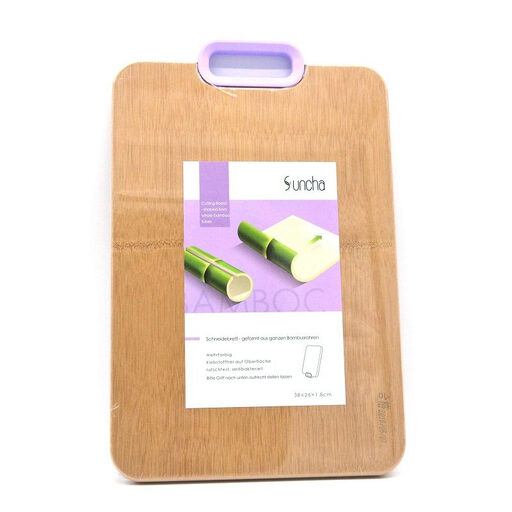
Why it suits this kitchen: The size offers a good balance of workspace for everyday chopping without taking up as much room as an XL board. The integrated handle makes it easier to carry and hang up.
At 380 × 260 mm, it avoids the limitations of a very small cutting surface. Its stated thickness of 18 mm also gives it more substance than particularly thin boards.
Bamboo construction, 18 mm thickness and an integrated handle; the product information recommends washing by hand.

Why it suits this kitchen: Its generous size works for both food preparation and serving. The juice groove and reversible design are useful for households that want to keep different work areas separate.
The product details specify the dimensions, a juice groove around the edge and a fully reversible design, rather than relying solely on general claims about the material.
45 × 30 cm working surface, a juice groove and two usable sides; the product description recommends hand-washing with a mild cleaning product.
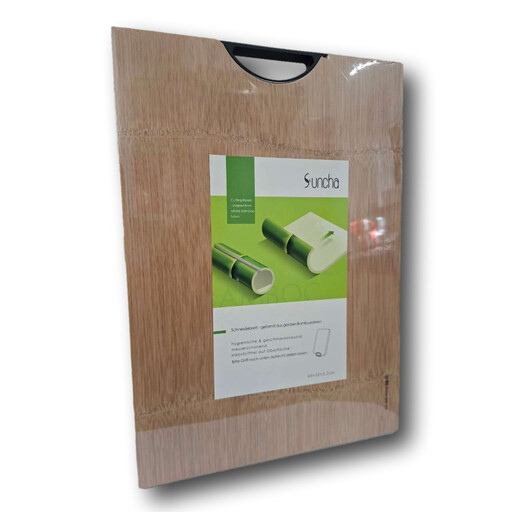
Why it suits this kitchen: The 26 mm thickness and generous surface make it suitable for regular food preparation, working with dough, and serving bread, cheese or other dry foods.
The clearly stated dimensions and weight of 1.99 kg help you assess how stable it is. The care instructions specifically advise against soaking it or putting it in the dishwasher.
50 × 35 cm surface, 26 mm thickness, a handle and, according to the product description, a single-piece bamboo construction.
We’ve put together a complete, regularly updated list of products that meet these strict selection criteria and fully comply with the safety regulations in force in the EU.
How long your board lasts depends largely on how you look after it. For bamboo and wooden boards, follow this routine:
When preparing raw animal products, it’s a good idea to use a separate board or assign one side of the board for that purpose. A double-sided chopping board can help you keep things organised, but it doesn’t replace thorough cleaning.
Many models are intended for both types of food. For good kitchen hygiene, raw animal products should be prepared separately from vegetables and bread wherever possible. A juice groove can catch liquid, but it won’t prevent the transfer of germs. Always follow the manufacturer’s care instructions and clean the board thoroughly.
There’s no reliable way to give a set lifespan for every model. It depends on the construction, how intensively you use it for chopping, how much moisture it’s exposed to and how well you care for it. Regular soaking, dishwasher use and high temperatures can damage the surface more quickly. Storing the board in a dry place and following the manufacturer’s instructions can help keep it in good condition.
It depends on how much worktop and storage space you have. A large model gives you more room to chop and can also be used as a serving board. For smaller kitchens, sizes around 34 × 24 cm or 38 × 26 cm are often easier to handle. Before you buy, check that the board will fit in a drawer or cupboard, or in the space where you plan to hang it.