
Lieferung heute & morgen

Qualitätsgarantie

Willkommens-Angebote freischalten: KOSTENLOSE Lieferung | Bis zu 80 % RABATT | Kostenlose 30-Tage-JoyPlus-Testphase
App herunterladen
A bamboo chopping board can be used in many ways for chopping, serving and arranging food. However, models vary considerably in dimensions, construction, stability and care requirements. Anyone who focuses solely on an attractive wood look or the claim “particularly robust” may overlook important details.
Three common buying misconceptions frequently lead to unsuitable products:
Compact formats are sufficient for simple preparation tasks. A kitchen board with a handle measuring 30 × 20 cm is easy to carry and can be stored without taking up much space. For families, extensive mise en place or chopping larger ingredients, formats from around 40 × 28 cm are more practical.
The material thickness also makes a difference. Thinner boards are lighter, but may sit less securely on the worktop. A 26 mm-thick model offers more material than a 17 mm version, but is heavier as a result. The key consideration is whether the board will mainly be used for chopping or primarily for serving.
Bamboo is a fast-growing raw material and is therefore often promoted as a sustainable chopping board material. However, its specific environmental impact depends on factors including cultivation, processing, transport and coating. A blanket statement about sustainability is therefore not possible without additional information about its origin and production.
Look for a smooth, splinter-free surface and clear information about the material. Bamboo is often made from several layers bonded together. One model, for example, is described as having a cross-laminated core designed to reduce moisture absorption and warping. Such technical details are more meaningful than general advertising claims such as “unbreakable”.
A soft to medium-firm chopping surface is more suitable for many kitchen knives than glass or very hard composite materials. Nevertheless, every chopping board is a used item: deep cuts, cracks or splinters are reasons to stop using the board for direct food contact.
A juice groove is particularly useful for fruit, vegetables with a high water content or meat. Check whether the groove runs all the way around the board and how much usable surface remains. An integrated handle makes it easier to carry the board from the worktop to the table. On large boards, the handle should be sturdy and not take up too much of the cutting surface.
For bamboo and wooden products, hand washing is generally the rule. Use warm water and a mild cleaning product, then dry the board thoroughly straight afterwards. Avoid soaking, harsh scouring products and the dishwasher unless the manufacturer expressly approves dishwasher use. Some products also recommend occasional treatment with food-safe oil.
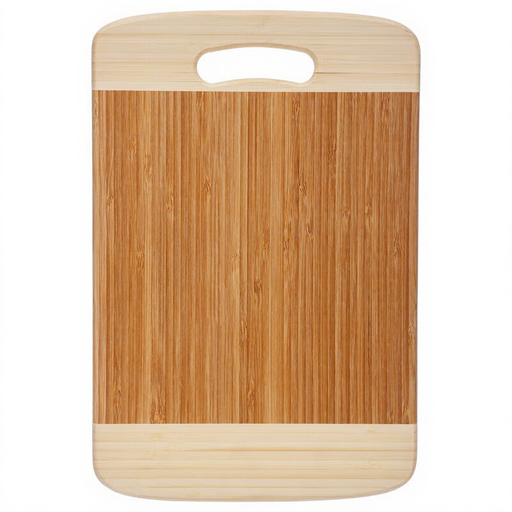
Why this product suits the profile: The compact format is ideal for everyday preparation and is easy to carry or store thanks to its integrated handle.
The stated 30 × 20 cm dimensions set clear expectations for the available work surface. The care instructions specify hand washing and thorough drying rather than unconfirmed dishwasher use.
Bamboo surface, integrated handle and clearly explained hand-washing care.

Why this product suits the profile: The 45 × 30 cm format provides a generous preparation and serving surface. Its reversible design allows each side to be used separately for different food groups.
The specific dimensions and material information avoid vague promises. The juice groove is identified as a functional detail, while care is specified as hand washing.
45 × 30 cm, 1.9 cm thick, with a juice groove and reversible design.
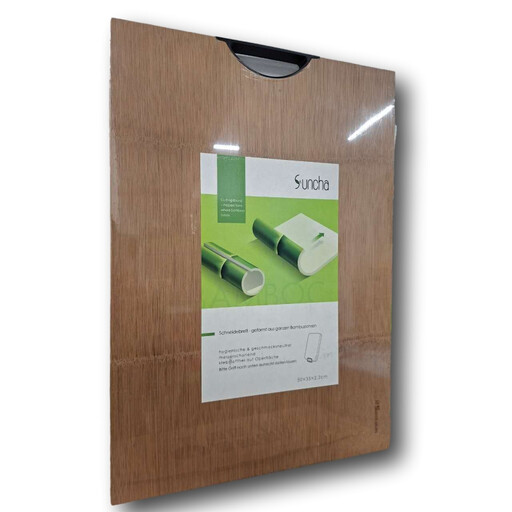
Why this product suits the profile: The XXXL dimensions are ideal for large quantities, preparing dough and extensive kitchen tasks. The handle makes it easier to move the 1.99 kg board.
The dimensions, thickness and weight are clearly stated. This lets you check before buying whether you have enough worktop, sink space and storage capacity.
50 × 35 × 2.6 cm, bamboo construction, handle, and suitability for chopping and preparing dough.
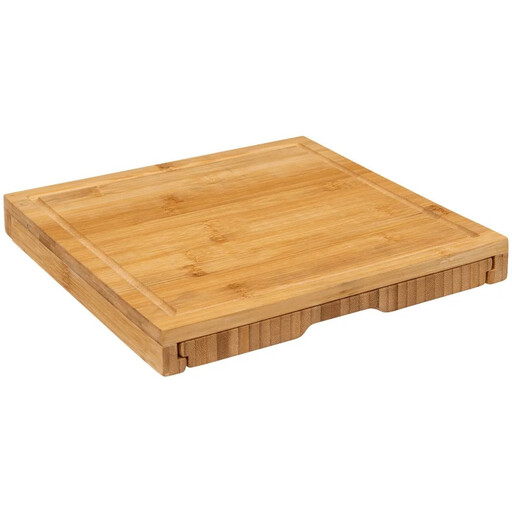
Why this product suits the profile: As a bamboo cheese board, this set combines a 30 × 30 cm surface with four different cheese knives and a storage solution.
Its purpose as a serving and cheese board is clearly defined. The lack of dishwasher suitability is expressly stated, preventing false expectations about cleaning.
Bamboo board with four cheese knives, storage drawer and an overall height of 3.6 cm.
We have put together a complete, regularly updated list of products that fully meet these strict selection criteria and the safety regulations applicable in the EU.
To keep a bamboo chopping board usable for as long as possible, you should follow a few simple habits:
A bamboo board can also be used as a bamboo serving board for bread, fruit or snacks. Multi-tiered versions such as the Secret de Gourmet Bamboo Serving Board, with a diameter of 25 cm, are primarily designed for presenting pastries, chocolate, cheese and snacks. As this model is not dishwasher-safe, hand washing is the only recommended cleaning method.
In principle, a bamboo chopping board designed for this purpose can be used to cut meat. What matters is having a sufficiently large, stable surface and thoroughly hand washing it afterwards. A juice groove can collect liquids. Wherever possible, use separate sides or separate boards for raw meat and other foods.
It is not possible to give a general lifespan. This depends on the board’s construction, how frequently it is used and how well it is cared for. Do not soak it, put it in the dishwasher or leave it damp after washing; dry the board completely. Cracks, severe warping or splinters indicate that it is time to replace it.
Bamboo and other types of wood have different properties. Bamboo is often chosen for its low weight, smooth surface and material origin. A wooden chopping board made from beech, walnut or acacia may also be suitable for chopping and serving, depending on its thickness and construction. Instead of comparing wood types alone, compare the specific dimensions, surface quality, care instructions and intended use.