
Lieferung heute & morgen

Qualitätsgarantie

Willkommens-Angebote freischalten: KOSTENLOSE Lieferung | Bis zu 80 % RABATT | Kostenlose 30-Tage-JoyPlus-Testphase
App herunterladen
A bamboo chopping board can be used in many ways for everyday cooking, baking and serving. However, models differ significantly in thickness, surface, shape and care. If you only look at the appearance or a large centimetre measurement, you might end up with a board that wobbles on the worktop, doesn't catch liquids or is difficult to store.
An XL chopping board offers plenty of space for vegetables, meat, bread or dough. What really matters, though, is the material thickness. A thin board with a large surface area can warp more easily when exposed to moisture or uneven pressure. For regular kitchen tasks, the combination of length, width and thickness, along with a sturdy construction, are important points to compare.
Bamboo grows quickly and is therefore often promoted as a sustainable material. However, this alone doesn't tell you how durable a product is. You should also check whether the board is made from solid bamboo or from glued or cross-laminated layers. The care instructions, surface treatment and manufacturer's details should also be taken into account.
A chopping board with a juice groove can catch liquid when cutting juicy fruit or meat. However, the groove takes up some of the usable cutting surface and needs to be cleaned carefully. A handle makes it easier to carry and serve, but can take up space when chopping. For dough, pasta or large loaves of bread, a surface that is as continuous as possible is often more practical.
For small kitchens or individual ingredients, a size of around 30 × 20 cm may be sufficient. Families, keen cooks and heavy users often benefit from a large bamboo chopping board measuring at least around 38 to 45 cm in length. A size like 50 × 35 cm is particularly suitable for extensive food preparation, but needs enough worktop and storage space.
Thickness affects the weight and stability:
The ranges mentioned are practical guidelines, not binding quality classes. What matters is that the board sits flat and the product description includes clear measurements.
A wooden chopping board made from bamboo should have an even, splinter-free surface. The specific construction can be solid, built up from several layers or made from a single piece. Details such as 'cross-laminated core' describe the construction, but don't replace checking the thickness and care instructions.
Bamboo is generally quite hard as a chopping surface. This can help it resist visible knife marks, but it doesn't mean that cuts won't appear. Boards that are heavily damaged, cracked or splintering should no longer be used for food.
An easy-care chopping board is not automatically dishwasher-safe. For the bamboo boards described here, the following care is generally recommended:
This way, you can reduce the strain caused by moisture. For raw meat and other food groups, it is also advisable to consistently separate work surfaces and clean thoroughly after each use.
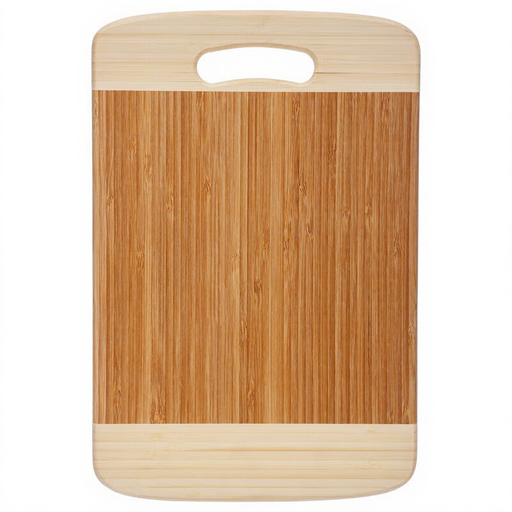
Why this product suits the profile: The compact size is ideal for smaller kitchens, individual ingredients and households looking for a manageable board with a carrying handle.
The clearly stated size reduces the risk of choosing a board that is too large for a small work surface. The care instructions advise against soaking and using the dishwasher.
30 × 20 cm, integrated handle and bamboo construction for everyday chopping tasks.
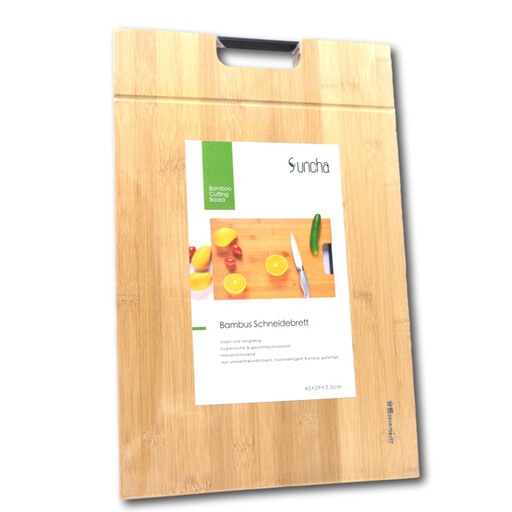
Why this product suits the profile: The 45 cm long, 29 cm wide and 35 mm thick board is designed for extensive food preparation where stability matters more than low weight.
The high material thickness addresses the common weakness of very thin XL boards. Before buying, you should still check whether the weight is suitable for your intended storage location.
450 × 290 × 35 mm, thickened design and smooth surface according to the product description.

Why this product suits the profile: The set of three sizes is aimed at households that want to separate chopping and serving, or organise tasks for different ingredients.
Multiple sizes prevent having to use a single very large board for every task. Juice grooves and handles increase functionality, but require hand washing.
Three sizes, integrated juice grooves and handles; made from carbonised bamboo with a cross-laminated core according to the product description.
We have put together a complete, regularly updated list of products that fully meet these strict selection criteria and the safety regulations in force in the EU.
The board should be cleaned after each use with warm water and mild washing-up liquid, then dried completely. Prolonged soaking can damage the material. A dishwasher is only suitable if the manufacturer explicitly states this. For the models mentioned, hand washing is recommended.
It is not possible to give a reliable fixed lifespan. It depends on material thickness, usage, knife pressure, moisture and care. A board should be replaced when deep cracks, severe warping or splinters appear. Regular drying and occasional application of food-safe oil can help maintain the surface.
The product descriptions for the models mentioned allow for use with various ingredients such as vegetables, fruit, meat and bread. For clear kitchen hygiene, it makes sense to use different boards or clearly separate work areas for raw animal products and ready-to-eat ingredients. Thorough cleaning and complete drying after use remain essential.