
Lieferung heute & morgen

Qualitätsgarantie

Willkommens-Angebote freischalten: KOSTENLOSE Lieferung | Bis zu 80 % RABATT | Kostenlose 30-Tage-JoyPlus-Testphase
App herunterladen
A bamboo chopping board fits into many British kitchens: the material looks natural, is relatively lightweight and, depending on its design, can be used for chopping, serving or presenting food. However, appearance alone doesn't determine how well it will perform day to day. If you only focus on an attractive wood colour or terms like "sustainable", you can easily overlook important details.
As Joybuy's Product Recommendation Officer, I filter the key product specifications and organise them according to specific usage scenarios. This helps you avoid typical buying mistakes.
A small board takes up little storage space, but it quickly offers too little work surface when chopping vegetables or bread. A large bamboo chopping board, on the other hand, can be awkward on small worktops and take up more room in the cupboard.
What matters, therefore, is not just the external dimensions, but the actual usable surface area. For individual ingredients, roughly 28 × 20 cm is sufficient. If you regularly prepare several ingredients, you'll benefit from formats starting at around 35 × 24 cm. For dough, large portions of vegetables or for serving, a larger surface is more suitable.
Bamboo absorbs less moisture than some open-pored types of wood, but it is not automatically suitable for the dishwasher. Heat, prolonged exposure to moisture and extreme temperature fluctuations can encourage warping or cracking.
Most of the models considered here should be washed by hand, dried immediately and not left to soak. For oiled surfaces, occasional treatment with food-safe wood or mineral oil can be beneficial. Always follow the specific care instructions provided by the manufacturer.
A chopping board with a juice groove partially catches liquid when cutting juicy fruit, vegetables or meat. However, the groove does not replace the need for separate boards. You should use a dedicated board for raw meat and poultry. Alternatively, the board must be thoroughly cleaned between uses.
Even a so-called "antibacterial" material is no substitute for proper kitchen hygiene. Claims of this kind should not be taken as a medical or hygiene guarantee.
Look for a clear material specification such as bamboo or solid bamboo. For multi-layer boards, the glue bond, edge finishing and a uniform surface are also important. One-piece constructions can feel sturdy, while laminated models, depending on their design, can offer additional formats or features.
The term sustainable chopping board should be considered carefully: bamboo grows quickly, but its environmental impact also depends on cultivation, transport, processing and certifications. If a country of origin or FSC certification is mentioned, check it directly in the product details. The 5Five model at 28 × 20 cm, for example, lists an FSC certification.
Thickness affects stability and weight:
A bamboo chopping board with a handle is easier to move from the work area to the table and can double as a serving board. Check whether the handle is cut out, which reduces the work surface, or whether it sits outside the actual chopping area.
Depending on your kitchen routine, the following features can be useful:
A bamboo kitchen board with a tray can help organise your preparation workflow. However, it requires more worktop space and often consists of several components that need to be cleaned individually and dried thoroughly.
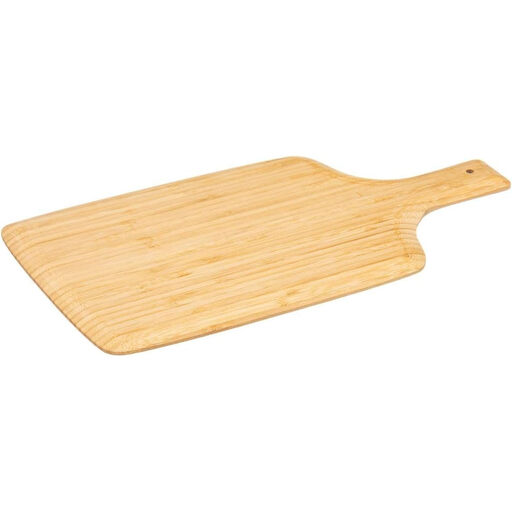
Why this product fits the profile: The 28 × 20 cm format is ideal for smaller kitchens, occasional preparation and anyone looking for a compact bamboo kitchen board.
The compact dimensions reduce the risk of buying an oversized board for a small worktop. The integrated handle makes it easier to carry.
Bamboo material, 28 × 20 cm, 1.5 cm height, handle and stated FSC certification.

Why this product fits the profile: The 45 × 30 cm board offers plenty of work surface and, according to the product information, can be used on both sides, for example for different food groups.
The juice groove addresses the problem of liquids running off. The reversible design allows you to assign different sides for different uses.
45 × 30 × 1.9 cm, juice groove, reversible design and bamboo surface.
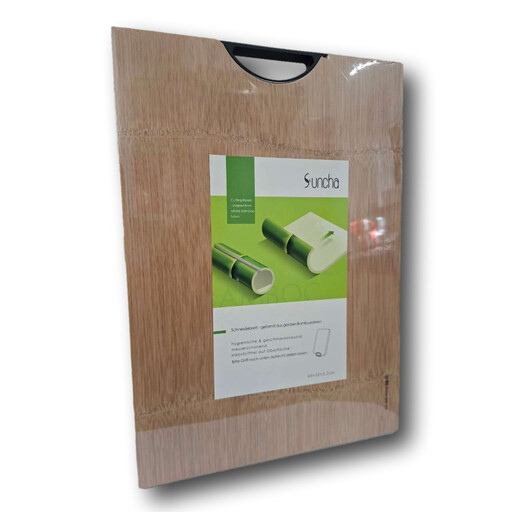
Why this product fits the profile: The large, 26 mm thick surface is designed for heavy users who want to prepare vegetables, bread, cheese or dough on a stable work area.
The greater thickness and the handle set clear standards against wobbly, too-small boards. Measure your worktop and storage space before buying.
45 × 32 cm surface, 26 mm thickness, integrated handle and combined use as a chopping or serving board.
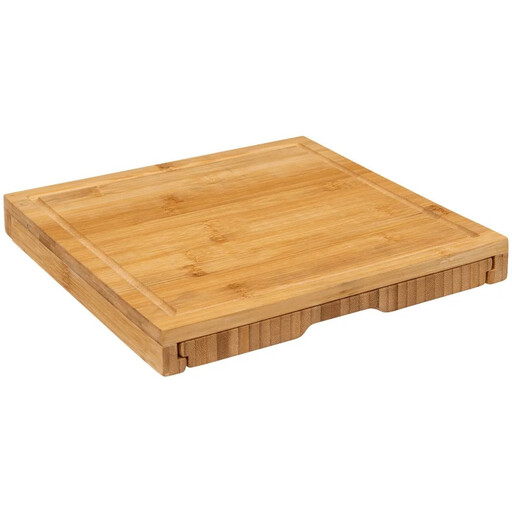
Why this product fits the profile: As a bamboo cheese board, this set is ideal for guests, snack platters and small tastings. The included cheese knives extend its intended serving purpose.
Its clear focus on serving prevents a presentation board from being mistaken for a large chopping board. According to the information, it is not dishwasher-safe.
30 × 30 cm, bamboo, storage drawer and four different cheese knives according to the product description.
We have compiled a complete, regularly updated list of products that fully meet these strict selection criteria and the safety regulations in force in the EU.
To keep your bamboo board in good shape for as long as possible, you should:
A bamboo bread board can also be used as a serving surface. For cheese, fruit and snacks, a bamboo serving board is practical, while a chopping board set can make it easier to separate different foods. Your decision should be based on how you will actually use it, rather than on as many extra features as possible.
Yes, provided the product is intended for food preparation and is thoroughly cleaned afterwards. It is advisable to use a separate board for raw meat and poultry to reduce the risk of cross-contamination in everyday kitchen use.
It is not possible to give a reliable fixed lifespan. It depends on the material construction, thickness, intensity of use and care. Hand washing, immediate drying and occasional maintenance according to the manufacturer's instructions can help extend its useful life. The dishwasher and prolonged soaking should be avoided with the models mentioned here.
Apart from the purchase price, maintenance costs are usually low. For oiled surfaces, you may occasionally need food-safe wood or mineral oil. The greater effort lies in proper hand washing and thorough drying after each use.