
Lieferung heute & morgen

Qualitätsgarantie

Willkommens-Angebote freischalten: KOSTENLOSE Lieferung | Bis zu 80 % RABATT | Kostenlose 30-Tage-JoyPlus-Testphase
App herunterladen
A bamboo chopping board might seem straightforward at first glance. However, differences in material thickness, workmanship and care can make all the difference in everyday use. A board that’s too small will slip while you’re chopping, a missing juice groove lets liquids spill onto your worktop, and a board that hasn’t been dried properly can warp over time.
If you’re looking for a bamboo kitchen board for vegetables, meat or bread, you shouldn’t just focus on looks. What really matters are clear details on dimensions, thickness, handle, surface construction and cleaning.
A large bamboo chopping board gives you more work surface, but it also needs the right material thickness. Models around 45 to 50 cm long are practical for multiple ingredients or dough work. If they’re too thin, they can feel less stable on uneven surfaces.
So pay attention to:
Bamboo is often promoted with qualities like “antibacterial” or “especially hygienic”. Such general statements don’t replace proper cleaning. For practical kitchen use, what really matters is hand washing, thorough drying and separate use for different foods.
A sturdy chopping board should be cleaned straight away with warm water and mild washing-up liquid after contact with meat or fish. If there are deep grooves, cracks or visible warping, it’s time to replace it.
A chopping board with a juice groove can catch liquid from fruit, vegetables or meat. However, the groove should be wide enough and fully enclosed. A bamboo chopping board with a handle is easier to carry and can also be used as a serving board. But the handle doesn’t automatically stop the board from slipping while you chop.
So check whether the board sits steadily on your worktop and whether the handle is a real cut-out or an attached piece.
For small kitchens or single ingredients, compact dimensions like 28 × 20 cm or 30 × 24 cm are enough. A large bamboo chopping board from around 40 cm long gives you more space for vegetables, meat and dough. Round or square boards also work well as a chopping board for serving, but they need a suitable place to sit.
Product details should clearly state whether it’s bamboo, solid bamboo or a glued or cross-laminated construction. A greater thickness can improve stability, but it also adds weight and storage needs.
With an FSC-certified chopping board, the FSC feature is explicitly stated in the product data. This is different from general claims like “eco-friendly” or “sustainable chopping board”. For an objective choice, look for specific certification details.
Most of the boards listed here are described as suitable for hand washing. Avoid soaking them for long periods, direct heat sources and the dishwasher, unless the manufacturer explicitly allows it. Dry the board upright or in a well-ventilated spot, and occasionally treat the surface with suitable food-safe oil if the instructions recommend it.
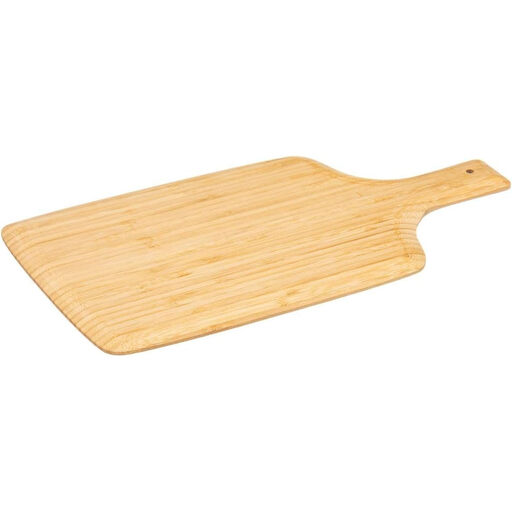
Why this product fits the profile: The compact dimensions are ideal for smaller worktops and everyday prep with fruit, vegetables, fish or meat. The integrated handle makes it easier to lift and store.
The product data gives specific dimensions of 28 × 20 × 1.5 cm, plus hand washing and occasional oil care. This makes it easier to judge the space needed before buying.
Compact format, handle and FSC marking according to the product details.
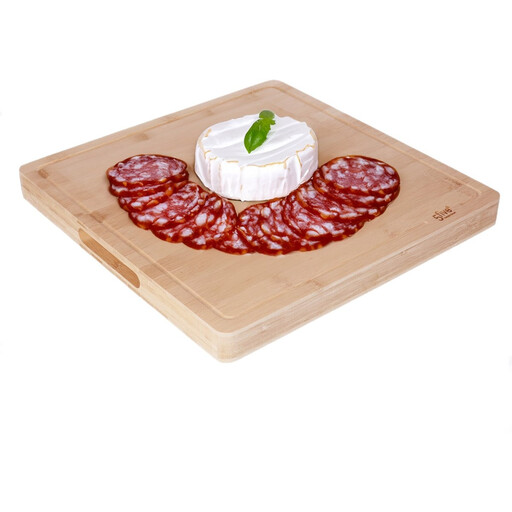
Why this product fits the profile: The square format with 3.5 cm thickness and a product weight of 2.93 kg is aimed at users who want a stable board with an additional serving function.
The details on format, thickness, weight and care are specific. The product description also explicitly lists it as a chopping, bread and presentation board.
FSC-certified bamboo according to the product details, 37 × 37 × 3.5 cm and versatile indoor use.
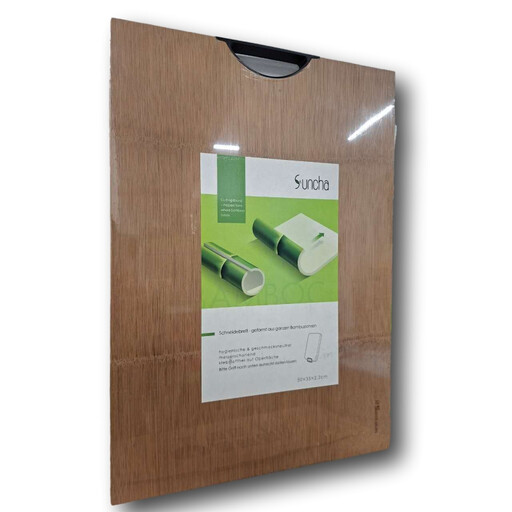
Why this product fits the profile: The work surface of 50 × 35 cm is ideal for extensive prep, dough work and chopping multiple ingredients. The integrated handle makes it easier to carry.
The 26 mm thickness and stated weight of 1.99 kg give concrete clues about handling. The care instructions rule out soaking and dishwasher cleaning.
Generous surface area, 26 mm thickness and, according to the product description, a one-piece bamboo construction with handle.
We’ve put together a full, regularly updated list of products that fully meet these strict selection criteria and the safety regulations in force in the EU.
Clean the board by hand after each use with warm water and mild washing-up liquid. Don’t leave it sitting in water, and dry both sides completely. Depending on the manufacturer’s instructions, you can occasionally apply food-safe oil. Avoid the dishwasher and direct heat unless they are explicitly allowed.
The lifespan depends on material thickness, how often you use it and how you care for it. A board without cracks or serious warping can last a long time with regular hand washing and thorough drying. Deep cut marks, splintering or persistent wobbling are reasons to replace your bamboo kitchen board.
Many models are described as suitable for vegetables, fruit and meat. However, for a hygienic kitchen routine, it’s still a good idea to use either a second board or clearly separate your work areas. After raw meat or fish, the board should be cleaned immediately and dried thoroughly.