
Lieferung heute & morgen

Qualitätsgarantie

Willkommens-Angebote freischalten: KOSTENLOSE Lieferung | Bis zu 80 % RABATT | Kostenlose 30-Tage-JoyPlus-Testphase
App herunterladen
A bamboo chopping board can be a practical alternative to plastic or thin wooden boards for everyday cooking, slicing bread and serving. However, it’s not just the “bamboo” label that matters. Dimensions, thickness, surface finish and care instructions determine whether the board stays sturdy in daily use and suits your worktop.
With budget-friendly offers especially, three common marketing pitfalls can lead to a bad buy:
For occasional use, a bamboo kitchen board around 28 × 20 cm is sufficient. It’s easy to store and works well for fruit, vegetables or small quantities. If you regularly prepare several ingredients, you’re better off choosing a size of at least 35 × 24 cm.
A large bamboo chopping board from about 45 cm in length offers more workspace for vegetables, meat or dough. However, it needs enough room on your worktop and in your kitchen cupboard. A sturdy chopping board shouldn’t just be large – it also needs to be thick enough:
Thickness doesn’t replace non-slip feet. If these are missing, a damp, non-slip mat underneath the board helps.
The term wooden chopping board made from bamboo is common in shops, but technically bamboo is a grass, not a type of wood. So other details are more relevant for your choice: Is solid bamboo mentioned? Is the board made from glued strips or a single-piece construction? Are the edges smoothly finished?
A solid bamboo board described as one piece can offer a calm, even surface. With glued models, the joints should be clean and uniform. The claim “naturally antibacterial” shouldn’t be seen as a substitute for hygienic practice. After contact with raw meat or fish, the board must be thoroughly cleaned and completely dried.
If you care about traceable origins, look for an FSC-certified bamboo board. An FSC claim should appear directly in the product information of that specific model. It’s not a general feature of every bamboo board.
A chopping board with a juice groove can partly catch liquid from juicy fruit, vegetables or meat. However, the groove isn’t a spill guard for large amounts of liquid. For bread, it’s usually less important than having a sufficiently large, smooth surface.
A chopping board with a handle is easier to carry from your prep area to the dining table and can double as a serving board. Check whether the handle is actually a cut-out or an integrated recess, and whether this reduces the usable cutting surface.
For care, the models described here all follow simple but important rules:
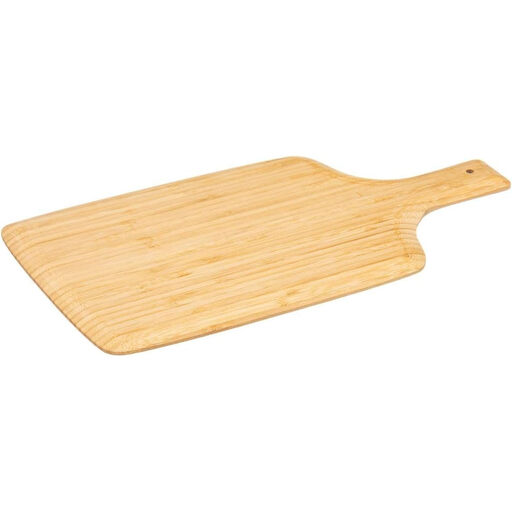
Why this product fits the profile: The compact size is ideal for smaller kitchens, quick prep and households looking for an easy-to-store bamboo kitchen board.
The product data gives specific dimensions of 28 × 20 × 1.5 cm and states hand-wash only. This makes it easier to assess the space needed and care required before buying.
Bamboo material, integrated handle and, according to the product info, FSC certification; suitable for vegetables, fruit, fish and meat.
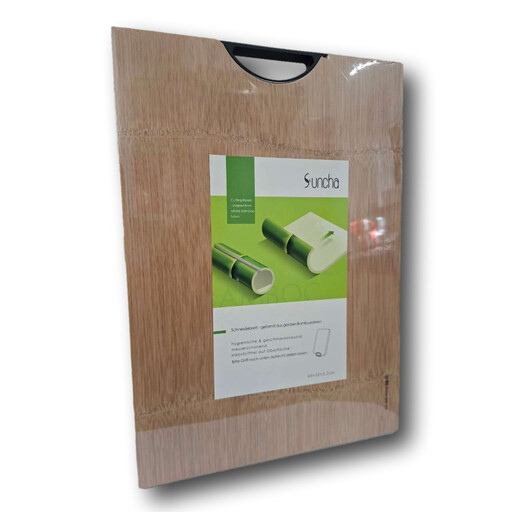
Why this product fits the profile: The large surface and 26 mm thickness are aimed at households that frequently prepare several ingredients or also use the board for serving.
At 45 × 32 cm and 26 mm, the key dimensions are clearly stated. The product description also explicitly advises hand-washing and avoiding the dishwasher.
Large work surface, 26 mm thickness and integrated handle; designed as a chopping and serving board for bread, cheese or other foods.
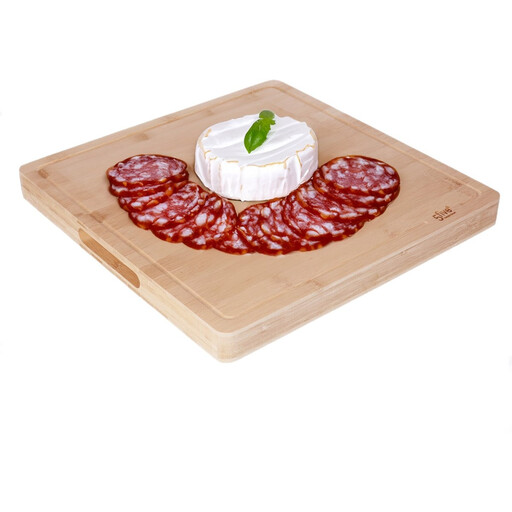
Why this product fits the profile: The square, extra-thick format is designed for larger quantities, slicing bread and presenting food at the table.
The details state 37 × 37 × 3.5 cm, a weight of 2.93 kg and its suitability as a chopping, bread and presentation board. This makes the usage and space requirements clear.
3.5 cm thickness, FSC-certified bamboo material according to the product info, and a format that also works for serving.
We’ve put together a full, regularly updated list of products that fully meet these strict selection criteria and the safety regulations in force in the EU.
Yes, provided the specific product is intended for food contact and is used hygienically. After cutting raw meat or fish, the board should be washed by hand immediately and dried completely. Using separate boards for different foods can be a good idea. Damaged or heavily cracked surfaces should not be used further.
It’s not possible to give a reliable fixed lifespan. It depends on the material quality, how intensively it’s used and how it’s cared for. Frequent soaking, the dishwasher, high heat and cutting with excessive pressure can encourage warping or cracking. Regular drying and occasional oiling according to the manufacturer’s instructions can help preserve the surface for longer.
That depends on what you’re using it for. A juice groove is handy with juicy fruit, vegetables or meat. For dough, bread and many general chopping tasks, a smooth surface usually offers more continuous usable space. If you’re looking for a bamboo bread board or bamboo serving board, you should therefore focus mainly on the size, a smooth surface and the handle design.