
Lieferung heute & morgen

Qualitätsgarantie

Willkommens-Angebote freischalten: KOSTENLOSE Lieferung | Bis zu 80 % RABATT | Kostenlose 30-Tage-JoyPlus-Testphase
App herunterladen
A bamboo chopping board can be used for a wide range of tasks, from cooking and baking to serving. However, eye-catching product claims don't automatically lead to the right purchase decision. What really matters are the dimensions, craftsmanship, care instructions and your specific intended use.
Bamboo grows quickly and is therefore often marketed as a sustainable material. On its own, though, that tells you very little about its origin, the adhesives used, the manufacturing process or the packaging. If you care about environmental factors, you should look for concrete information about the material's source and how it's processed. When such details are missing, it's only possible to make a limited assessment of its sustainability.
A compact kitchen board might fit neatly into small drawers, but it offers very little space when you're chopping vegetables, bread or meat. For a family or regular meal prep, formats around 30 × 20 cm can quickly feel cramped. A large chopping board measuring at least 40 cm in length gives you more room to manoeuvre, but it also needs a suitable worktop and storage space.
A bamboo chopping board with a juice groove can catch liquid when you're cutting fruit, vegetables or meat. However, the groove doesn't replace hygienic cleaning and won't prevent potential cross-contamination between foods. What's more, many bamboo boards are not dishwasher-safe. Soaking them for long periods, exposing them to high heat or storing them while still too wet can lead to warping or cracking.
Bamboo isn't a classic solid wood; in many products, it's made from glued strips. So look for a smooth, even surface with no open joints or sharp edges. Claims like "100% bamboo" describe the raw material, but they don't automatically tell you anything about the glue used or the exact construction.
A wooden chopping board made from beech, acacia or other types of wood could be an alternative. When choosing, it's not just the material name that counts, but also the thickness, surface quality and care instructions. If you're looking for a sustainable chopping board, you should also check for verifiable origin or certification details.
For everyday kitchen tasks, these guidelines are useful:
The external dimensions should fit your sink, worktop and existing drawer. A chopping board with a handle is easier to carry and can double as a serving board. With a board without a handle, the usable cutting surface can be larger instead.
A juice groove is particularly handy for water-rich foods or when carving meat. A reversible surface allows you to better separate cutting areas. For raw animal products and ready-to-eat ingredients, it's generally advisable to use either a separate board or to clean the surface thoroughly in between.
A bamboo chopping board set with multiple sizes can be useful if you're preparing different foods at the same time. An integrated drip tray or a storage drawer can also help with organisation, but they don't replace hygienic working practices.
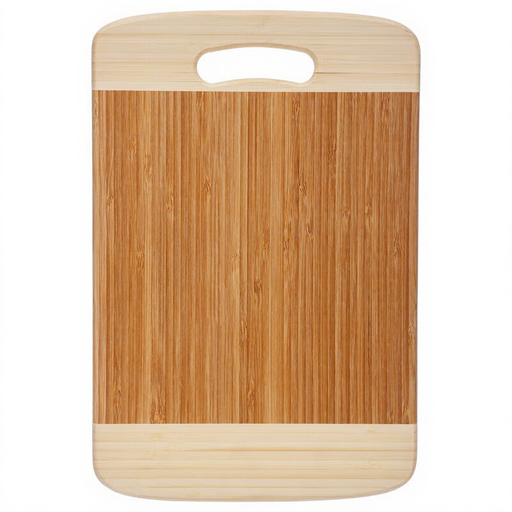
Why this product fits the profile: The compact size is ideal for small kitchens, shared flats and student accommodation. The integrated handle makes it easier to carry and store.
The dimensions are clearly stated, preventing an oversized purchase for limited work surfaces. The care instructions recommend hand washing and thorough drying.
30 × 20 cm, bamboo material and integrated handle; suitable for everyday cutting tasks.

Why this product fits the profile: The large format offers plenty of space for extensive meal prep. The stated juice groove and reversible construction expand its practical uses.
The 45 × 30 cm surface reduces the lack of space when cutting. The juice groove addresses spilled liquids, while separate sides allow for clearer separation.
Large rectangular format, juice groove, reversible function and bamboo surface; according to product details, intended for cutting and serving.

Why this product fits the profile: Three sizes, juice grooves and handles make this set suitable for households that cook regularly and want to separate cutting and serving tasks.
The different sizes prevent a single board from being too small or too unwieldy for every task. The product details still recommend hand washing.
Set of three sizes, integrated juice grooves and handles; according to the supplier, made from carbonised bamboo.
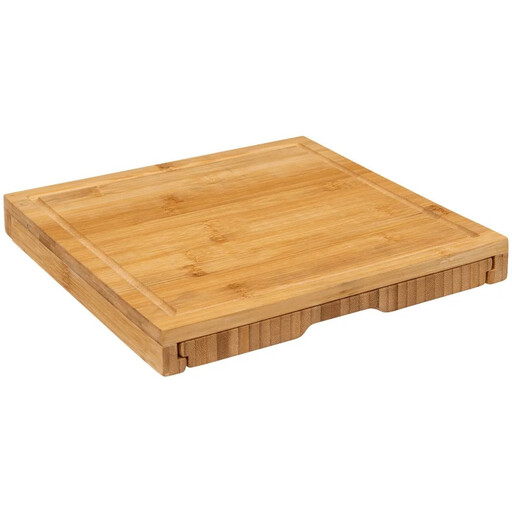
Why this product fits the profile: The 30 × 30 cm cheese board with four cheese knives is designed for arranging and sharing food with guests.
Its function is clearly aimed at cheese, bread and snacks. The product details explicitly state that the board is not dishwasher-safe.
30 × 30 cm, bamboo material, storage drawer and four cheese knives; can be used as a cheese board and serving board.
Whether you're looking for a bamboo bread board, a kitchen board for daily prep or a serving board for guests, you should always match the product description to your own habits. A drip system can improve your workflow, while a simple board is often easier to clean and store.
We've put together a complete, regularly updated list of products that fully meet these strict selection criteria and the safety regulations in force in the EU.
Hygiene depends mainly on cleaning, drying and the condition of the surface. Bamboo is not a substitute for proper kitchen hygiene. If the board develops cracks or deep knife marks, it should be replaced.
It's impossible to give a fixed lifespan. Gentle hand washing, quick drying and appropriate care can help extend its useful life. The dishwasher, prolonged soaking and extreme temperature changes can put more strain on the material.
For raw meat, a board that's easy to clean, large enough and has a juice groove is practical. Even more important is separating raw and ready-to-eat foods. A set with multiple boards can make this organisation easier.