
Lieferung heute & morgen

Qualitätsgarantie

Willkommens-Angebote freischalten: KOSTENLOSE Lieferung | Bis zu 80 % RABATT | Kostenlose 30-Tage-JoyPlus-Testphase
App herunterladen
A bamboo chopping board can be practical for everyday cooking, baking and serving. However, claims such as “particularly robust”, “antibacterial” or “sustainable” are not always enough to assess a product’s quality. What matters are verifiable details: dimensions, material, thickness, care instructions and construction features.
The external dimensions do not always show how much space is actually available for chopping. A bamboo chopping board with a handle can be easy to carry and hang up, but the handle reduces the usable surface. For bread, large vegetables or several ingredients, a large chopping board measuring at least around 40 cm in length is often more practical.
The space available in your kitchen should also be taken into account. A board measuring 50 cm in length needs sufficient room on the worktop and a suitable storage solution.
Thickness affects weight and stability. An extra-thick chopping board is generally more stable, but is heavier to move and needs more storage space. Thinner models may be sufficient for bread or occasional serving.
When choosing a board, shoppers should therefore look beyond promotional descriptions and check the specific measurement in millimetres. Examples from the product selection range from 8.5 mm for a lightweight model to 35 mm for an especially solid board.
Bamboo and wooden products are not automatically suitable for the dishwasher. Prolonged soaking, high heat and permanently damp storage can warp the material or encourage cracks. A wooden chopping board should be allowed to dry completely after cleaning.
Caution is also advisable with blanket hygiene claims. A smooth surface and correct cleaning do not replace good kitchen practice. Separate boards can be useful for raw meat, fish, vegetables and bread. Damaged or heavily scored surfaces should no longer be used.
Bamboo grows quickly and is therefore often marketed as a sustainable chopping board. However, the material description alone does not prove the sustainability of the entire supply chain or a specific environmental benefit. Verifiable certifications such as FSC are more meaningful, provided they are expressly stated for the product in question.
The construction and surface should also be considered for bamboo boards. Multi-layer or glued constructions may differ from a board made from one piece. Shoppers should check whether information is provided about adhesives, coatings and suitability for contact with food.
The right size depends on how the board will be used:
A kitchen chopping board should also sit securely without slipping. If it does not have non-slip feet, a damp kitchen mat or non-slip cloth can be used underneath.
A chopping board with a juice groove can collect liquid from juicy foods. The groove is particularly useful when cutting fruit, tomatoes or meat. However, it does not remove the need to clean the board immediately after use.
An integrated handle makes the board easier to carry and hang up. A chopping board set with several sizes can make it easier to keep different foods separate. Before buying, check whether the set actually contains three boards or just one board with accessories.
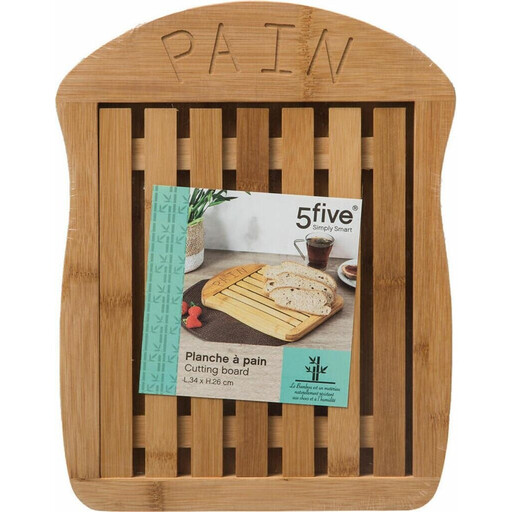
Why this product suits the profile: Its compact dimensions are suitable for smaller kitchens, breakfast preparation and everyday bread cutting.
The clearly stated surface area of 34 × 26 cm makes the size easy to assess and prevents a choice based on vague size descriptions.
Bamboo construction and handy dimensions; suitable as a bamboo bread board for simple everyday tasks.

Why this product suits the profile: The square surface and stated thickness of 3.5 cm provide plenty of room for preparation and presentation.
The documented FSC information and clearly stated thickness are verifiable criteria, rather than a blanket claim about sustainability or stability.
FSC-certified bamboo according to the product information; 37 × 37 cm surface and 3.5 cm height.
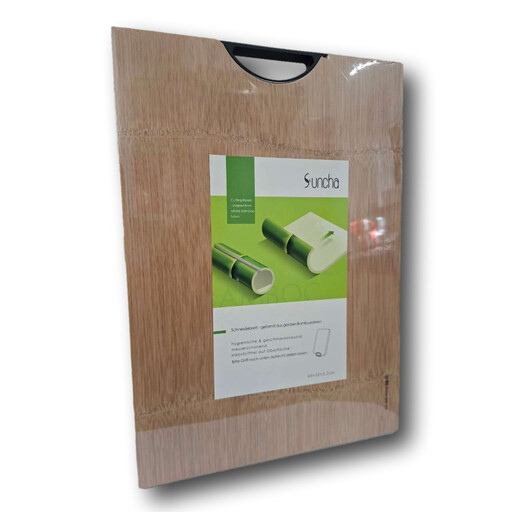
Why this product suits the profile: The format provides a large working surface, while the integrated handle makes it easier to carry, store and use as a serving board.
The dimensions and thickness are clearly stated. The handle is identifiable as a specific feature, rather than being described merely as a general convenience.
45 × 32 cm surface, 26 mm thickness, integrated handle and dual use for chopping and serving.
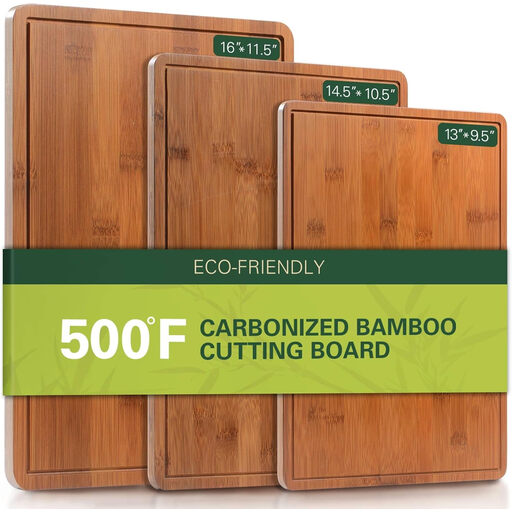
Why this product suits the profile: Three sizes are suitable for different preparation and serving tasks in a frequently used household.
The set contents, three sizes, juice grooves and handles are described specifically. This allows you to check the actual contents before buying.
Three boards with integrated juice grooves and handles; suitable for chopping and serving.
We have put together a complete, regularly updated list of products that fully meet these strict selection criteria and the safety regulations applicable in the EU.
It is not possible to give a reliable fixed lifespan for every model. This depends on the material thickness, frequency of use, knife use and care. Regular drying, avoiding soaking and occasional oiling can help extend its service life. The board should be replaced if cracks or splinters appear.
In principle, the boards mentioned may be intended for general kitchen tasks. For raw meat and fish, a separate board is recommended for hygiene reasons. Thorough cleaning and complete drying are required after use. The relevant product instructions take precedence.
Both materials can be suitable for chopping and serving. Bamboo is often chosen because of its low material weight and available certification information. Woods such as beech, acacia and walnut differ in colour, hardness, weight and care requirements. For your buying decision, the specific construction, dimensions and intended use therefore matter more than the material description alone.