
Lieferung heute & morgen

Qualitätsgarantie

Willkommens-Angebote freischalten: KOSTENLOSE Lieferung | Bis zu 80 % RABATT | Kostenlose 30-Tage-JoyPlus-Testphase
App herunterladen
A bamboo chopping board can be used for a wide range of food preparation, chopping and serving tasks. However, kitchen boards vary considerably in dimensions, thickness, surface treatment and care requirements. If you focus only on a natural appearance or sweeping marketing claims, you may end up buying a board that is too small, slips around or warps after a short time.
This buying guide explains which features matter before you buy and which model suits different kitchen needs.
A board may look generously sized in product photos but leave little room in practice for vegetables, a knife and a bowl. For families or preparing several ingredients, formats from around 40 × 28 cm are more comfortable. A rectangular chopping board measuring 45 x 30 cm, for example, provides a clearly usable surface, but it also requires sufficient storage space and a worktop that is large enough.
A chopping board with a juice groove catches liquid when cutting juicy fruit, roasts or tomatoes. For bread, dough and dry ingredients, however, the groove can reduce the usable surface area. Also check whether the groove is wide and deep enough and can be brushed clean easily.
Bamboo and other types of wood are affected by prolonged contact with water, high heat and sudden changes in temperature. Even a robust chopping board should therefore generally be washed by hand, dried immediately and stored upright. Claims such as “hygienic” or “long-lasting” are no substitute for specific care instructions. Dishwasher suitability should only be assumed if it is expressly stated in the manufacturer’s information.
Bamboo is a fast-growing raw material and is often processed into glued boards or boards made from several layers. The surface should be smooth, free from splinters and intended for contact with food. Look for complete information about the material, the manufacturer or responsible person in the EU, and care.
A wooden chopping board made from beech, walnut or acacia can also provide a suitable work surface. However, wood types differ in weight, grain and how they react to moisture. For protecting your knives, hard materials such as glass or stone are generally less suitable than an appropriate wood or bamboo surface. “Knife-friendly” does not mean that a knife will stay sharp permanently; regular sharpening and suitable cutting technique are still required.
Thickness affects weight and stability. For everyday chopping, models measuring around 17 to 26 mm are often more stable than very thin boards. A thicker wooden or bamboo chopping board usually sits more securely on the worktop, but is heavier to carry.
Look for:
A large bamboo chopping board is suitable for vegetables, bread and larger ingredients. For small kitchens or individual tasks, a format of around 30 × 20 cm may be more practical. A chopping board with a handle is easier to carry from the worktop to the dining table and can be hung up to save space.
For raw meat and fish, a separate board or clearly separate use is recommended for hygiene reasons. A reversible board can make this organisation easier, but does not replace thorough cleaning between uses. Wherever possible, use different sides or separate kitchen boards for raw animal products and ready-to-eat ingredients.
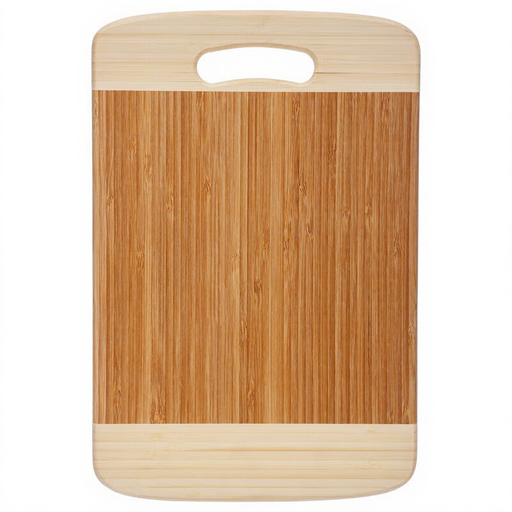
Why this product suits this profile: The compact format is ideal for smaller kitchens, single-person households and simple everyday chopping tasks. The integrated handle makes it easier to carry and store.
The dimensions are clearly stated, avoiding unrealistic expectations of an especially large worktop board. Hand washing should be factored in.
30 × 20 cm, bamboo construction and an integrated handle; suitable for basic kitchen tasks and serving.

Why this product suits this profile: The rectangular format combines plenty of workspace with moderate thickness. It is suitable for food preparation and can also be used as a bamboo serving board.
The product details specify 45 × 30 × 1,9 cm, a juice groove and a reversible design. This makes it easier to assess the intended uses and the space required.
Bamboo surface, juice groove, reversible design and a large rectangular work surface; hand washing according to the care instructions.
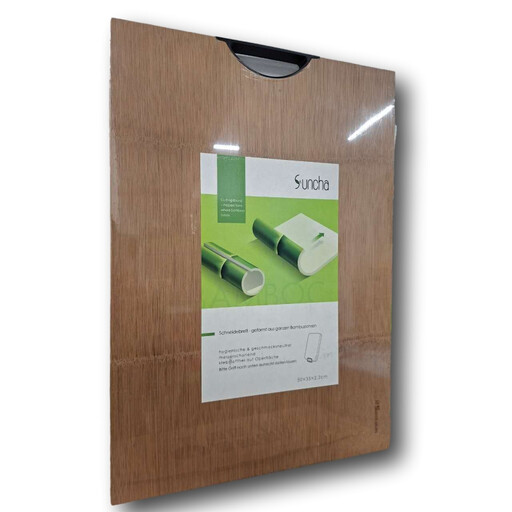
Why this product suits this profile: The extra-large surface is designed for families, keen home cooks and anyone who needs plenty of space for chopping, rolling out dough or preparing several ingredients.
At 50 × 35 cm and 2,6 cm thick, the key measurements are clearly stated. Because of its greater weight, you should check your worktop and storage space in advance.
Bamboo, 50 × 35 × 2,6 cm, an integrated handle and, according to the product details, suitability for chopping and dough preparation.
Clean the board after every use with warm water and a mild cleaning product. Do not leave it standing in the sink, and dry both sides thoroughly. Storing it upright helps it dry evenly.
The following points are also important for extending its service life:
Using a separate board for bread and vegetables and another for raw meat and fish can make your kitchen routine more organised. This helps prevent residue from being transferred between different food groups.
We have put together a complete, regularly updated list of products that fully meet these strict selection criteria and the safety regulations applicable in the EU.
Yes, provided it is expressly intended for food preparation. Clean and dry the board thoroughly immediately afterwards. For raw animal products, a separate board or a separate side is advisable.
It is not possible to give a reliable fixed lifespan. This depends on the board’s thickness, construction, use and care. Deep cut marks, cracks, splinters, mould or permanent warping are signs that it should be replaced.
Not every model requires oil. The relevant manufacturer’s instructions are decisive. If care with food-safe oil is recommended, the board should be clean and completely dry beforehand. Oiling does not replace daily cleaning or avoiding prolonged contact with water.