
Lieferung heute & morgen

Qualitätsgarantie

Willkommens-Angebote freischalten: KOSTENLOSE Lieferung | Bis zu 80 % RABATT | Kostenlose 30-Tage-JoyPlus-Testphase
App herunterladen
A bamboo chopping board can be used in many ways when cooking every day, slicing bread and serving cheese. However, attractive product images and claims such as “antibacterial”, “sustainable” or “extra robust” do not automatically lead to the right purchasing decision. What matters are clear details about dimensions, material construction, stability and care.
Bamboo is often marketed as a naturally hygienic material. However, the material itself does not make a kitchen board germ-free. Cleaning after every use, thorough drying and the condition of the surface are what matter. Deep cracks, heavy knife marks or swollen areas can make cleaning more difficult.
An antibacterial chopping board should therefore not be chosen based on this marketing claim alone. Instead, check whether it comes with specific care instructions, has a smooth surface and provides clear information about food contact.
A large bamboo chopping board offers plenty of workspace, but if it is not thick enough, it may slide around on the worktop or warp when exposed to moisture. Measurements such as 45 × 32 cm or 50 × 35 cm only become meaningful when considered alongside the thickness. The weight can also indicate how securely the board will sit.
Many bamboo or wooden boards are not suitable for the dishwasher. Heat, prolonged exposure to moisture and strong cleaning products can cause warping, cracks or a rough surface. A high-quality wooden chopping board will only remain usable for a long time if its care requirements suit your household.
Botanically speaking, bamboo is not wood, but it is used in much the same way for kitchen boards. Pay attention to the specific material description: “bamboo”, “solid bamboo” and a laminated bamboo construction do not necessarily describe the same structure. With a one-piece model, the construction is easy to understand. For laminated boards, the surface and edges should be finished evenly.
A sustainable chopping board cannot be assessed by its material alone. Its origin, manufacturing quality, durability and the possibility of using it for an extended period are also relevant. General environmental claims without further information should not be the sole reason for buying.
A medium-sized board is often sufficient for preparing vegetables every day. If you prepare large quantities, roll out dough or are looking for a bread chopping board, a larger work surface can be useful. Practical guidelines include:
A round chopping board can also be used as a serving surface, but it requires different storage on the worktop from a rectangular model.
A chopping board with a handle is easier to carry from the preparation area to the dining table and can be used as a serving board. For large, heavy boards, the handle should be sufficiently wide and sturdy.
A juice groove is useful if you often cut juicy fruit, meat or roasts. It catches liquid around the edge, but does not replace separate cleaning. It is not essential for bread, cheese and dry ingredients.
If you prepare raw animal products and vegetables on the same kitchen board, you should use separate boards or clearly separated sides for hygiene reasons. A reversible design can make this separation easier, provided the surfaces are marked accordingly or consistently used separately.
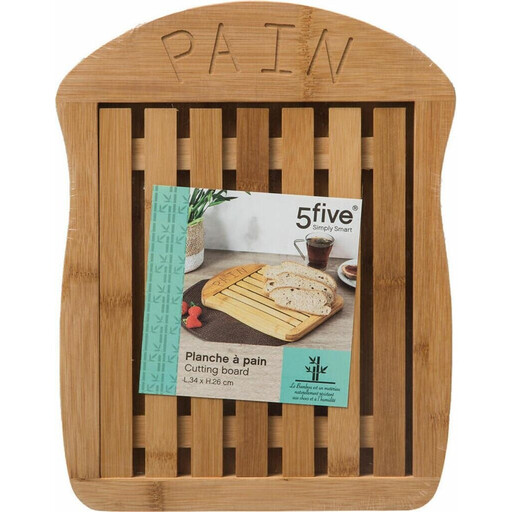
Why this product suits this profile: Its size is ideal for smaller kitchens and everyday chopping tasks, without taking up much storage space.
The stated size makes the available work surface clear and reduces the risk of buying a board that is too large for a small worktop.
Bamboo construction and a practical rectangular format for bread, vegetables and smaller portions.

Why this product suits this profile: The large format combines a chopping surface with serving functionality for family households and entertaining.
The product description explicitly lists the dimensions, material, juice groove and hand-washing requirement, rather than making only general claims about stability.
45 × 30 cm, juice groove and reversible use according to the product details; designed for hand washing.

Why this product suits this profile: Three sizes allow separate use for vegetables, meat, bread, or serving cheese and charcuterie.
Having several sizes reduces the need to use a single board for every task. The juice grooves and handles are clearly specified.
Set of three formats with integrated juice grooves and handles; according to the product details, suitable for hand washing only.
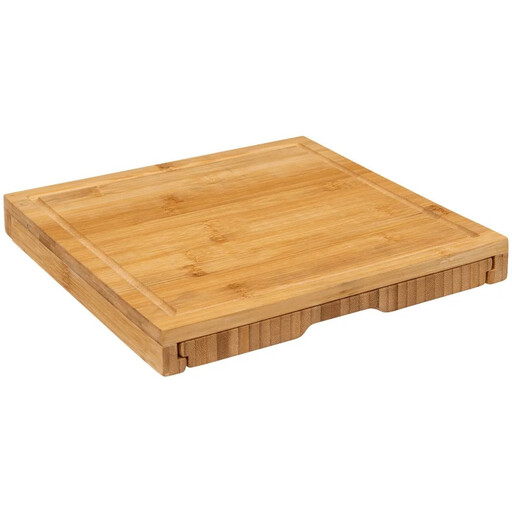
Why this product suits this profile: The 30 × 30 cm cheese board with four cheese knives is designed for serving directly at dinner parties and gatherings.
The fixed product size and included accessories make it clear that this is primarily a serving and cheese board, rather than an extra-large preparation board.
Bamboo construction, four cheese knives and integrated storage drawer according to the product description.
A bamboo or wooden chopping board should be cleaned with warm water and mild washing-up liquid after use. It should then be dried with a tea towel and left upright to air-dry completely. Avoid:
When the surface is dry, a suitable food-safe care oil can occasionally be applied, provided the manufacturer recommends this. As soon as clear cracks, splinters, mould or severe warping appear, the board should no longer be used for contact with food.
We have put together a complete, regularly updated list of products that fully meet these strict selection criteria and the safety regulations applicable in the EU.
Bamboo can offer a smooth, dense surface, but it is not automatically more hygienic. Cleaning, drying and the condition of the board are decisive. When choosing, specific material and care information should carry more weight than blanket marketing claims.
It is not possible to give a reliable fixed lifespan. It depends on the material thickness, frequency of use, pressure applied with knives and care. Hand washing, drying immediately after use and regularly checking the surface can help extend its service life. Cracks and severe warping are reasons to replace it.
A chopping board set is useful if you need different sizes or separate work surfaces. Small boards are suitable for fruit and herbs, while larger models are better for bread, vegetables or meat. However, if you mainly need a serving board, cheese board or charcuterie board, a single suitable model may be enough.