
Lieferung heute & morgen

Qualitätsgarantie

Willkommens-Angebote freischalten: KOSTENLOSE Lieferung | Bis zu 80 % RABATT | Kostenlose 30-Tage-JoyPlus-Testphase
App herunterladen
A bamboo chopping board may seem straightforward at first glance: it should be sturdy, kind to knives and easy to clean. In practice, however, material claims, unsuitable dimensions and incorrect care often lead to disappointing purchases. Hobby cooks, families and environmentally conscious households in particular should check whether a bamboo kitchen board suits their everyday cooking needs before buying.
Bamboo is a plant-based material, but a bamboo board remains sensitive to standing water and high temperatures. If it is regularly soaked or cleaned in the dishwasher, the material may warp, swell or develop cracks. A smooth surface alone is therefore not enough to indicate quality.
A large wooden or bamboo chopping board provides plenty of space for vegetables, meat and bread. However, it also requires sufficient worktop and storage space. For small kitchens, a compact board with a handle may be more practical. If you often prepare larger ingredients, on the other hand, you will benefit from a longer and wider cutting surface.
A chopping board with a juice groove can collect liquid when cutting juicy foods. However, the groove is no substitute for hygienically separating different foods. A handle makes the board easier to carry, but depending on its design, it may reduce the available cutting surface. The key question is whether the board is actually intended for chopping, cutting or serving.
Bamboo usually consists of strips glued together. Look for:
The description sustainable chopping board should not be judged solely by the marketing claim. Bamboo grows relatively quickly, but its origin, processing, adhesive and transport are also relevant factors. If information about the material composition or care is missing, price comparisons are only of limited value.
For everyday use, dimensions of around 30 to 45 cm in length are often practical. A board measuring 45 × 30 × 1,9 cm, for example, provides plenty of space for vegetables, bread or larger pieces. Smaller formats are easier to store and are suitable for fruit, herbs or snacks.
Thickness affects stability and weight. Thin boards are light, but may slide around more easily. A thicker butcher’s block is generally more stable, but is heavier and takes up more space.
Bamboo is sometimes marketed as an antibacterial chopping board. This description should not be taken as a guarantee of hygienic performance. What matters is cleaning the board after every use, drying it thoroughly and using separate boards for raw animal products, vegetables and bread.
A chopping board set is practical when several boards are intended for different foods. Visible labelling or an established system for using each board can help prevent cross-contamination at home. Always follow the care instructions provided by the manufacturer.
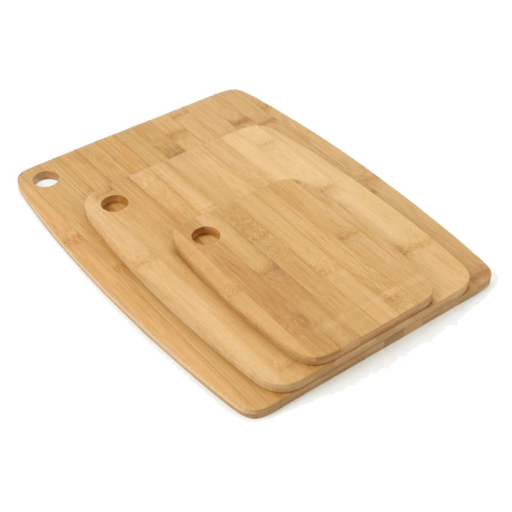
Why this product suits this profile: Three rectangular sizes measuring 20 × 15 cm, 30 × 23 cm and 38 × 28 cm cover everything from small preparation tasks to larger chopping jobs. According to the product description, the boards can also be used for serving.
The set reduces the risk of using a board that is the wrong size for each task. The different dimensions also make it easier to use the boards separately.
Three sizes; bamboo material; suitable for preparation and serving.

Why this product suits this profile: This large wooden chopping board provides a 45 × 30 cm surface, a surrounding juice groove and a reversible design. According to the product description, one side can be used for raw animal products and the other for vegetables or bread.
The dimensions are clearly stated and the juice groove is described as a specific feature. The reversible design supports assigning each side to different types of food.
45 × 30 cm; 1,9 cm thick; juice groove; reversible design; hand wash according to the care instructions.

Why this product suits this profile: The set includes three XL sizes and combines juice grooves with integrated handles. It is therefore suitable for households that regularly prepare and chop ingredients, then serve food straight away.
The clearly stated sizes prevent a single small board from being used for extensive preparation work. The handles also make the boards easier to carry.
Three sizes; integrated juice groove; handle; hand wash and thorough drying according to the product information.
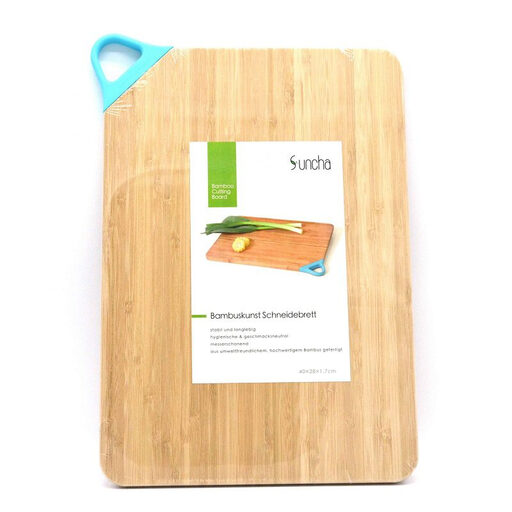
Why this product suits this profile: This bamboo chopping board with handle measures 40 × 28 cm and is 17 mm thick. The handle makes it easier to carry the board from the worktop to the sink or dining table.
The dimensions and thickness are clearly stated. This allows you to check before buying whether the surface area and weight are suitable for your available worktop.
40 × 28 cm; integrated handle; 17 mm thick; bamboo material.
A bamboo wooden chopping board should be cleaned with warm water and a mild cleaning product after every use, then dried thoroughly. Avoid:
When the surface is dry, you can occasionally apply a food-safe oil suitable for kitchen boards. If the board becomes cracked, splintered or badly warped, it should be replaced for hygienic and practical reasons.
We have put together a complete, regularly updated list of products that fully meet these strict selection criteria and the safety regulations applicable in the EU.
Yes, provided it is intended for food use and is cleaned and dried thoroughly after use. For greater peace of mind, use a separate side of the board or a separate board for raw meat, poultry and fish.
Its service life depends on the material thickness, bonding, level of use and care. Regular soaking and dishwasher cleaning can shorten its lifespan. If you notice visible cracks, severe warping or splinters, the board should no longer be used.
A juice groove is useful if you often cut tomatoes, citrus fruit, meat or other juicy foods. It collects liquid around the edge. For dry ingredients or small kitchen tasks, a simple bamboo kitchen board without a groove is often lighter and more space-saving.