
Lieferung heute & morgen

Qualitätsgarantie

Willkommens-Angebote freischalten: KOSTENLOSE Lieferung | Bis zu 80 % RABATT | Kostenlose 30-Tage-JoyPlus-Testphase
App herunterladen
A bamboo cutting board has become a staple in many kitchens, prized for its natural aesthetic, durability, and sustainable properties. However, not every bamboo cutting board lives up to its promise. Many buyers find that after a short time, their new board warps, cracks, or dulls their knife blades faster than expected.
As your Joybuy Product Recommendation Officer, I'm here to help you separate the wheat from the chaff. In this guide, I'll show you the most common pitfalls to avoid and the critical features to look for to find a durable and functional addition to your kitchen.
Before you make a decision, it's important to understand the typical flaws found in low-quality products. These issues often lead to frustration and can render the board unusable.
A good bamboo cutting board is engineered to prevent these exact problems.
To avoid a bad purchase, you should focus on three key technical aspects. These determine the board's longevity, functionality, and safety.
The way the bamboo is processed is fundamental. There are two main differences here:
Another quality indicator is carbonisation. This process involves heat-treating the bamboo at high temperatures. According to manufacturers like VVM, this process can increase hardness and reduce moisture absorption, which improves the board's dimensional stability.
A large cutting board or a carving board must lie completely flat on the work surface. A wobbly board is not only annoying but also a safety hazard. Stability is largely determined by thickness.
Practical details make all the difference in daily kitchen use:
We have selected products from our range that, based on their objective features, offer a suitable solution for different user profiles.

Why This Fits Their Persona: This cutting board set offers three different sizes for maximum flexibility—from quickly chopping an onion to arranging a large cheese platter. Ideal for people who love to entertain and want the right board on hand for any task, which also looks great as a bamboo serving board.
The carbonisation at 500°F (according to the manufacturer) and the cross-laminated core counteract warping and cracking caused by moisture.
Set of three sizes for various tasks. Each board features an integrated juice groove and handles for clean and easy handling.
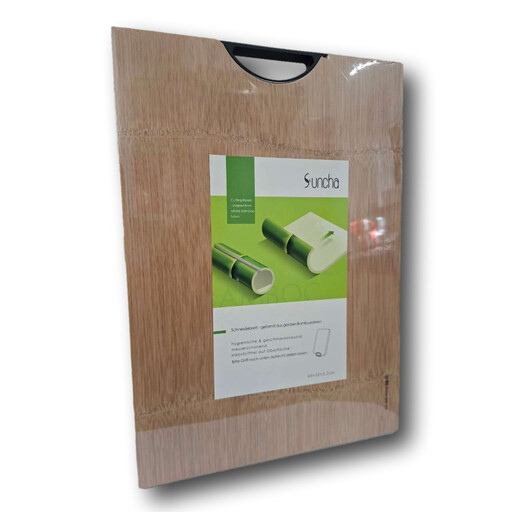
Why This Fits Their Persona: Anyone who regularly chops large quantities of vegetables, carves a roast, or rolls out dough needs a large cutting board. This model offers a massive work surface that can handle demanding tasks and serves as a sturdy carving board.
The massive thickness of 26 mm provides substantial weight and extreme dimensional stability. This prevents the typical wobbling and warping that occurs with thinner boards.
Extra-large work surface (45 x 32 cm) and high material thickness for maximum stability. The integrated handle makes managing the heavy board easier.
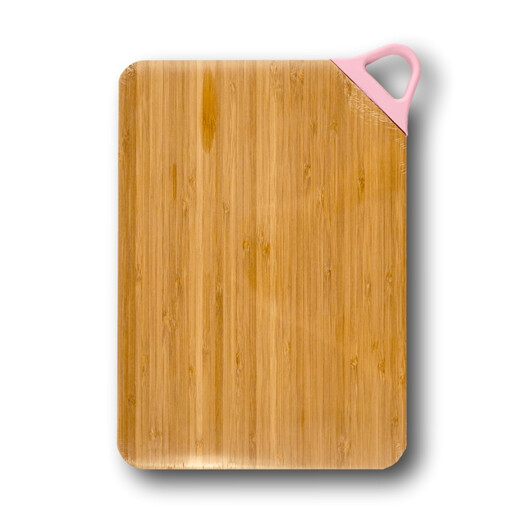
Why This Fits Their Persona: For daily, straightforward kitchen tasks—like chopping vegetables for a salad or making a sandwich—a handy and easy-to-clean board is ideal. This model offers just that in a compact size that fits in any kitchen.
Thanks to its solid construction and smooth surface, the risk of deep cut marks is minimised, which improves hygiene compared to porous, low-cost boards.
Compact and manageable size (34 x 24 cm). The cutting board with handle is easy to store and is ideal for quick, everyday cutting tasks.
A good cutting board is an investment in your kitchen. If you'd like to compare more models that meet our criteria for stability and durability, you can find a comprehensive selection here.
Proper care is crucial for longevity. Clean the board by hand after use with warm water and a mild dish soap. It's important to never let it soak in water or clean it in the dishwasher. Dry it immediately with a cloth after rinsing and let it air dry completely in an upright position. To keep the material supple and prevent it from drying out, it's recommended to treat the board with a food-safe mineral oil every few weeks.
Botanically, bamboo is a grass and has a higher density and hardness than many traditional woods like maple or beech. A very hard bamboo cutting board can potentially dull a knife blade faster than a softer wooden cutting board. However, high-quality bamboo boards with a smoothly finished, slightly yielding surface offer a good compromise between durability and being knife-friendly. Ultimately, the quality of the surface finish is more critical than the material alone.
Look for a dense, non-porous, and smooth surface. Run your finger over the board: it should feel even and free of any noticeable seams or rough spots. A solid construction and sufficient thickness prevent deep cuts from forming during normal use, where bacteria could settle. Boards made from a single piece of bamboo often have an advantage here, as they lack glue seams that could be potential weak points.