
Lieferung heute & morgen

Qualitätsgarantie

Willkommens-Angebote freischalten: KOSTENLOSE Lieferung | Bis zu 80 % RABATT | Kostenlose 30-Tage-JoyPlus-Testphase
App herunterladen
A good cutting board is the foundation of any kitchen. The bamboo cutting board, in particular, has become a staple in many households due to its unique properties. However, the market is crowded, and not every board lives up to its promises. Before you make a decision, it's crucial to understand the typical weaknesses that often only become apparent after a few weeks of use and lead to a bad buy.
As your Joybuy Product Recommendation Officer, I'm here to help you separate the wheat from the chaff. We'll look at the three common pitfalls you should be aware of and the objective criteria that truly matter when making your selection.
At first glance, many cutting boards look sturdy and high-quality. The disappointment often follows later. Watch out for these three common problems:
To avoid a purchase you'll regret, you should focus on verifiable features. These three parameters are crucial for the longevity and functionality of your kitchen board.
The manufacturing method is a key indicator of quality.
The dimensions determine the board's use case. A large cutting board (e.g., 40 x 30 cm) is essential for preparing full meals. For smaller tasks like chopping herbs or a lemon, a smaller board will suffice. A cutting board set offers flexibility here.
Look for a thickness of at least 1.8 cm. Thicker boards are more dimensionally stable, lie more securely on the countertop, and provide a more solid work surface.
These two features significantly enhance practical usability:
Based on these objective criteria, we have identified several products that represent a smart choice for different user profiles and requirements.
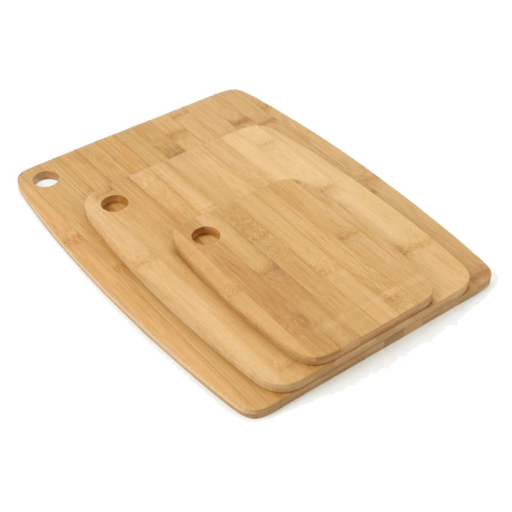
Why This Fits Their Persona: Ideal for students or a first apartment. This bamboo cutting board set offers three different sizes (small, medium, large), covering all basic cutting tasks without breaking the bank.
The set allows for the hygienic separation of foods (e.g., one board for meat, one for vegetables), which is an often-overlooked practical aspect that prevents cross-contamination.
Three sizes for maximum flexibility. Excellent value for money for a first kitchen setup.
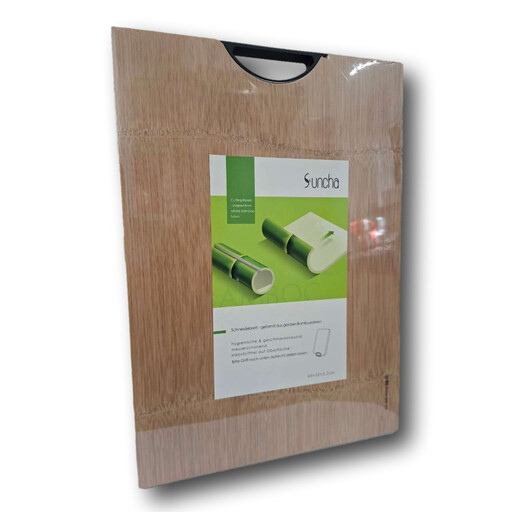
Why This Fits Their Persona: Anyone who cooks fresh meals daily needs a large, reliable work surface. This extra-large cutting board with a thickness of 26 mm provides the necessary stability and space for demanding tasks like carving a roast or chopping large quantities of vegetables.
The massive, thick construction actively prevents warping and slipping—a direct counter to the problem of unstable, thin boards. The integrated handle solves the issue of impractical handling.
Very large work surface (45 x 32 cm) and substantial thickness (2.6 cm) for maximum stability. Made from solid bamboo.
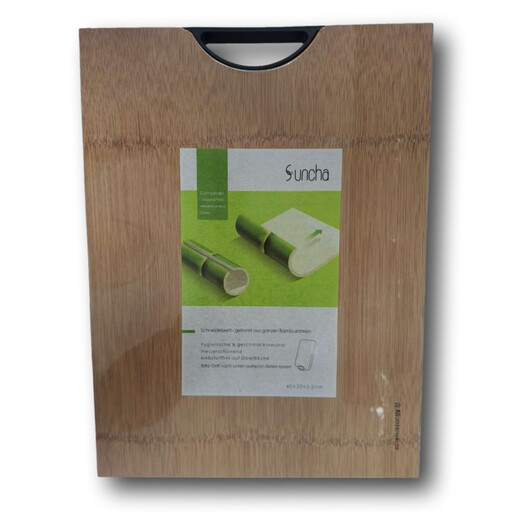
Why This Fits Their Persona: For users who value exceptional craftsmanship, sustainability, and a flawless aesthetic. According to the manufacturer, this bamboo kitchen board is crafted from a single piece of bamboo and has no adhesive on its surface.
It directly addresses the pitfall of inferior lamination by offering a seamless, adhesive-free surface. This minimizes the risk of material fatigue and potential contaminants.
Crafted from a single piece of bamboo (per manufacturer claims) for superior hygiene and durability. A thickness of 26 mm ensures excellent stability.
We have compiled a complete, up-to-date list of products that fully meet these strict selection criteria and safety regulations.
Proper care is crucial for longevity. Clean the board by hand after each use with warm water and a mild dish soap. Rinse it thoroughly and dry it immediately with a cloth. Store it upright to allow air to circulate. Important: Never put a bamboo board in the dishwasher, as the heat and moisture can cause the material to warp and crack. Occasionally rubbing it with a food-safe mineral oil will condition the material and protect it from drying out.
Bamboo naturally has a dense structure and is harder than many types of wood. This results in fewer deep knife cuts where bacteria can accumulate. Additionally, according to various studies, bamboo exhibits natural antimicrobial properties. Compared to plastic boards, which can develop deep grooves over time, a smooth bamboo surface provides a hygienic workspace, provided it is cleaned and maintained correctly.
You can recognize a high-quality bamboo cutting board by several features: a material thickness of ideally over 1.8 cm, clean craftsmanship with as few visible glue seams on the cutting surface as possible (or the claim "made from a single piece"), and practical details like a deep juice groove or a sturdy handle. A heavier weight is also often an indicator of dense and solid material quality.