
Lieferung heute & morgen

Qualitätsgarantie

Willkommens-Angebote freischalten: KOSTENLOSE Lieferung | Bis zu 80 % RABATT | Kostenlose 30-Tage-JoyPlus-Testphase
App herunterladen
A good bamboo cutting board set is an asset to any kitchen. It's not just a practical tool for daily food preparation, but often a stylish serving platter as well. However, the market is flooded with products of widely varying quality. Many buyers only discover after a few weeks that their new boards are warping, cracking, or quickly dulling their knives. To save you from such disappointment, we will highlight the critical features you should look for before making a purchase.
Before we turn to the positive attributes, it's important to be aware of the most common issues. These often lead to frustration and unnecessary expense.
To avoid the problems mentioned above, you should base your selection on objective criteria. A high-quality kitchen board set is distinguished by the following three features.
The durability of a bamboo board is directly linked to its manufacturing process. Look for the following terms:
Practical details determine whether a cutting board is a daily joy or a chore.
A set is most useful when it offers different sizes for various tasks. A typical configuration includes:
This separation also promotes hygienic practices, allowing raw meat and produce to be prepared on separate boards.
Here are some recommendations based on the objective criteria above, tailored to different user profiles.

Why This Fits Their Persona: This set is ideal for heavy daily use in a family kitchen. With three different sizes, it covers all use cases—from chopping vegetables and carving roasts to serving small snacks.
The carbonisation process at 500°F (according to the manufacturer) reduces moisture absorption, counteracting the typical warping and cracking. Each board features a juice groove and handles, avoiding impractical design flaws.
Set of three versatile sizes (13x9.5”, 14.5x10.5”, 16x11.5”). Robust construction with a cross-laminated core for increased stability.

Why This Fits Their Persona: This large board is excellent as a combined carving and serving platter. It is presentable enough to be used at the dining table while remaining functional for demanding kitchen tasks.
With a thickness of 1.9 cm and the material quality of an established brand, it offers the necessary stability to resist warping. The integrated juice groove makes it a fully functional carving board.
Generous dimensions (45 x 30 cm) for versatile use. The board is reversible, which allows for hygienic separation of different food types.
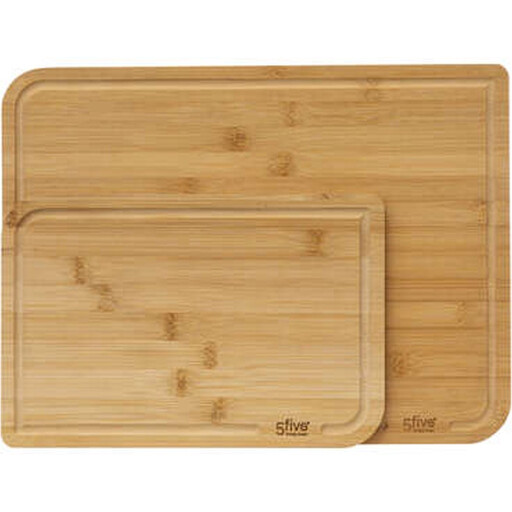
Why This Fits Their Persona: This 2-piece set provides a solid starter kit for kitchens with limited space or budget. It focuses on essential functions without unnecessary extras, making it a practical and straightforward choice.
With a remarkable thickness of 2.5 cm, this set is exceptionally sturdy for its price point and effectively resists warping. The integrated juice groove ensures a clean work surface.
Practical 2-piece set in a universal size (35 x 25 cm). Excellent material thickness that promises high stability and durability.
We have compiled a complete, up-to-date list of products that fully meet these strict selection criteria and safety standards.
Proper care is crucial for longevity. Clean the boards by hand after each use with mild dish soap and warm water. Dry them thoroughly with a cloth immediately and store them upright in a well-ventilated area. Never put them in the dishwasher, as the high heat and moisture will lead to cracks and warping. To keep the material supple, you can rub the boards with a food-grade mineral oil every few weeks.
Bamboo naturally has a dense surface and contains substances that can inhibit bacterial growth. Compared to plastic boards, where deep knife cuts can trap bacteria, a smooth bamboo surface is often easier to keep clean. However, for any material, the key to hygiene is consistent and thorough cleaning after every use, especially after contact with raw meat or fish.
Warping or bowing is almost always due to moisture. When a board absorbs water unevenly—for example, by sitting on a wet surface or having only one side dried—the wood on the wet side swells more than on the dry side. This creates tension in the material, which causes the board to warp. High-quality manufacturing, such as carbonisation, and sufficient material thickness significantly reduce this vulnerability.