
Lieferung heute & morgen

Qualitätsgarantie

Willkommens-Angebote freischalten: KOSTENLOSE Lieferung | Bis zu 80 % RABATT | Kostenlose 30-Tage-JoyPlus-Testphase
App herunterladen
Bamboo furniture is on-trend. It brings a natural, warm aesthetic into any home and is often associated with sustainability. However, not every piece of furniture marketed as "bamboo" lives up to expectations of quality and durability. Before you invest, it's crucial to understand the typical weaknesses that often only become apparent after a few months.
As your Joybuy Product Recommendation Officer, I'm here to help you separate the wheat from the chaff. In this guide, I'll show you the three most common pitfalls when buying bamboo furniture and what you need to look out for to make an informed decision.
Many buyers are disappointed after a short time because their new furniture quickly shows defects. These problems can usually be traced back to three causes:
To avoid the problems mentioned above, you should check three decisive aspects before buying. These will help you objectively assess the quality of a piece of furniture.
Examine the product description carefully. Does it specify solid bamboo or a combination of bamboo and MDF panels? A combination is not inherently bad. High-quality, E1-class certified MDF panels are dimensionally stable and low in emissions. When combined with real bamboo elements, for instance for the body or fronts, this can be a durable and low-maintenance solution, especially with lacquered surfaces. Pure furniture made of bamboo often offers higher density and hardness, making it very resilient.
A good seal is essential. Look for terms like "clear lacquered," "PU-coated," or "oiled." A lacquer forms a closed, water-repellent layer and is ideal for bamboo bathroom furniture or a bamboo under-sink cabinet. Oiled surfaces enhance the natural grain and allow the material to breathe but require occasional re-treatment. Untreated surfaces are unsuitable for humid rooms or high-traffic areas like the hallway.
Functionality determines everyday usability.
Here are some recommendations tailored to different needs and room situations that meet the quality criteria mentioned.
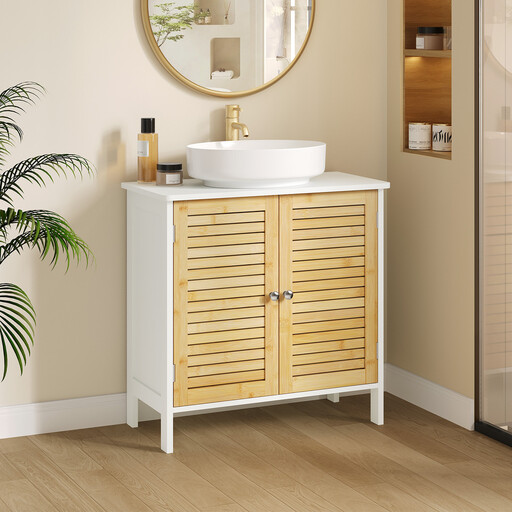
Why This Fits Their Persona: Ideal for anyone looking to make the most of the often-unused space under the sink. The compact dimensions of 60x60x30 cm fit most standard bathrooms and create valuable, concealed storage space.
The combination of natural bamboo and water-repellent lacquered E1-MDF panels avoids the "bamboo-look" trap. This material mix is specifically designed for bathroom conditions and is resistant to moisture.
Features an adjustable shelf for flexible organisation and a magnetic catch that keeps the doors securely closed, protecting contents from dust and splashes.
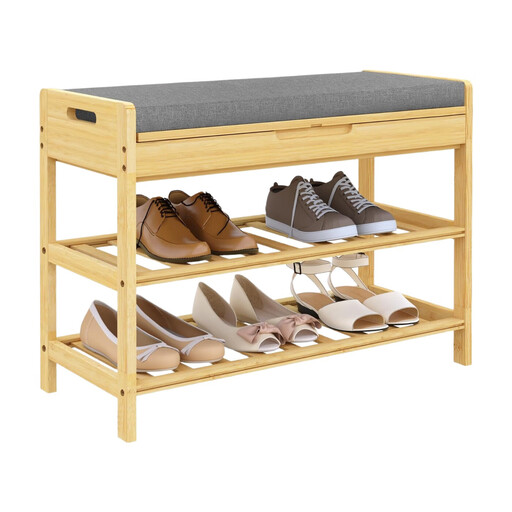
Why This Fits Their Persona: Perfect for a tidy entryway. This piece combines a comfortable seat for putting on and taking off shoes with practical storage for footwear and accessories.
The sturdy bamboo construction is designed for stability, proven by the specified maximum load capacity of 150 kg for the seat. This directly addresses the weakness of unstable, cheap constructions.
Multifunctional design with two open shoe shelves and a hidden storage compartment under the padded seat. The clear lacquer finish protects the surface and makes cleaning easy.
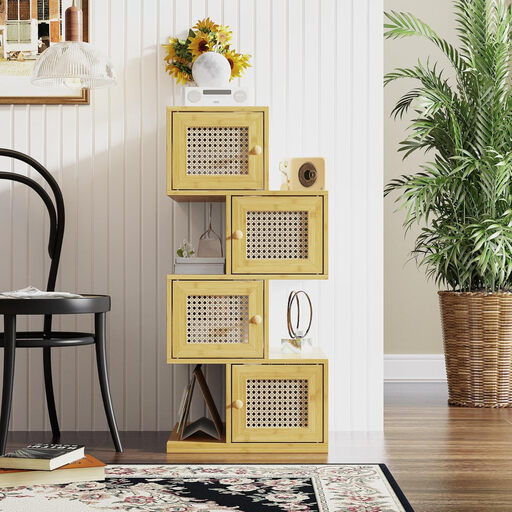
Why This Fits Their Persona: For those who want to combine functionality with aesthetics. This narrow shelving unit is suitable for the living room, hallway, or bedroom and offers a mix of open and closed storage.
The robust bamboo frame provides the necessary stability. The combination with breathable rattan doors is not just a design statement but also functional, as it promotes air circulation inside, thus preventing mildew.
Very slim profile with a depth of only 25.4 cm, ideal for narrow niches. The flexible layout allows you to display decorative items openly and store other objects out of sight.
We've compiled a full, up-to-date list of products that fully meet these strict selection criteria and German safety regulations.
Yes, bamboo bathroom furniture is a great choice, provided it is designed for this purpose. Make sure the surface is treated with a water-repellent lacquer or oil. This protects the material from moisture penetration and makes cleaning easier. Products explicitly designated as bathroom furniture usually meet this requirement.
Maintenance is straightforward. In most cases, it's sufficient to regularly wipe the surfaces with a soft, slightly damp cloth. Avoid standing water and aggressive cleaning agents. For oiled surfaces, it may be beneficial to re-treat the wood with a suitable care oil every one to two years, depending on use, to refresh its protection.
Botanically, bamboo is a grass, not a tree. Some bamboo species grow extremely fast—sometimes up to a metre per day—and can be harvested after just a few years. In comparison, trees used for furniture production often take decades to mature. This makes bamboo a rapidly renewable resource. Additionally, bamboo sequesters CO? during its growth. For these reasons, sustainable furniture is often made from bamboo.