What should you look for when buying?
First, decide whether you want dried snacks or frozen bananas for smoothies and baking. If dehydrating is right for you, choose the appliance size and settings to suit your batch and how you want to use it.
| Priority |
What to look for when buying |
Who is it most relevant to? |
| Space for a full batch |
Compare the usable area and tray dimensions with the quantity you plan to prepare. The number of tiers alone won’t tell you how many slices will fit side by side. |
If I want to arrange a whole batch in a single layer, usable area is crucial. Around 40% of consumers say batch capacity is their main priority. |
| Dehydrating or freezing straight away |
Decide whether you want dried slices or frozen banana pieces for smoothies and baking. If you’re only stocking up for the freezer, there’s no need to dehydrate them. |
If I’m freezing bananas for smoothies or baking, I want to consider whether dried fruit is necessary for my needs. Around 30% of consumers say their main priority is freezing bananas for a particular purpose. |
| Drying and storage |
For slices ⅛ to ¼ inch thick, Oregon State University Extension Service recommends 135 °F, around 57 °C, for approximately 6–12 hours. Check how dry they are rather than relying on the timer alone. |
I don’t want to rely solely on a preset time when dehydrating, and I want to store the fruit somewhere dry afterwards. Around 20% of consumers say drying and storage are their main priorities. |
| Counter space and storage |
Check the appliance dimensions and the number of trays you’ll need for your batch. A smaller appliance may mean you need to run several batches. |
If I only want to dehydrate small quantities occasionally, I care about whether the appliance is practical to use and store. Around 10% of consumers prioritise compactness. |
Dehydrators at Joybuy
This selection includes Joybuy dehydrators for fruit, with different temperature settings, timers and numbers of trays. Check the usable area against the size of the banana batch you plan to prepare.
 No image available
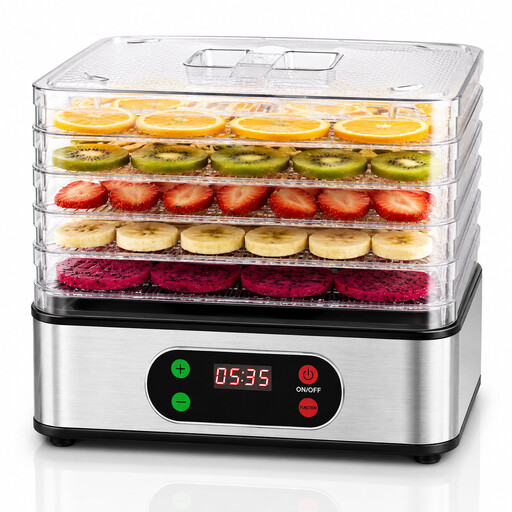
Dehydrator with LED display, 35–70 °C, 0.5–72-hour timer, 350 W
Could suit occasional dehydrating if you’re looking for a compact design.
Temperature range: 35–70 °C. Timer: 0.5–72 hours in 30-minute increments. The product description lists 3.5 cm between the tiers, plus removable, dishwasher-safe parts.
View at Joybuy
 No image available
Havenwell stainless steel dehydrator with 10 trays and a 48-hour timer
The stated number of trays may appeal if you’re planning to use several tiers. Check the dimensions against the size of your banana slices.
Features include ten stainless steel trays, variable temperature control, a 48-hour timer, ten programmes and 850 W.
View at Joybuy
 No image available
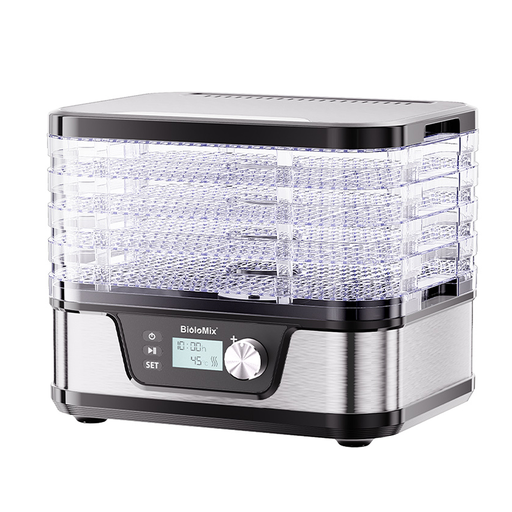
BioloMix BFD1300 dehydrator with five trays
The five trays give you several layers to work with. Compare the usable area with the amount you want to dehydrate in one go.
Temperature range: 35–75 °C. Adjustable timer up to 24 hours. The product name mentions 360° hot-air circulation.
View at Joybuy
Frequently asked questions
Do I need to dehydrate banana slices before freezing them?
No, not if you want frozen bananas for smoothies or baking. The German Federal Centre for Nutrition specifically lists freezing as an option for bananas used this way. Dehydrating is a different way to prepare them as dried fruit.
How should I prepare banana slices for a dehydrator?
Oregon State University Extension Service recommends slices ⅛ to ¼ inch thick, arranged side by side on the trays. It recommends 135 °F, around 57 °C, for approximately 6–12 hours. The slices should bend like thick leather and no longer feel sticky. Dipping them in fruit juice to prevent browning is optional.
Can I pack dehydrated bananas while they’re warm?
Let the slices cool completely first. The National Center for Home Food Preservation warns that moisture can form when warm dried fruit is packed. Use clean, dry, airtight containers and check stored fruit for moisture. Discard any mouldy fruit.
What regulations apply to electric dehydrators in Germany?
For materials that come into contact with food, Regulation (EC) No 1935/2004 is relevant, among others, as explained by the German Federal Office of Consumer Protection and Food Safety. The EU Low Voltage Directive applies to electrical equipment within its voltage range. This alone doesn’t establish whether a particular model meets the relevant requirements; check the product information for that model.


