Anyone short on worktop space
You want to make banana smoothies without leaving a large countertop blender out all the time. Measure the appliance with the cup attached and check whether you can store it away afterwards.


For a single serving of banana and liquid, a compact blender with a blending and drinking cup is a natural place to start if you’re short on worktop space. Before you buy, measure the footprint and height with the cup attached. A rechargeable blender gives you more flexibility over where you use it, but it needs charging and may have a smaller container. If you’re blending frozen banana, an explicitly stated suitability for frozen ingredients matters more than wattage alone.
You want to make banana smoothies without leaving a large countertop blender out all the time. Measure the appliance with the cup attached and check whether you can store it away afterwards.
You blend one serving and want to take it with you in the sealed blending cup. Check the cup capacity, that it has a suitable lid and which containers are included.
You also use frozen banana or other frozen fruit. What matters is whether the model is explicitly stated to be suitable for these ingredients, not just its wattage.
A good fit if: You regularly blend a single serving on a small clear worktop and want to take your smoothie with you without transferring it to another container.
The trade-off: You’ll need a socket and worktop space while blending, and the cup capacity limits the serving size.
A good fit if: You want to use your blender in different places and put it away after use.
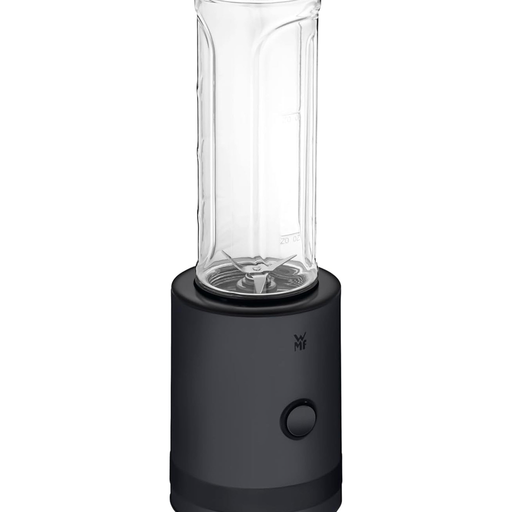
The trade-off: Charging is part of the routine. According to WMF, the WMF KÜCHENminis Mix on the go holds 0.3 l; this model is listed as having no ice-crushing function.
A good fit if: You often use frozen banana or other frozen fruit; Bosch specifically lists this use for the VitaPower Serie 2 MMB2111S.
The trade-off: Even a mini appliance needs worktop space while blending. Bosch lists this model as measuring 367 × 122 × 126 mm and having a 0.6-l cup.
| What to consider | What to check before buying | Who should pay particular attention |
|---|---|---|
| Worktop space and storage | Measure the width, depth and height with the cup attached; allow for operating space and the cable. Bosch lists the MMB2111S as measuring 367 × 122 × 126 mm. | If you have limited worktop space, the blender and cup need to fit where you plan to use it and be easy to store away. Around 36% of consumers prioritise footprint and storage. |
| Taking a serving with you | Compare the cup capacity, drinking lid and what’s included with the specific offer. Severin describes the SM 3735 as coming with two 0.6-l containers. | If you want to take your smoothie with you without transferring it to another container, a suitable cup and lid are important. Around 29% of consumers prioritise being able to take a serving with them. |
| Frozen ingredients | Check the model-specific information on frozen fruit and the preparation instructions; wattage alone isn’t a way to compare results. | If you use frozen banana, you’ll want a function explicitly stated as suitable, rather than making assumptions based on wattage. Around 21% of consumers prioritise frozen ingredients. |
| Cleaning | Check the cleaning instructions for the cup, lid and blade separately. For the NB606DG, nutribullet describes the cups and attachments as dishwasher-safe, but says to clean the blade with soap and water. | If you want to make cleaning as straightforward as possible after each serving, check how to care for the cup, lid and blade. Around 14% of consumers put cleaning first. |
When worktop space is limited, the whole appliance needs to fit where you plan to put it, with the cup attached.
Compare the width, depth and height of the complete appliance with the space available on your worktop or in a cupboard, and allow room to use it.
Wattage alone doesn’t tell you whether a particular model is designed for frozen ingredients. According to WMF, the KÜCHENminis Mix on the go isn’t listed with an ice-crushing function.
If you want to use frozen ingredients, check the functions and preparation instructions listed for the specific model.
Just because the cups and attachments are dishwasher-safe doesn’t automatically mean the blade assembly can be cleaned the same way.
Check the instructions for each part separately. For the nutribullet NB606DG, the blade is unscrewed and cleaned with soap and water; also allow space for it to dry.
WMF offers both the mains-powered Kult X Mix & Go, with a 0.6-l blending and drinking cup, and the differently designed rechargeable KÜCHENminis Mix on the go, with a 0.3-l capacity.
The VitaPower Serie 2 MMB2111S is a mini countertop blender with a 0.6-l cup, which Bosch also describes as suitable for making smoothies with frozen fruit.
The Smoothie Mix & Go SM 3735 is described as coming with two 0.6-l drinking containers.
The Original 600 NB606DG is described as coming with a 700-ml and a 525-ml to-go cup.
The Daily Collection HR2600/80 is a mini countertop blender that Philips describes as suitable for smoothies and other small blending tasks.
This selection includes cup blenders for making banana smoothies when worktop space is limited, including to-go and rechargeable models.
 No image available
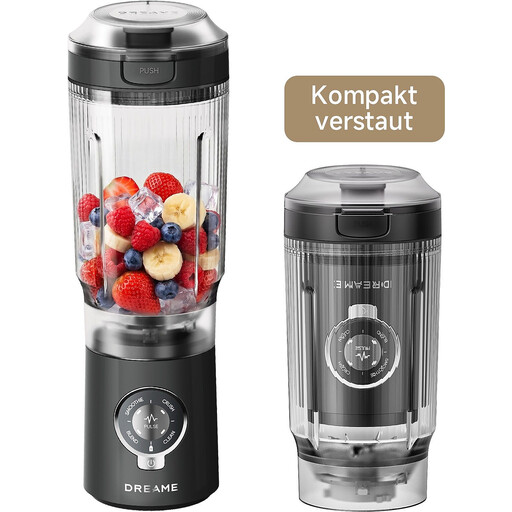
Its portable design and travel cup make it a good fit if you want to blend a serving and take it with you.
The product description lists a 710 ml cup, three pre-set automatic programmes and removable dishwasher-safe parts. It also says the blender can be used with frozen fruit.
 No image available
Cordless operation is a handy option if you want to put the blender away after use or use it in different places.
The product description lists a 0.88 l capacity, 120 W, a USB-C charging port, stainless steel blades and an ice-crushing function. The battery needs to be charged before use.
 No image available
This rechargeable blender is designed for portable single servings and could be a good choice if you want the flexibility to blend in different places.
The product description lists a 0.59 l capacity, a pulse function and frozen fruit as a suitable ingredient. The battery needs to be charged before use, using the USB-C cable mentioned in the product description.
 No image available
Two blending and drinking containers are handy if you want to make different serving sizes or share the blender with someone else.
The product description lists two containers, each with a 0.6 l capacity, a 300 W motor and a four-blade assembly. The containers and lids are described as dishwasher-safe.
 No image available
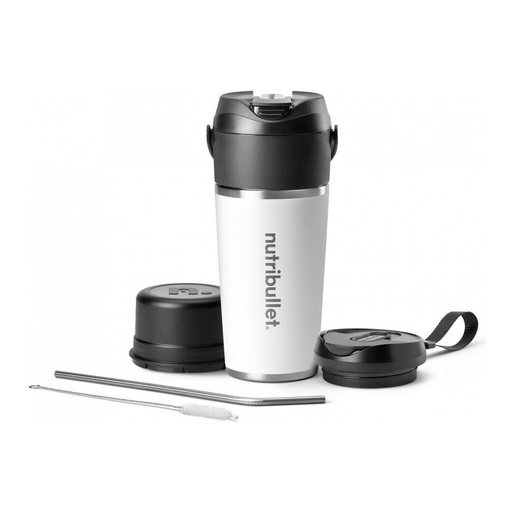
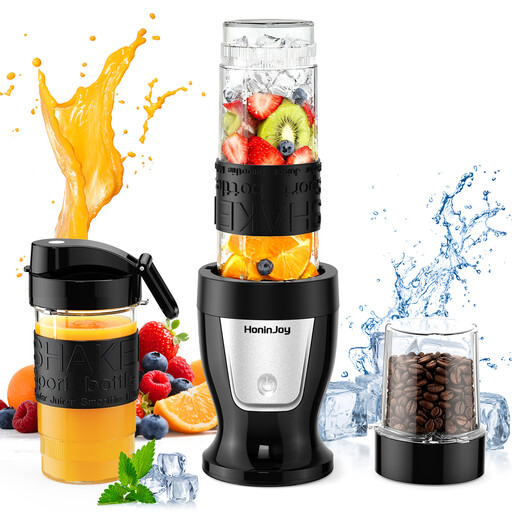
Two cups in different sizes give you options if you want to prepare servings to take with you.
The product description lists a peak power of 650 W, 20 oz and 14 oz cups, and a grinding cup. The cups, lids and grinding cup are described as dishwasher-safe.
For a single serving, a mini blender with a blending cup is a space-saving option. Choose based on the amount you need and the full dimensions of the appliance; you don’t automatically need a large jug for this.
Check the specific model’s approval and preparation instructions for frozen fruit. Bosch describes this use for the MMB2111S; according to WMF, the KÜCHENminis Mix on the go isn’t listed with an ice-crushing function.
There’s no one-size-fits-all answer. For the nutribullet NB606DG, the manufacturer describes the cups and attachments as dishwasher-safe, but recommends cleaning the unscrewed blade with soap and water. Check the instructions for every part of your model.
For consumer purchases, the seller is generally responsible for the statutory guarantee, not the manufacturer. The Verbraucherzentrale states that it lasts for two years from delivery; this is separate from any voluntary manufacturer’s warranty.
According to the EU, CE marking is only required where the relevant harmonised EU rules require it. The Low Voltage Directive 2014/35/EU applies to equipment within the specified voltage range; the European Commission explains the CE requirements, while EUR-Lex sets out the scope of the directive. Parts that come into contact with food must also meet the requirements of Regulation (EC) No 1935/2004, as explained by the German Federal Institute for Risk Assessment. Check that the documentation relates to the specific model.