
Lieferung heute & morgen

Qualitätsgarantie

Willkommens-Angebote freischalten: KOSTENLOSE Lieferung | Bis zu 80 % RABATT | Kostenlose 30-Tage-JoyPlus-Testphase
App herunterladen
A bar table with storage can functionally and stylistically enhance a kitchen or living room. It creates a social hub, a compact dining solution, or a practical kitchen bar. However, the market is flooded with models whose weaknesses often only become apparent after purchase. Certain design flaws and material defects can quickly render a seemingly practical piece of furniture useless. This guide highlights the pitfalls to avoid and the core features you should look for.
Many buyers focus on design and overlook fundamental functional flaws. These three problems most frequently lead to disappointment:
To avoid a bad purchase, you should check three technical aspects before making a decision. These determine the longevity and practical utility of your new piece of furniture.
Stability is the most important criterion. A solid metal frame, often found in industrial-style bar tables, generally offers high stability, provided the tubes are sufficiently thick and the welds are cleanly finished. Look for additional cross-bracing or an integrated footrest, as these significantly stiffen the structure. For models made of wooden bar tables or engineered wood, the thickness of the panels and the quality of the screw connections are crucial.
An indispensable feature is adjustable feet. They allow you to level the table on slightly uneven floors, ensuring it doesn't wobble. Always check the maximum load capacity specified by the manufacturer.
A high top table with a shelf is only an asset if the storage is well-designed. Measure the height and depth of the compartments and compare them with the dimensions of your bottles and glasses. An integrated bar table with a wine rack should securely hold standard wine bottles. Drawers offer an advantage for small items like corkscrews or coasters.
For smaller apartments, a small bar table is ideal, but functionality should not be compromised. Think carefully about what you want to store and check whether the chosen model meets these requirements.
The tabletop is the most heavily used component. Models made from E1-grade engineered wood (particleboard or MDF) are a common standard. However, the surface coating is critical. A melamine veneer is water-repellent and scratch-resistant, making it significantly more durable than a simple paper foil. It protects the underlying material from moisture and makes cleaning easier.
Instead of making a general recommendation, we have identified models that meet specific requirements and avoid the aforementioned pitfalls.

Why This Fits Their Persona: With its 60 x 60 cm square footprint, this table fits perfectly into small kitchens or nooks. It serves as a breakfast bar or a compact home counter without overwhelming the space.
The powder-coated steel frame is reinforced with a horizontal footrest. This counteracts the typical wobbling of smaller tables and ensures a solid structure.
Compact dimensions for maximum space-saving; adjustable feet to compensate for uneven floors.
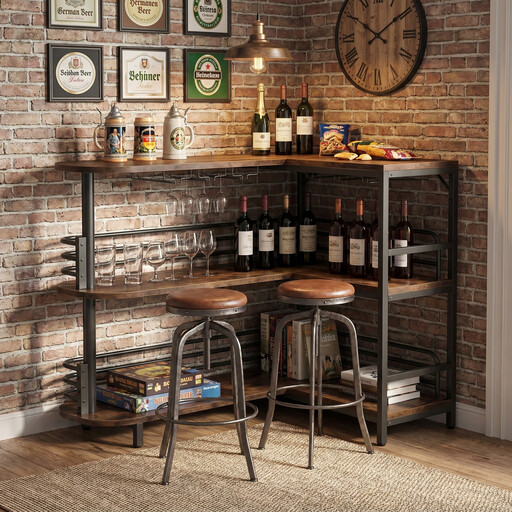
Why This Fits Their Persona: The L-shape creates a dedicated bar corner with a large work surface for mixing drinks. It's ideal for anyone who regularly entertains guests and wants a central hub for socialising.
This model offers genuinely usable storage. The integrated wine glass holders and deep shelves are designed for common bottle and glass sizes, not just for decoration.
Generous L-shape for corners; dedicated holders for stemmed glasses; high load capacity of up to 99 kg according to the manufacturer.
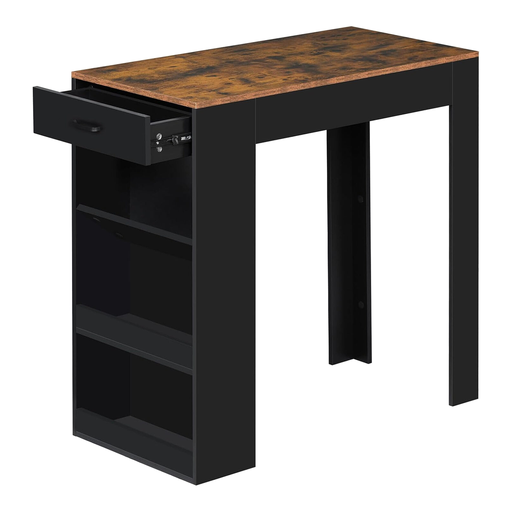
Why This Fits Their Persona: This model functions as a kitchen bar, dining spot, and storage unit all in one. The combination of a drawer, a wine rack, and open shelves makes it an all-in-one solution for the kitchen or dining area.
The construction of E1-grade engineered wood with a melamine veneer addresses the problem of low-quality surfaces. According to the manufacturer, it is scratch-resistant and water-repellent, ensuring durability in daily kitchen use.
Versatile storage with a drawer, wine rack, and open shelves; easy-to-clean and robust surface.
We have compiled a complete, up-to-date list of products that fully meet these strict selection criteria and German safety regulations.
The standard height for a bar table or kitchen bar is between 100 cm and 110 cm. This height is optimal for standard bar stools, which typically have a seat height of 70 cm to 80 cm. This allows for a comfortable seating position with sufficient legroom.
The load capacity varies greatly depending on the model and construction. It is essential to check the maximum load capacity specified by the manufacturer. Sturdy models can often support up to 100 kg. However, note that this value refers to a uniformly distributed load on the tabletop. The shelves usually have a separate, lower load capacity limit. The table is not suitable for sitting or standing on.