For making several portions of basil pesto, a food chopper is an obvious choice if you want to process herbs and firm ingredients in controlled batches. A hand blender set is a better fit if you also want to blend directly in a suitable container. A jug blender is worth considering if you also make larger batches or other blended dishes: its container capacity doesn’t prove that it can handle small amounts of thick pesto well. Compare the working capacity and accessories of the specific model, and plan portioning and freezing separately from the blending process.
Who makes pesto in batches?
Batch cooks making pesto
If you’re processing a lot of basil, plan the amount for each batch alongside how you’ll portion it afterwards. The Federal Centre for Nutrition recommends measuring food before freezing and freezing it in portions in suitable packaging.
Fans of chunky pesto
If you want the herbs and nuts to remain recognisable, controlled chopping matters more than wattage alone. The Federal Centre for Nutrition recommends chopping the ingredients first and stirring in the olive oil afterwards.
Anyone with a range of blending needs
If you’d also like to use the appliance for other blending or mixing tasks, compare what’s included and the capacity of the attachment you’ll actually use. Braun and Tefal list different containers and uses for their respective models.
What should you consider when choosing?
Electric food chopper
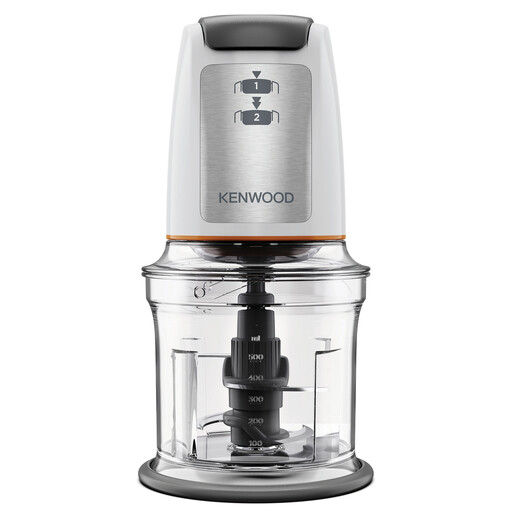
A good fit if: you want to chop herbs and firm ingredients in controlled batches; according to the manufacturer, the Kenwood CHP61.100WH has two speeds and a 500-ml container.
Consider: A smaller working bowl may mean several batches for a larger quantity; conversely, a larger capacity doesn’t prove that the appliance is suitable for very small amounts.
Hand blender with chopper
A good fit if: you want to blend in a suitable container as well as make pesto; Braun lists a blending shaft and a separate 350-ml chopper for the MQ7045X.
Consider: Check the exact set version and allow space for the extra attachments, as well as time to clean them.
Jug blender
A good fit if: you regularly make larger batches or other blended dishes as well as pesto; Tefal lists a usable capacity of 1.75 litres and manual settings for the BL91HD.
Consider: The usable capacity doesn’t tell you what minimum quantity is suitable for thick pesto, so check your recipe against the instructions.
| What you need |
What to look for when buying |
Who is this important to? |
| Amount per batch |
Match the working capacity of the specific model to the recipe quantity; portion your freezer supply separately. |
If I’m processing a larger quantity of basil, I want to know how many batches I’ll need and how to divide up the pesto afterwards. Around 33 % of consumers put the amount per batch first. |
| Consistency |
Check for pulse or speed controls and suitable accessories; don’t assume the appliance will produce your preferred texture based on its rated power alone. |
If I want chunky pesto, I need to be able to chop the ingredients in a controlled way. Around 27 % of consumers prioritise consistency. |
| Cleaning |
Check the instructions for each removable part individually to see whether it is dishwasher-safe. |
After several batches containing oil, I want to know how to clean the container and accessories without assuming they can be treated like the motor unit. Around 20 % of consumers focus primarily on how much cleaning is involved. |
| Other uses |
Compare what’s included with the exact version and the usable capacity of the attachment or container you’ll use. |
If I also blend soups or make other blended dishes, I compare the attachments and the capacity of each container. Around 20 % of consumers prioritise these additional uses. |
Common misconceptions
-
Assuming container capacity means it will suit your pesto quantity
The stated capacity doesn’t tell you the minimum amount an appliance can process. Rommelsbacher recommends a different appliance category for small quantities of pesto rather than the MZ 400 or MZ 500.
Check your batch size against the instructions and the intended use of the specific model.
-
Assuming wattage guarantees your preferred texture
Rated power alone doesn’t show whether a model can process your desired quantity to your preferred consistency.
Compare how it works, its accessories and quantity guidance rather than using these details to rank models.
-
Assuming a layer of oil guarantees safe storage
The Federal Institute for Risk Assessment warns against storing homemade herb and garlic oils. This doesn’t provide a specific safe storage period for homemade pesto.
Plan portioning and packaging separately from your appliance purchase, and don’t assume a layer of oil makes pesto safe to store for a particular length of time.
Relevant brands and models
Kenwood
According to Kenwood, the Easy Chop CHP61.100WH is a compact chopper for smaller quantities.
- The manufacturer lists a 500-ml container and two speeds.
- You may need several batches for a larger quantity.
Rommelsbacher
Rommelsbacher lists pesto as a use for the MZ 400, which has a 1.0-litre glass container.
- The manufacturer says the removable parts are dishwasher-safe.
- For small amounts of pesto, the manufacturer recommends a different appliance category; this doesn’t apply to all models.
Braun
According to Braun, the MultiQuick 7 MQ7045X set combines a hand blender with a chopper and other attachments.
- The set includes a separate 350-ml chopper.
- The small container may limit the amount you can process in each batch; extra parts also need cleaning and storage space.
Bosch
Bosch lists the MMR08A1 as a universal chopper with a pulse switch.
- Bosch lists a rated power of 400 W and says some parts are dishwasher-safe.
- These details don’t confirm a minimum filling quantity or a particular pesto result.
Tefal
According to Tefal, the InfinyMix BL91HD is a jug blender for larger batches and other blended dishes.
- Tefal lists a usable capacity of 1.75 litres and manual settings.
- The usable capacity doesn’t confirm a minimum filling quantity or particular suitability for small amounts of thick pesto.
Joybuy products
This product selection includes an electric chopper for smaller batches of pesto.
 No image available
Kenwood Easy Chop CHP61.100WH mini chopper
For smaller batches of pesto when you want to control chopping with multiple speed settings.
Container: 0.5 l. Two speed settings.
View at Joybuy
Frequently asked questions
Do you need to blend the olive oil for a long time?
No. The Federal Centre for Nutrition recommends chopping the other ingredients first, then stirring in the olive oil.
Can I freeze pesto in the blending container?
Only if the instructions for that specific container explicitly state that it is suitable for freezing. The Federal Centre for Nutrition recommends using freezer bags or freezer containers marked as suitable for freezing, and measuring and labelling portions.
Are the blades and accessories all dishwasher-safe?
It depends on the model and the individual part. Rommelsbacher lists removable parts for the MZ 400; Braun advises checking the instructions for details of dishwasher-safe parts. Check each part before cleaning it.
Does a layer of oil keep homemade pesto fresh for a long time?
When planning how to store pesto, don’t rely on a layer of oil as a safety guarantee. The Federal Institute for Risk Assessment warns against storing homemade herb and garlic oils; this doesn’t establish a specific safe storage period for frozen pesto.


