If you batch-cook for the week
If you want to prepare as many portions of tomato and basil soup as possible, plan your batch size around the space you have available for cooling and storing it.


For larger quantities, the maximum fill level for hot soup is what matters. For smaller batches, a compact soup maker may be enough, while a heated jug blender also offers cold functions. Compare the maximum fill level for hot ingredients, rather than just the jug capacity: Russell Hobbs and Krups each state a 1.4 l capacity for hot preparations, compared with 1.75 l for cold ingredients (Russell Hobbs Germany; Krups Germany). Make room for shallow containers and space in the fridge, too: the German Federal Institute for Risk Assessment recommends dividing larger quantities of food into smaller portions to cool.
If you want to prepare as many portions of tomato and basil soup as possible, plan your batch size around the space you have available for cooling and storing it.
If you want to switch between smooth and chunky tomato soup, check which programmes the specific model offers.
If you’re preparing several batches one after another, it’s worth checking how easy the jug and blades are to clean between uses.
Start with the maximum fill level for hot ingredients per batch, then compare the texture programmes, cleaning requirements and space you have for cooling and storage with your needs.
A good fit if: you want to make as much soup as possible in one batch; DOMO lists a 2 l capacity for the DO705BL (DOMO Elektro).
Consider: You’ll still need suitable containers and enough room to cool a larger batch afterwards.
A good fit if: smaller quantities are enough and you want to choose between smooth and chunky soup; Philips lists a 1.2 l jug for the HR2203/80, while DOMO lists 1.6 l for the DO498BL (Philips Germany; DOMO Elektro).
Consider: You may need to make several batches to prepare enough for the week.
A good fit if: you want a machine with both hot and cold functions; according to their manufacturers, the Russell Hobbs 21480-56 and Krups KB835D each hold 1.4 l for hot preparations.
Consider: The manufacturers’ stated 1.75 l capacity for cold ingredients is not the maximum fill level for hot soup (Russell Hobbs Germany; Krups Germany).
| Buying priority | What to check | Who is it most important to? |
|---|---|---|
| Usable batch size | Check the maximum fill level for hot ingredients, the fill markings and the recipe instructions. The stated capacity for cold ingredients is not the same as the amount of hot soup you can make. Russell Hobbs Germany and Krups Germany each list a 1.4 l capacity for hot preparations. | If I want to prepare as many portions as possible for the week in just a few batches, I need to know how much soup I can actually make at a time. Around 36% of consumers prioritise batch size. |
| Preferred texture | Check whether the specific model offers programmes for smooth and chunky soup, or a manual blending function. Philips Germany lists these programmes and manual blending for the HR2203/80. | If I want to serve my tomato soup smooth or with chunks, depending on the recipe, I need the right functions. Around 29% of consumers prioritise their preferred texture. |
| Cleaning between batches | Compare any cleaning programmes with the guidance on whether each part is dishwasher-safe. Philips Germany states that no parts of the HR2203/80 are dishwasher-safe. | If I’m making several batches one after another, I want to keep cleaning between uses manageable. Around 21% of consumers focus primarily on cleaning. |
| Storing the soup | Make room for shallow containers and enough space in the fridge. The German Federal Institute for Risk Assessment recommends cooling larger quantities to below +7 °C within a few hours, dividing them between several shallow dishes. | If I want to choose a machine size that suits my portions and the space in my fridge, I also need to think about how I’ll store the soup after cooking. Around 14% of consumers put this planning first. |
For the heated blenders from Russell Hobbs and Krups, the manufacturers’ stated capacity for hot preparations is lower than for cold ingredients: 1.4 l rather than 1.75 l for both models.
Check the maximum fill level for hot ingredients first, then work out how many batches you’ll need for the quantity you have planned.
If the maximum fill level for hot ingredients is lower, you may need to make extra batches to prepare enough for the week.
A cleaning programme doesn’t automatically mean that the jug, lid and blades can go in the dishwasher. Philips states that no parts of the HR2203/80 are dishwasher-safe.
Check the cleaning instructions for every part of the specific model. Never immerse electrical components in water unless the manufacturer explicitly says it’s safe to do so.
If parts need to be washed by hand, you’ll have to do it again between every batch.
You can’t plan a larger quantity of soup based on the machine size alone: once it’s cooked, you’ll need suitable containers and enough room to cool it.
Plan ahead. The German Federal Institute for Risk Assessment recommends dividing larger quantities of food between several shallow dishes to cool.
DOMO offers standalone soup makers in a range of sizes. The manufacturer lists a 1.6 l capacity for the DO498BL and 2 l for the DO705BL (DOMO Elektro).
The SoupMaker HR2203/80 is a model with a 1.2 l jug, suited to smaller quantities (Philips Germany).
The Perfectmix Cook KB835D is a jug blender with hot and cold functions. Krups lists a capacity of 1.4 l for hot dishes and 1.75 l for cold dishes (Krups Germany).
The Soup & Blend 21480-56 is a jug blender with a cooking function (Russell Hobbs Germany).
The SVD 1400 Vera is a soup and plant-based drink maker with a maximum capacity of 1.3 l (Rommelsbacher).
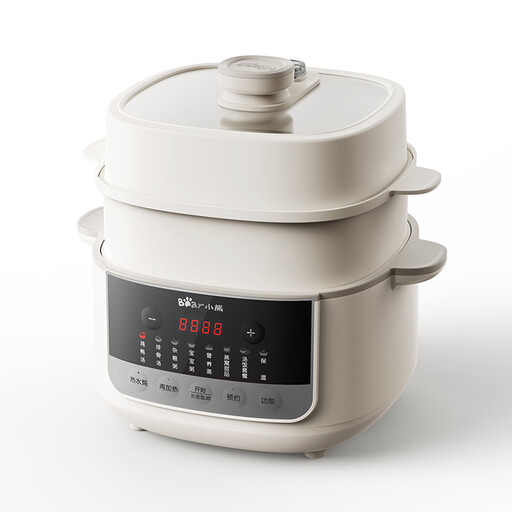
The selection below includes a multi-function appliance listed as a Soup Maker at Joybuy. Before buying, check the fill level recommended for making soup in this specific model.
 No image available
Worth considering for batch cooking if you’d also like to use the slow-cooking, steaming and keep-warm functions, as well as making soup.
The product details list a 4.1 l capacity, a 2.5 l main pot and four 0.4 l inner pots. These capacity figures don’t confirm how much soup the appliance is designed to hold, so check the model details before buying.
After cooking, wait a few minutes before opening the lid to avoid scalding from steam.
Not necessarily. Russell Hobbs lists a 1.75 l capacity for cold ingredients and 1.4 l for hot soup for the 21480-56; Krups also lists 1.75 l for cold ingredients and 1.4 l for hot ingredients for the KB835D. So check the maximum fill level for hot ingredients for the specific model (Russell Hobbs Germany; Krups Germany).
That depends on the model and its individual parts. Philips explicitly states that no parts of the HR2203/80 are dishwasher-safe. Check the cleaning instructions before buying, and don’t immerse electrical components in water unless the manufacturer explicitly says it’s safe to do so.
The German Federal Institute for Risk Assessment recommends dividing larger quantities of food between several shallow dishes to cool, and eating refrigerated leftovers within two to three days. This recommendation doesn’t guarantee that every recipe will keep for that long.
Electrical appliances covered by the EU Low Voltage Directive must meet the requirements for CE marking and the accompanying documentation. The marking isn’t an independent recommendation for a particular appliance. The German consumer advice centre distinguishes between your statutory rights against the seller and a voluntary guarantee.