
Lieferung heute & morgen

Qualitätsgarantie

Willkommens-Angebote freischalten: KOSTENLOSE Lieferung | Bis zu 80 % RABATT | Kostenlose 30-Tage-JoyPlus-Testphase
App herunterladen
A cluttered bathroom can make for a stressful start to the day. When towels, cosmetics, and cleaning supplies don't have a designated spot, chaos quickly takes over. The right bathroom cabinet promises a solution, but the selection is vast, and not every product lives up to its claims. Many buyers invest in a piece of furniture that shows signs of defects after just a few months.
Before you make a decision, it's crucial to understand the three most common pitfalls that lead to a bad purchase:
To find a durable and functional bathroom cabinet, you should check three core technical parameters. These features are crucial for quality and utility.
The foundation of any good piece of bathroom furniture is its material. Look for products made from MDF (Class E1) boards. Unlike conventional particleboard, medium-density fibreboard is significantly denser and more dimensionally stable. The E1 designation also signifies a low formaldehyde emission class, contributing to a healthier indoor environment.
The surface finish is just as important. A high-quality lacquered finish, often found on white bathroom furniture models, provides better and more complete protection against moisture than a simple melamine coating. With the latter, small cracks can quickly form at the edges, allowing water to penetrate.
Measure your available space precisely before you buy. For tight areas, a narrow bathroom cabinet or a special niche bathroom cabinet is often the only solution. Consider not only width and depth but also skirting boards, door swing clearance, and any existing pipes. An under-sink cabinet, for example, requires a precisely fitting cut-out for the P-trap. A tall bathroom cabinet makes optimal use of the room's height and creates valuable storage for a small bathroom.
A solid base is essential. Check the cabinet's maximum load capacity, which is specified in kilograms (kg). A higher value indicates a more robust construction. An anti-tip device is crucial for safety, especially with tall cabinets. This is a mechanism for securing the cabinet to the wall. Reputable manufacturers include the necessary mounting hardware and explicitly mention it in the instructions.
Not everyone needs the same cabinet. We've identified models tailored to specific needs and room situations.

Why this model fits: Ideal for a first apartment or small bathrooms where a functional and cost-effective solution is needed to create order. Its compact 30x30 cm footprint fits into many corners.
The frame is made from FSC-certified MDF boards, making it more resistant to moisture than simple particleboard. An included anti-tip device addresses the stability issue.
The combination of an open shelf and two removable drawers offers a flexible layout that can be adapted to various items.
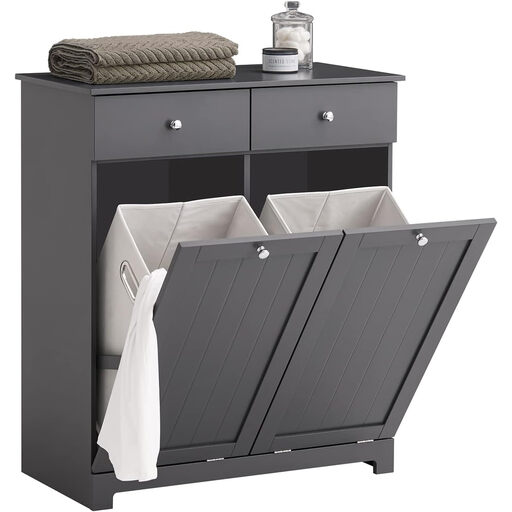
Why this model fits: This bathroom chest of drawers is designed for families seeking an all-in-one solution. It combines storage for toiletries with an integrated laundry solution.
The construction from E1-MDF boards and a high total load capacity of 70 kg ensure stability. The layout is highly functional, avoiding the problem of impractical compartments.
Two separate laundry bags, each with a 45-litre capacity, allow for direct pre-sorting of laundry. Two additional drawers provide space for smaller items.
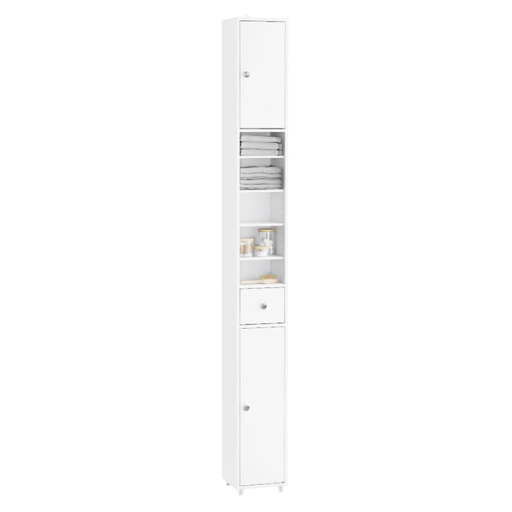
Why this model fits: This niche bathroom cabinet is specifically designed for the tightest of spaces. With a mere 20x20 cm footprint, it transforms unused gaps next to the toilet or sink into vertical storage.
The six height-adjustable shelves offer maximum flexibility, solving the problem of rigid compartments. The required wall mount provides the essential stability for a tall cabinet.
Maximum space utilisation on a minimal footprint. The matte white lacquer finish is resistant to fingerprints and easy to clean.
We have compiled a complete, up-to-date list of products that fully meet these strict selection criteria and safety standards.
Regularly ventilating the bathroom to reduce humidity is the first step. Always wipe away water splashes from the cabinet's surface immediately with a dry cloth. Periodically check the edge seals for any damage. Models with a continuous lacquer finish offer better protection than those with foiled or coated edges.
For tall and narrow cabinets, such as a tall bathroom cabinet, wall mounting is strongly recommended to prevent tipping. This is an essential safety measure, especially in households with children. Most manufacturers include the necessary mounting hardware. For low, wide cabinets like a bathroom chest of drawers, it is often not mandatory but still increases stability.
This is a European standard for engineered wood products. MDF stands for "Medium-Density Fibreboard," a material that is denser and more resistant to warping and moisture than conventional particleboard. The E1 class certifies that the product emits only a very low amount of formaldehyde. This contributes to better and healthier indoor air quality.