
Lieferung heute & morgen

Qualitätsgarantie

Willkommens-Angebote freischalten: KOSTENLOSE Lieferung | Bis zu 80 % RABATT | Kostenlose 30-Tage-JoyPlus-Testphase
App herunterladen
By a Joybuy Product Recommendation Officer, August 29, 2026
A cluttered bathroom can make for a difficult start to the day. Often, the problem isn't a lack of tidiness, but rather insufficient or unsuitable storage. The selection of bathroom cabinets is vast, but not every solution is designed for the specific conditions of a bathroom. Before you make a decision, it's important to understand the common pitfalls that can lead to disappointment and unnecessary expense.
Some of the most common problems when choosing a cabinet include:
To avoid a bad purchase, you should focus on a few key parameters that determine the durability and functionality of a bathroom cabinet.
The most crucial factor for long-lasting bathroom furniture is the material. Look for products made from MDF boards (E1 standard). Unlike simple particle boards, these medium-density fibreboards are more homogeneous and dimensionally stable. The E1 standard also ensures that formaldehyde emissions are at a level considered safe for health. However, the surface treatment is decisive. A high-quality lacquer or a melamine resin coating seals the material and provides high moisture resistance. Check that all edges are cleanly sealed, as this is where moisture is most likely to penetrate.
Measure the available space precisely before you start your search. Consider not only the width and depth but also the height. There are specialised solutions for different room situations:
A good bathroom cabinet offers more than just empty compartments. Consider which features would make your daily routine easier. A bathroom cabinet with a laundry hamper, for example, integrates dirty laundry collection directly into the furniture, ensuring a tidy appearance. Adjustable shelves allow you to flexibly adapt the interior to the size of your toiletries and maximise your bathroom storage space.
Based on these objective criteria, we have identified several models that are particularly well-suited for the specific needs and spatial situations in modern households.
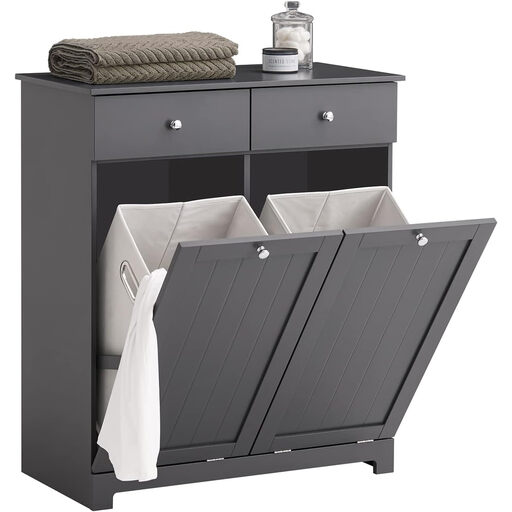
Why it's a great fit: This bathroom cabinet solves two central problems in a family bathroom: storing toiletries and sorting laundry. The two separate laundry baskets make daily organisation much easier.
The model sidesteps the "lack of functionality" trap by integrating two 45-litre laundry baskets and additional drawers. According to the manufacturer, it is made of lacquered E1-grade MDF boards suitable for humid environments.
Combines storage and laundry management in a single piece of furniture. The manufacturer, SoBuy, states a total load capacity of up to 70 kg.

Why it's a great fit: As a freestanding cabinet, it requires no wall mounting, making it ideal for rental properties. It efficiently uses the space under the sink without needing any structural changes.
This model avoids the "wasted space" pitfall with an integrated siphon cut-out. The construction from lacquered E1-grade MDF boards is designed for bathroom conditions.
Simple, drill-free installation and optimal use of space under the sink. According to the manufacturer WOLTU, the doors open 180° for easy access.
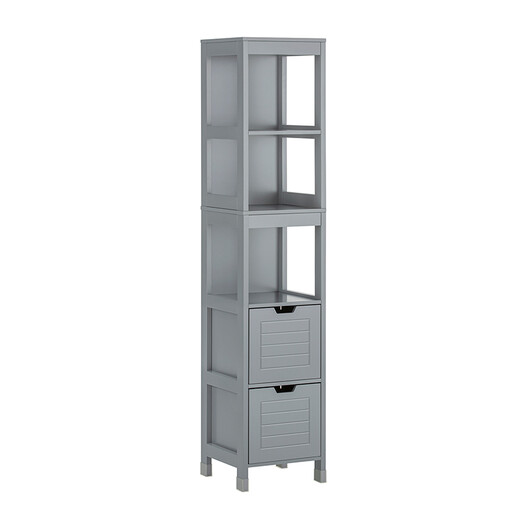
Why it's a great fit: At only 30 cm wide, this tall cabinet makes optimal use of the room's height. It's perfect for small bathrooms where every square centimetre counts, offering a mix of open and closed storage.
This model is the solution to the "wrong dimensions" problem. Instead of squeezing a wide dresser into a small bathroom, this slim tall cabinet utilises vertical space and fits even in tight corners.
Maximum storage on a minimal footprint (30x30 cm). The combination of open shelves and closed baskets offers flexible storage options.
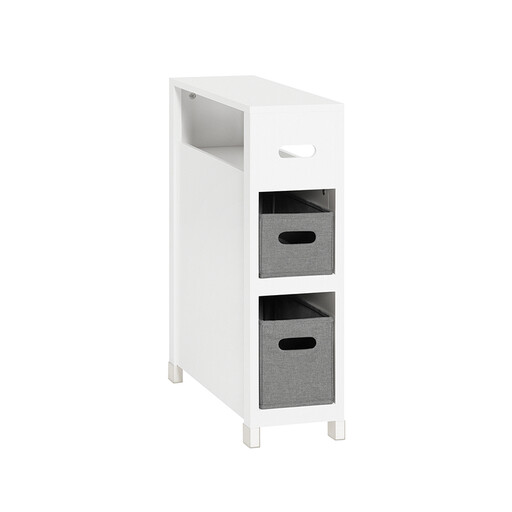
Why it's a great fit: This shelf is specifically designed to make smart use of narrow, unused gaps in the bathroom. At only 20 cm wide, it fits next to the toilet or in small corners, providing space for toilet paper and cleaning supplies.
It's the direct answer to the "wasted space" pitfall. Instead of leaving a gap empty, this niche shelf turns it into functional storage. It even includes a separate compartment for the toilet brush.
Extremely slim design (20 cm) to utilise otherwise lost space. The raised feet provide additional protection from moisture on the floor.
Some of the models featured here are available as a grey bathroom shelf or in other finishes. We have compiled a complete, up-to-date list of products that meet these strict selection criteria.
The best protection is good ventilation. Air out the bathroom thoroughly after showering or bathing to reduce humidity. Wipe away any water spots on the cabinet's surface immediately with a dry cloth. Ensure the cabinet is not exposed to direct water spray. Models with raised feet offer additional protection from water pooling on the floor.
MDF stands for "medium-density fibreboard." It is an engineered wood product made from finely shredded wood fibres pressed together under high pressure. Class E1 is a European standard that limits the emission of formaldehyde, a binding agent. E1-certified boards release only a very small amount of formaldehyde into the air, which is considered safe for health, making them the standard for residential furniture.
No, a key advantage of freestanding models is that they do not require mounting to the wall. They are simply slid into place under the sink. This is particularly practical in rental properties, as no holes need to be drilled. For safety, the cabinet should stand on a level floor. Some models come with an optional anti-tip kit that can be fixed to the wall for extra stability, but it is generally not mandatory.