
Lieferung heute & morgen

Qualitätsgarantie

Willkommens-Angebote freischalten: KOSTENLOSE Lieferung | Bis zu 80 % RABATT | Kostenlose 30-Tage-JoyPlus-Testphase
App herunterladen
A new bathroom cabinet promises order and more storage space. But the joy can be short-lived if the edges start to swell after just a few months, the doors no longer close properly, or the interior space is impractical. Many purchasing decisions are swayed by attractive product photos, often overlooking the technical details that are crucial for long-term durability and functionality.
This guide focuses on the three most common pitfalls when buying bathroom furniture and shows you which objective criteria to look for to make an informed decision.
To avoid these problems, you should carefully check three core parameters before buying. These determine whether a bathroom cabinet will be a satisfactory long-term solution for your bathroom storage.
The choice of material is fundamental to longevity in a humid bathroom climate. Look for products made from MDF (Medium-Density Fibreboard) panels, ideally with an E1 classification, which stands for low formaldehyde emissions. However, the surface treatment is crucial. A high-quality lacquer or a melamine resin coating should completely seal all surfaces, especially the edges. This forms a water-repellent barrier and protects the core material from swelling.
Measure the available space precisely before choosing a model. Consider not only the width and depth but also the height, especially for a freestanding bathroom cabinet.
For an under-sink cabinet, the dimensions of the siphon cutout are critical. Compare the cutout dimensions in the product description with your siphon's measurements to ensure a perfect fit.
Also, check if the interior layout meets your needs. Adjustable shelves offer maximum flexibility to adapt the storage space to items of different sizes. A bathroom chest with a combination of drawers and doors can be useful for organising small utensils and larger towels separately.
Simple and secure assembly is another quality indicator. Look for clear instructions, numbered parts, and the inclusion of all necessary screws and fittings. For freestanding cabinets, especially tall and narrow models, an anti-tip device for wall mounting is an important safety feature to prevent accidents. The specified maximum load capacity per shelf and for the top panel should not be exceeded to ensure stability.
Here are some recommendations tailored to different needs and room situations.
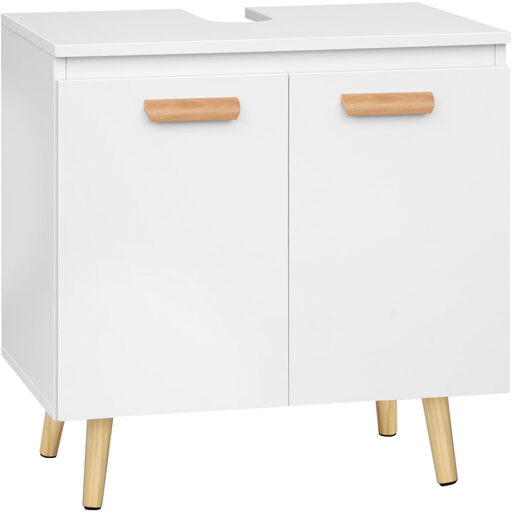
Why it's a great fit: Ideal for a first apartment or renovations on a tight budget. The simple, white design fits easily into most bathrooms, quickly and cost-effectively creating storage space under the sink.
The engineered wood material, described as moisture-resistant with an easy-care surface, addresses the material pitfall in this price segment. It offers basic protection against splashes and humidity.
The standardised dimensions (60 x 40 cm) and the provided siphon cutout are designed for common sinks, minimising the fit pitfall for many standard bathrooms.
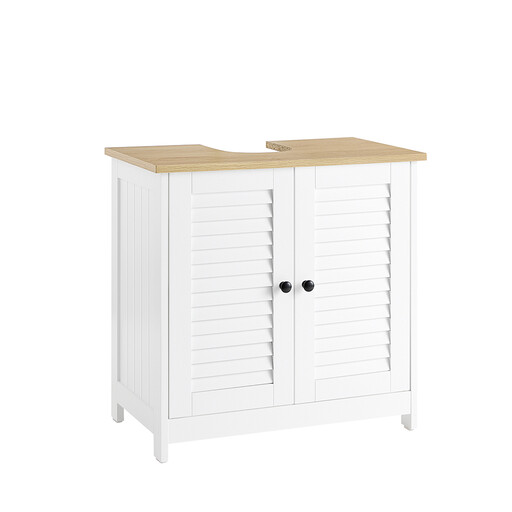
Why it's a great fit: A smart solution for compact or internal bathrooms without windows. The louvered doors are not just a design element; they actively promote air circulation.
The louvered doors counteract the moisture and mould pitfall by ensuring constant ventilation inside the cabinet. The adjustable shelves solve the problem of an inflexible interior layout.
The combination of E1-grade MDF panels, adjustable shelves, and ventilated doors offers a functional solution specifically tailored to the challenges of small, humid spaces.
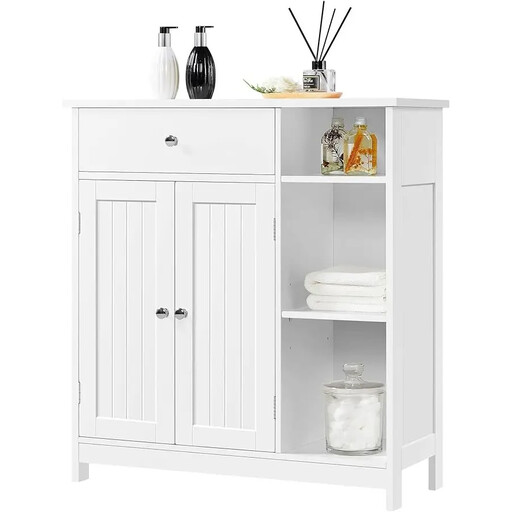
Why it's a great fit: This bathroom chest is a versatile solution for anyone who needs more than just a simple cabinet. It's suitable for families or for those looking for a piece of furniture that will also look good in a hallway or living room if they move.
By combining open compartments, a drawer, and a large compartment with an adjustable shelf, it bypasses the pitfall of an inflexible layout. Users can tailor the storage space exactly to their needs.
The included anti-tip device significantly increases safety, which is especially important in households with children. Its versatility beyond the bathroom justifies the investment.
If you're looking for other models selected based on objective criteria like material quality and functionality, you'll find a broader selection here.
The most effective protection is good bathroom ventilation. Air out the room in short bursts after showering or bathing to quickly lower the humidity. Immediately wipe up any puddles or splashes on the cabinet with a dry cloth. When buying, make sure the cabinet's edges are well-sealed.
Adjustable shelves offer maximum flexibility for your bathroom storage. They allow you to customise the height of the compartments. This lets you store tall cleaning bottles, flat stacks of towels, and small cosmetic items in a space-saving and organised way, without wasting room.
Most models, like the white bathroom cabinet or other variants, are designed for DIY assembly by non-experts. Manufacturers typically include numbered parts, an illustrated step-by-step guide, and all the necessary screws. Before buying, check if tools like a screwdriver or a cordless drill are required. Assembly is usually straightforward but requires care and close attention to the instructions.