
Lieferung heute & morgen

Qualitätsgarantie

Willkommens-Angebote freischalten: KOSTENLOSE Lieferung | Bis zu 80 % RABATT | Kostenlose 30-Tage-JoyPlus-Testphase
App herunterladen
A lack of storage is a common problem in bathrooms. Towels, toiletries, and cleaning supplies all need a dedicated spot, but space is often limited. A well-chosen bathroom cabinet can be the perfect solution. However, the vast selection often leads to poor purchases, with unsuitable materials or impractical designs revealing their flaws all too quickly. This guide highlights the pitfalls you should avoid and the features that truly matter when making your choice.
Many products look appealing at first glance but reveal their weaknesses only through daily use. Pay close attention to these three points to avoid a bad investment:
To avoid the problems mentioned above, you should base your purchasing decision on objective criteria. The following three aspects are crucial for functionality and longevity.
The choice of material is of central importance in the bathroom. MDF (Medium-Density Fibreboard) is often more resistant to moisture than simple particleboard due to its higher density and more homogeneous structure. However, the surface seal is the deciding factor. A high-quality lacquer or a melamine resin coating seals the surface and prevents water vapour or splashes from penetrating the material. Check that all edges are cleanly sealed.
Precisely measure the available space before you decide on a model. Consider not only the width and height but also the depth. A slim bathroom cabinet is particularly well-suited for narrow alcoves or small guest bathrooms. Also, think about the type of storage you need. A bathroom cabinet with drawers is ideal for small items, while open shelves provide quick access to everyday objects. Cabinet doors, on the other hand, conceal unsightly cleaning supplies and create a tidy, clutter-free look.
A good bathroom storage cabinet must be stable. Look for a solid base and an adequate weight. Many manufacturers include an anti-tip kit—a small component used to fix the cabinet to the wall. This is an important safety precaution, especially for taller, narrower models and in households with children. For models on castors, at least two of the wheels should be lockable to ensure a secure footing.
Based on the criteria mentioned, we have compiled a selection of models suitable for various needs and room situations.
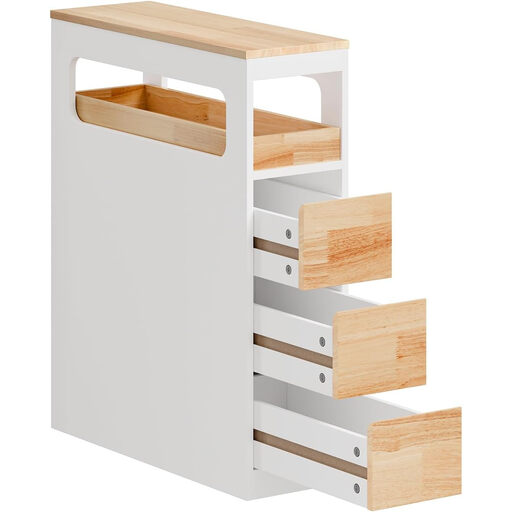
Why it's a great fit: With a depth of just 23 cm, this cabinet makes optimal use of niches that would otherwise go unused. The wheels allow for flexible positioning and make cleaning the floor easier. It is an ideal solution for small bathrooms or guest toilets.
The material, made of E1-grade MDF and rubberwood, is suitable for damp environments. The lockable brakes on two of the four wheels prevent unstable wobbling.
Extremely space-saving design combined with mobility. The three drawers and open compartment offer structured storage for various bathroom essentials.

Why it's a great fit: This classic white bathroom cabinet offers a thoughtful mix of an open compartment, two drawers, and a cupboard section. It is suitable for anyone who wants a clear separation between quickly accessible items and those stored out of sight.
The included anti-tip kit ensures a secure stand. The shelf behind the door is adjustable to three different heights, thus avoiding the problem of impractical compartment sizes.
Flexible storage layout thanks to the adjustable shelf. The combination of different storage types makes it a versatile all-rounder.
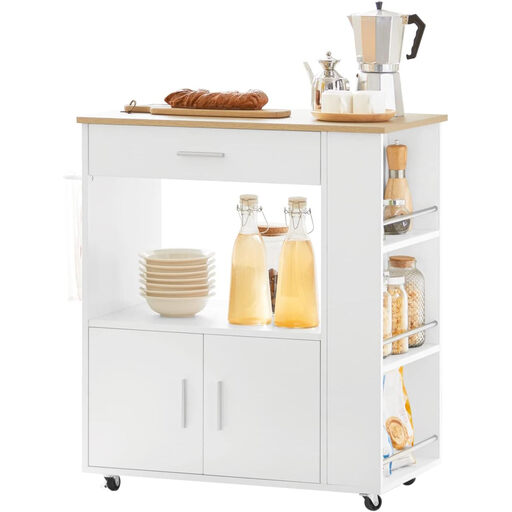
Why it's a great fit: Although designed as a kitchen island, the robust and mobile construction makes this cabinet an excellent side cabinet for the bathroom, hallway, or kitchen. The generous worktop provides additional counter space, which is lacking in many bathrooms.
The construction from E1-grade particleboard is designed for a high load capacity (up to 75 kg, according to the manufacturer). The four sturdy wheels, two of which have brakes, ensure both mobility and a secure stand.
High mobility and load capacity. Its multifunctional use as both storage and an additional work surface makes it particularly flexible.
We have compiled a complete, up-to-date list of products that fully meet these strict selection criteria and safety requirements.
The most effective protection is an intact surface seal. Wipe up spills and condensation immediately with a dry cloth. Also, ensure good ventilation in the bathroom by regularly airing it out or using an exhaust fan. Avoid placing wet towels directly on wooden surfaces.
MDF (Medium-Density Fibreboard) consists of very fine wood fibres that are compressed under high pressure. This results in a very dense, homogeneous board that is less prone to swelling. Particleboard is made from coarser wood chips that are glued together. It is lighter and less expensive but has a lower density and can more easily absorb moisture if the surface is damaged.
An anti-tip kit is an essential safety measure, especially for tall and narrow cabinets. It prevents the cabinet from tipping forward, for example, if a child tries to climb on it or if heavy items are stored in the upper drawers. Installation is simple and significantly increases the stability and safety of the furniture piece.