
Lieferung heute & morgen

Qualitätsgarantie

Willkommens-Angebote freischalten: KOSTENLOSE Lieferung | Bis zu 80 % RABATT | Kostenlose 30-Tage-JoyPlus-Testphase
App herunterladen
A cluttered bathroom can make for a difficult start to the day. When toiletries, towels, and cleaning supplies don't have a designated place, chaos quickly ensues. A well-chosen bathroom cabinet not only creates valuable storage space in the bathroom but also contributes to a calm and organised atmosphere. However, the selection is vast, and not every piece of bathroom furniture lives up to its promise.
Many buyers focus on design, overlooking crucial functional flaws that only become apparent in daily use. Before you make a decision, you should be aware of the most common pitfalls to avoid a poor investment.
To find the right bathroom cabinet that is both practical and durable, you should check three core parameters. These will help you objectively assess a model's quality.
The material is crucial for longevity in a humid bathroom. Look for the following features:
Measure the available space precisely before you start your search. Consider not only the width and depth but also the height and the clearance needed to open doors and drawers.
A good bathroom cabinet is more than just a box with a door.
Instead of presenting an overwhelming list, we have selected models that meet specific requirements and avoid the pitfalls mentioned earlier.
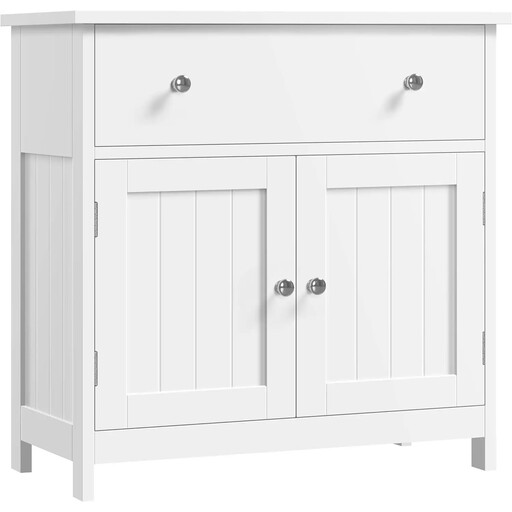
Why it's a good fit: This model is a classic and functional solution for utilising the unused space under the sink. It conceals the S-trap while creating enclosed storage for cleaning supplies and toilet paper—ideal for quickly establishing order.
The construction from MDF wood panels with a water-resistant coating is designed for bathroom use and is more resistant to moisture than unsealed particleboard.
It offers a combination of a drawer and a cabinet compartment, allowing for flexible organisation of both small and large items. The S-trap cut-out measures 20 x 15.3 cm.
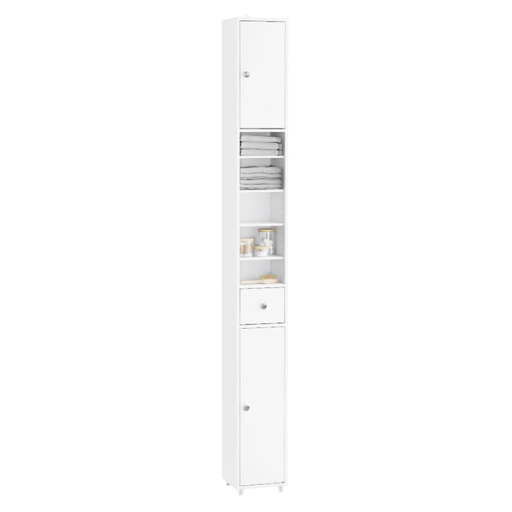
Why it's a good fit: With a footprint of just 20 x 20 cm, this tall cabinet is the ideal solution for bathrooms where every centimetre counts. It makes optimal use of vertical space, creating storage where there would otherwise be none.
This model bypasses the space dilemma with 6 height-adjustable shelves and a drawer. This allows the interior to be flexibly adapted to the size of towels, bottles, and other utensils.
The option for wall mounting provides the necessary stability, which is crucial for such a tall and narrow cabinet. The matte white finish is also resistant to fingerprints.
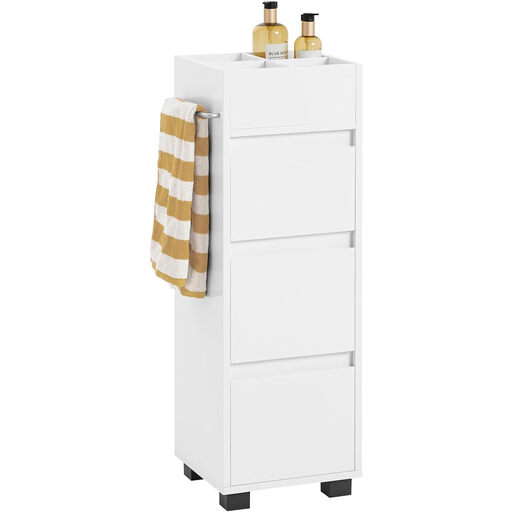
Why it's a good fit: Specifically designed for tight gaps, this modern and slim 30 cm wide cabinet offers a thoughtful combination of open compartments, drawers, and a side towel holder. It transforms unused corners into functional storage space.
The construction from high-quality lacquered MDF (E1) is designed for humid environments. An included anti-tip kit for wall mounting addresses the stability risk associated with narrow furniture.
The multifunctional towel holder can be mounted on the left or right, depending on the bathroom layout, allowing for high flexibility in placement. The combination of open and closed compartments is practical.
We have compiled a comprehensive, up-to-date list of products that meet these strict selection criteria.
1. How do I protect a bathroom cabinet made of engineered wood from moisture? The most effective protection is choosing the right material from the outset. Look for models made of MDF with a seamless, water-resistant lacquer or coating. Additionally, ensure good ventilation in the bathroom to reduce overall humidity, and always wipe up water splashes on the furniture immediately.
2. Does a bathroom cabinet need to be fixed to the wall? For tall or narrow cabinets, this is strongly recommended to prevent tipping. Most manufacturers include an anti-tip kit for this reason. For wide, low under-sink cabinets, it is not always mandatory, but it increases stability and safety, especially if there are children in the household.
3. What is the difference between MDF and particleboard for bathroom furniture?MDF (Medium-Density Fibreboard) is made by compressing finer wood fibres under high pressure. This makes it denser, more stable, and, with proper sealing, more resistant to moisture. Particleboard consists of coarser wood chips. If its coating gets damaged—which can easily happen at edges or drill holes—it soaks up moisture like a sponge and swells quickly and irreparably. For durable bathroom furniture, MDF is therefore the more solid choice.