
Lieferung heute & morgen

Qualitätsgarantie

Willkommens-Angebote freischalten: KOSTENLOSE Lieferung | Bis zu 80 % RABATT | Kostenlose 30-Tage-JoyPlus-Testphase
App herunterladen
A new bathroom cabinet promises to bring order and create more space. However, the selection is vast, and not every model delivers on its promise. Flaws often only become apparent after a few months in the humid bathroom environment. To help you make an informed decision, we'll highlight the most common problems and show you which criteria truly matter.
Many buyers focus on design, overlooking critical functional weaknesses. Three typical frustrations include:
To avoid these issues, you should check three core parameters. These will help you objectively assess a cabinet's quality and durability.
The material is crucial for the cabinet's lifespan in the bathroom. Look for furniture made from MDF (Medium-Density Fibreboard), ideally to E1 standard, as it has a higher density and stability than simple particleboard. Even more important is the surface finish. A high-quality lacquer or a melamine resin coating seals the material, making it water-resistant and easy to clean. A white bathroom cabinet with such a coating is not only timeless but also resilient against moisture.
A good bathroom cabinet adapts to your needs, not the other way around. Check if the shelves are adjustable. This allows you to flexibly configure the interior for items of different heights. A combination of closed compartments for private items, open shelves for towels or decor, and drawers for small items offers a well-thought-out organizational solution, especially in bathroom furniture for small spaces.
Choose the mounting type that suits your bathroom and your walls.
Based on these criteria, we have selected a few models for different user profiles.

Why This Fits Their Persona: Ideal for a first apartment or guest bathroom where budget and a space-saving combination of mirror and storage are priorities. It meets basic requirements without unnecessary extras.
The adjustable shelf prevents the problem of rigid compartments. According to the manufacturer, metal fittings are used for mounting, which aims for a more stable construction.
Combines two functions (mirror and cabinet), saving space and money. The open shelf at the bottom provides quick access to daily-use items.
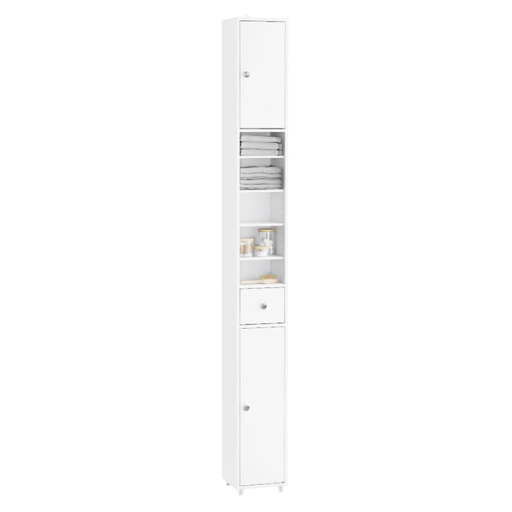
Why This Fits Their Persona: Perfect for utilizing narrow niches (only 20 cm wide) next to the toilet or sink. It transforms unused corners into valuable vertical storage.
Made from MDF, it is more resistant to moisture. The six height-adjustable shelves offer maximum flexibility, and the included wall mount prevents tipping.
Extremely slim 20 cm profile for optimal space utilization. High flexibility with six adjustable shelves and an additional central drawer.
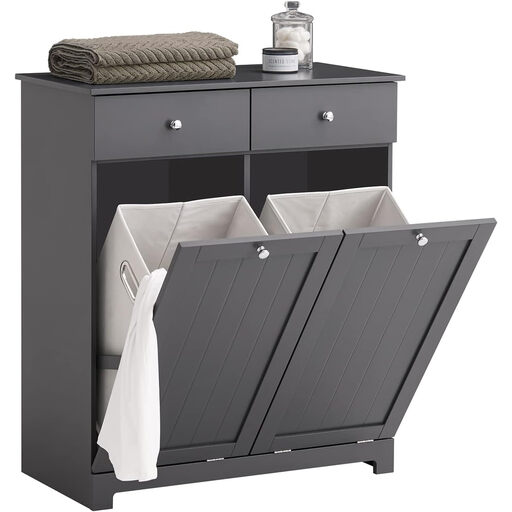
Why This Fits Their Persona: For households that need to combine storage and laundry management in one piece of furniture. Ideal for bathrooms or utility rooms with no space for separate laundry baskets.
The sturdy construction from E1-MDF is moisture-resistant. The elevated design promotes air circulation, reducing the risk of dampness and mildew in the laundry bags.
Integrated laundry management with two removable bags for pre-sorting. Additional drawers provide storage for detergent or bathroom essentials.
We have compiled a complete, up-to-date list of products that fully meet these strict selection criteria and safety regulations.
For the humid climate of a bathroom, lacquered or coated MDF boards (E1 standard) are an excellent choice. They are dimensionally stable, and the sealant protects against moisture penetration. Solid wood can also be suitable but requires special treatment (oiling or lacquering) and regular maintenance to prevent warping or cracking. Untreated particleboard is unsuitable for bathrooms.
Safety is the top priority. A wall-mounted cabinet must always be attached to a load-bearing wall. For solid walls (e.g., concrete, solid brick), standard anchors and screws are usually sufficient. For hollow walls (e.g., drywall), you must use special hollow-wall anchors that expand behind the panel. Before drilling, use a stud finder or pipe detector to ensure there are no electrical or water lines in the wall. Follow the manufacturer's installation instructions precisely.
Measure not only the width, depth, and height of the available space but also the exact position and dimensions of the siphon (p-trap) and water connections. An under-sink cabinet has a special siphon cutout in its top panel and back panel. Compare the dimensions of this cutout with your siphon's measurements to ensure the cabinet will fit without colliding with the pipes.