
Lieferung heute & morgen

Qualitätsgarantie

Willkommens-Angebote freischalten: KOSTENLOSE Lieferung | Bis zu 80 % RABATT | Kostenlose 30-Tage-JoyPlus-Testphase
App herunterladen
A cluttered bathroom can make starting your day a challenge. Tubes, bottles, and towels are scattered everywhere because there's simply not enough storage. The right bathroom cabinet promises a solution, but the selection is vast, and not every model delivers on its promise. Many buyers invest in furniture that shows defects after a short time or proves to be impractical.
Before you make a decision, it's helpful to know the most common pitfalls that can lead to a poor purchase:
To avoid these problems and find a durable, functional solution, you should pay attention to a few fundamental features when making your choice.
The material is the foundation for your bathroom cabinet's longevity. Look for models made from MDF (medium-density fibreboard) that are finished with a water-repellent layer. A lacquer or melamine resin coating seals the surface and prevents moisture from penetrating. A white bathroom cabinet with such a coating is not only timeless but also easy to clean.
A natural alternative is bamboo. This material is inherently more moisture-resistant than many other types of wood and brings a warm, inviting atmosphere to the bathroom.
Measure the available space exactly before you decide on a model.
Consider whether a freestanding or a wall-mounted model fits your concept better. Wall-mounted cabinets make floor cleaning easier and create an airy feel. Freestanding cabinets are often easier to assemble and typically offer more volume.
Regardless of the mounting type, stability is key. For all tall and narrow models, an anti-tip device for securing it to the wall should be included or installed separately. This prevents the furniture from tipping over.
Instead of presenting an overwhelming list, we have selected a few products that are well-suited for specific needs and room situations.
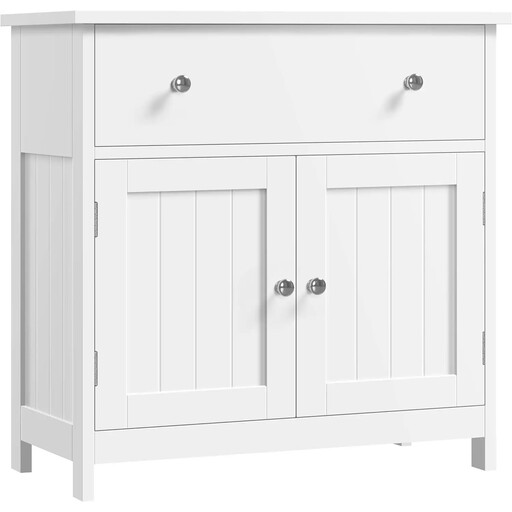
Why it's a great fit: It cost-effectively creates order under the sink, conceals unsightly pipes, and provides clear separation for different utensils with a drawer and a cabinet compartment. A solid base solution for any bathroom.
The water-repellent coating on the MDF boards protects against the typical swelling caused by moisture. The siphon cutout, measuring 20 x 15.3 cm, is suitable for many standard installations, which avoids the "space waster" effect.
Efficient use of the empty space under the sink. The combination of a drawer and a cabinet compartment allows for separate storage of small and large items.
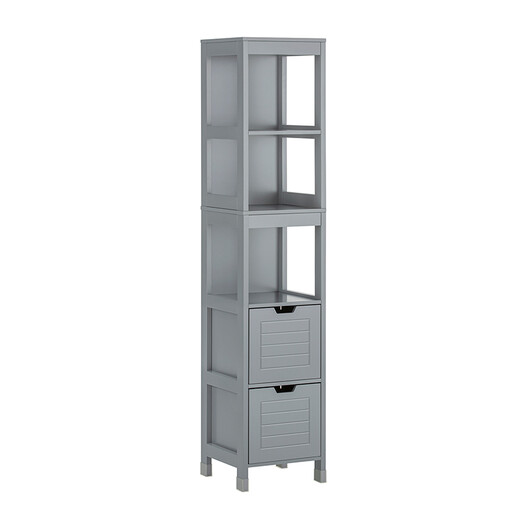
Why it's a great fit: It makes optimal use of the room's height and requires a minimal footprint of just 30 x 30 cm. This makes it an excellent choice for tight niches, guest toilets, or as a supplement to existing furniture in small bathrooms.
As a narrow tall cabinet, stability is crucial. The construction from lacquered MDF is more robust than simple particleboard. A wall mount for tip-over protection is generally recommended for such models to minimise the stability risk.
High storage capacity on a small footprint. The flexible layout with three open compartments and two removable baskets allows for storing items of various sizes.
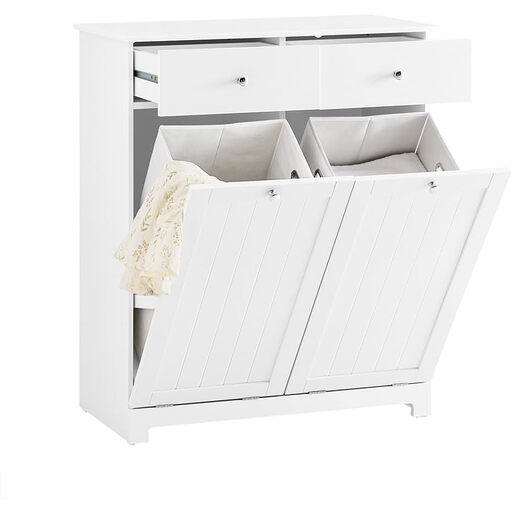
Why it's a great fit: It combines a stylish laundry hamper with practical drawers, solving two problems at once: sorting laundry and storing bathroom essentials. Ideal for anyone who appreciates a tidy and well-thought-out aesthetic.
This piece of furniture is an example of thoughtful space utilisation, avoiding the "space waster" trap. The raised feet also protect it from floor moisture, and the construction from E1-grade MDF boards is designed for durability.
Integrated laundry separation with two tilt-out hampers (90-litre total volume). Additional drawers provide discreet storage for small items like cosmetics or socks.
We have compiled a comprehensive, up-to-date list of products that fully meet these strict selection criteria and UK safety regulations.
The most effective method is choosing the right material. Opt for furniture made of MDF with a water-repellent lacquer or coating, or for models made of solid bamboo. Additionally, ensure good ventilation in the bathroom and wipe away any puddles of water on the cabinet immediately with a dry cloth.
No. There is no universal standard for the size and position of the siphon. Therefore, before buying, you must measure the distance from the floor to the bottom edge of the sink, the available width and depth, and the exact dimensions of the siphon cutout you need. Many product details specify the cutout dimensions, which makes comparison easier.
For bathroom furniture in small bathrooms, wall-mounted cabinets are often the better choice. They leave the floor clear, which visually enlarges the room and simplifies cleaning. However, freestanding cabinets, especially a narrow tall cabinet, can offer more storage space on a small footprint if you can utilise the vertical space. The decision depends on your priorities: an open, airy feel or maximum storage volume.