
Lieferung heute & morgen

Qualitätsgarantie

Willkommens-Angebote freischalten: KOSTENLOSE Lieferung | Bis zu 80 % RABATT | Kostenlose 30-Tage-JoyPlus-Testphase
App herunterladen
A new bathroom cabinet promises an organized, clutter-free space and more storage in your bathroom. However, the sheer number of options can quickly become overwhelming. Many models look great at first glance but turn out to be a poor investment after just a few months. Before you make a decision, it's crucial to understand the typical weak points that often only become apparent after the purchase.
This guide will walk you through the three most common pitfalls when buying bathroom furniture and explain which core features to look for to find a durable and functional solution for your home.
The decision for a bathroom cabinet is often made hastily, based on looks and price alone. However, certain defects only reveal themselves in the humid environment of a bathroom.
To avoid the problems mentioned above, you should check three essential technical features before buying. These determine the longevity and functionality of your new bathroom furniture.
The material is the foundation for a bathroom cabinet's lifespan. Look for furniture made from MDF (Medium-Density Fibreboard), ideally with an E1 emission class rating. Compared to simple particleboard, MDF is denser, more dimensionally stable, and less prone to swelling when exposed to moisture.
The surface seal is also crucial. A high-quality, multi-layer lacquer or a melamine resin coating protects the wood from water vapor and splashes. White bathroom furniture is often treated with easy-care lacquers that are simple to clean and create a bright atmosphere.
Measure the available space precisely before choosing a model. Consider not only the width and depth but also the height.
Check whether the interior layout meets your needs. Adjustable shelves are a must for flexible use. Drawers should run smoothly and ideally feature a pull-out stop.
A solid footing is essential. Look for a robust construction and check the product description for the presence of an anti-tip device. This small component, which anchors the cabinet to the wall, is an important safety feature and should be included with any taller cabinet. Details like magnetic door catches also contribute to stability and ensure the doors close neatly.
Based on the quality criteria mentioned, we have identified several models that are well-suited for different needs and room situations.

Why this model is a great fit: This bathroom sideboard is an all-rounder. It combines open and closed compartments with drawers, offering a flexible solution for families. Thanks to its neutral design, it's also suitable for use in a hallway or living room.
The model is made of MDF wood panels and features a shelf that is adjustable to 3 heights, which avoids the pitfall of a rigid interior. An anti-tipping device prevents the drawers from falling out.
The combination of an open compartment, drawers, and a cabinet door provides versatile organization options for different items.
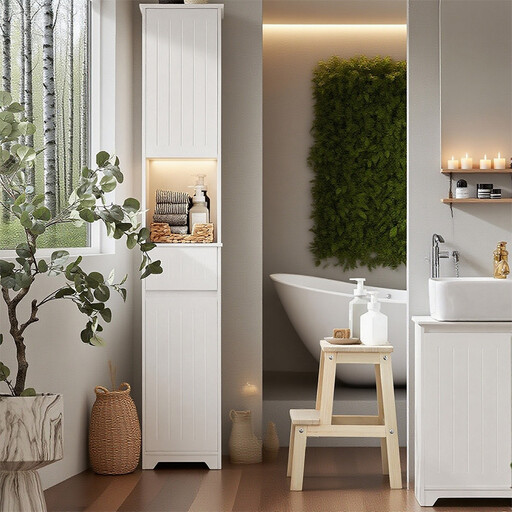
Why this model is a great fit: With a footprint of just 30x30 cm, this tall cabinet is the ideal solution for small bathrooms and unused niches. It makes optimal use of vertical space to store towels, toiletries, and other essentials.
The material is specified as moisture-resistant MDF (E1), which prevents the problem of swelling. Additionally, the shelves behind both doors are adjustable to 3 different heights.
Maximum storage on a minimal footprint (30x30 cm). The total height of 170 cm creates ample space in small rooms.

Why this model is a great fit: With its shallow depth of 23 cm, this tall cabinet is perfect for utilizing corners or narrow wall sections without protruding into the room. It combines open shelving with closed storage space.
Made from MDF (Class E1) with a double-sided lacquer finish, the cabinet offers good protection against moisture. A 3-level adjustable shelf ensures flexibility, and the magnetic catch provides stability.
The slim design with a shallow depth (23 cm) is optimal for tight spaces. The mix of open and closed areas is practical for both quick access and tidy storage.
We've compiled a complete, up-to-date list of products that fully meet these strict selection criteria and safety requirements.
The best protection starts with choosing the right material, such as lacquered or coated MDF. Additionally, ensure good ventilation in the bathroom by opening a window or turning on a fan after showering or bathing. Always wipe away water spots from the cabinet's surface immediately.
MDF (Medium-Density Fibreboard) is made from very fine wood fibers that are compressed under high pressure. This creates a very dense, homogeneous board that is dimensionally stable and swells less when it comes into contact with moisture. Particleboard consists of coarser wood chips that are glued together. It is lighter and cheaper, but also more porous and susceptible to moisture damage if the seal is compromised. For the bathroom, MDF is the more robust choice.
Always use the included anti-tip hardware. This usually consists of a bracket or a strap that is screwed to the cabinet and the wall. Choose wall anchors and screws that are appropriate for your wall type (e.g., drywall, brick, concrete). Follow the manufacturer's assembly instructions precisely to ensure a safe and stable installation.