
Lieferung heute & morgen

Qualitätsgarantie

Willkommens-Angebote freischalten: KOSTENLOSE Lieferung | Bis zu 80 % RABATT | Kostenlose 30-Tage-JoyPlus-Testphase
App herunterladen
A bathroom cabinet should keep toiletries, towels and cleaning products neatly organised, take up as little space as possible and cope with humid air. In practice, however, a few common purchasing decisions can lead to unnecessary costs: a cabinet may not fit the intended alcove, open compartments can quickly become untidy, or integrated lighting may not replace the bathroom’s main lighting.
This buying guide explains which dimensions, materials and features are important to consider before buying a bathroom cabinet. You will then find a selection for different home and usage profiles.
When choosing a tall bathroom cabinet, width is not the only factor that matters. You also need to consider depth, door-opening angle, plinth height and the distance from the washbasin or shower. In a small cloakroom, even a depth of just a few centimetres can determine whether the door can still be opened comfortably.
Therefore, measure:
A moisture-resistant bathroom cabinet is designed for high humidity and occasional splashes. This does not automatically mean that it can be exposed to a wet floor or direct jets of water for extended periods. Particular attention should be paid to the edges, back panels and plinth.
Coated MDF or chipboard, rust-protected metal parts and a design that does not stand directly on the damp floor are sensible choices. Regardless of the material, standing water should be removed promptly.
A mirror cabinet with LED lighting can illuminate the area around the washbasin. However, according to the product description for the relevant model, the lighting is not necessarily intended to serve as the only main light source for the entire bathroom. Pay attention to the mounting and electrical instructions, and have fixed electrical connections installed by a qualified professional.
A bathroom cabinet with doors provides better protection for towels, toilet paper and toiletries against dust and splashes. Open compartments are suitable for frequently used items or decorative boxes. A combination of both is practical for many households, as it offers quick access alongside protected storage.
Adjustable shelves are particularly useful when you need to store bottles, tins or storage boxes of different heights. With a bathroom sideboard or vanity unit, you should also check whether the drawers are compatible with the siphon and water connections.
Coated wood-based materials are easy to clean, but should not remain in permanent contact with water. A raised design can increase the clearance from the floor and make cleaning easier. On narrow models with slatted doors or ventilated drawers, air circulation inside the cabinet can be improved.
Important: descriptions such as “rust-resistant”, “splash-proof” or “moisture-resistant” should always be considered in relation to the specific product and its installation location.
For a bathroom cabinet with mirror, the following details are relevant:
For the relevant product, the IP44 rating indicates protection against solid foreign objects above a certain size and against splashing water. It does not replace correct installation or compliance with bathroom installation zones.
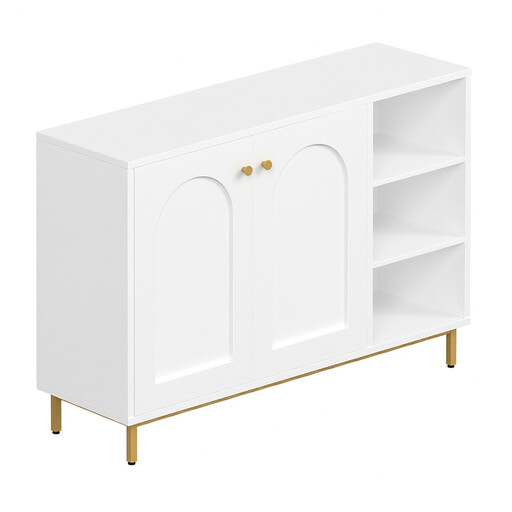
Why this product suits this profile: This freestanding unit offers a combination of enclosed storage and three open compartments across its 100 cm width. It is suitable for households that need additional storage beside the washbasin.
The raised design, with a specified height of 12.5 cm, keeps the main body off the floor. Three adjustable shelves help you organise containers of different heights.
MDF body with moisture-resistant coating, metal components and external dimensions of 35.5 × 100.5 × 75.5 cm, according to the product specifications.
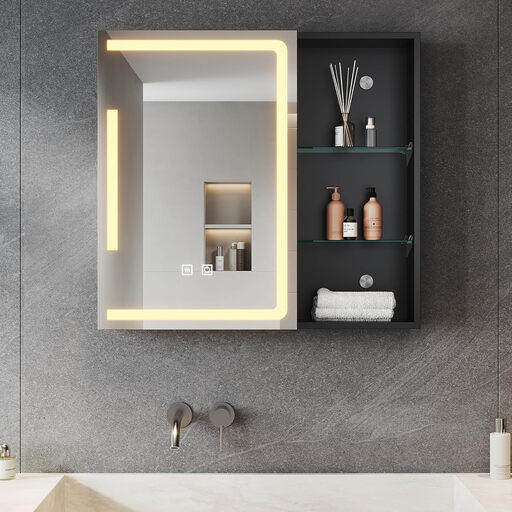
Why this product suits this profile: This wall-mounted mirror cabinet with LED lighting is aimed at users who want to combine a mirror, storage and additional features at the washbasin.
The product description lists an anti-fog function, four adjustable glass shelves and dimmable lighting with three light colours. According to the product information, the light is not intended to serve as the main lighting.
Powder-coated steel body, socket to German standards, soft-close hinges and wall mounting, according to the product data.
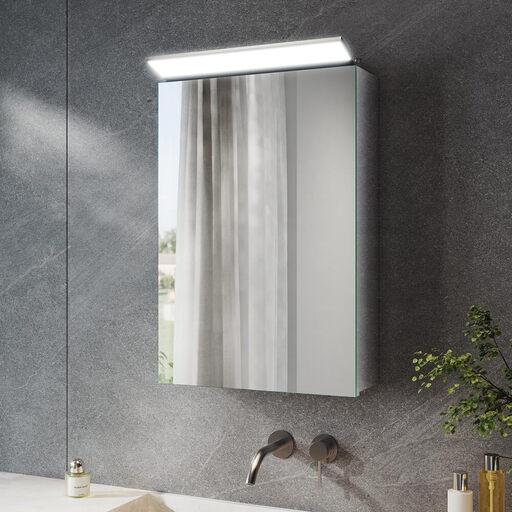
Why this product suits this profile: Its compact width is suitable for small washbasins, cloakrooms or narrow wall areas where a large mirror cabinet would not fit.
The specified IP44 rating is relevant to the intended splash protection. According to the description, the LED lighting and power supply can be replaced separately.
Body made from rust-resistant 201 stainless steel, two compartments, one metal shelf and external dimensions of 36 × 52 × 12 cm, according to the product specifications.
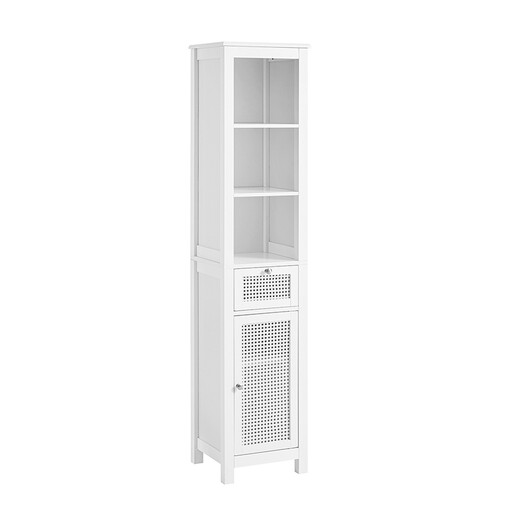
Why this product suits this profile: This slim bathroom cabinet makes use of vertical space rather than floor space. With three open compartments, a drawer and a slatted door, it fits into many small bathrooms and rented flats.
The ventilation openings in the door and drawer help address the risk of trapped moisture. To ensure stability and prevent tipping, use the supplied wall fixing.
E1-grade MDF, a compact footprint of approximately 35 × 32 cm and a specified total load capacity of up to 55 kg.
We have put together a complete, regularly updated list of products that fully meet these strict selection criteria and the safety regulations applicable in the EU.
For small spaces, a slim bathroom cabinet or a wall-mounted mirror cabinet is a sensible choice. As well as the width, check the depth and the door-opening area. A tall cabinet makes use of vertical space, while a compact mirror cabinet creates storage directly above the washbasin.
Its service life depends on the material, workmanship, ventilation and usage. Coated surfaces should be kept dry and cleaned with a soft, damp cloth. Avoid direct contact with water, harsh cleaning products and permanently wet floors. Secure wall fixing is important for tall or narrow furniture.
Consumption depends on the power rating of the built-in LED light and how long it is used each day. For a rough estimate, multiply the power in watts by the operating hours and divide the result by 1,000. With a model featuring dimmable lighting, a lower brightness setting can reduce consumption while the light is in use.