
Lieferung heute & morgen

Qualitätsgarantie

Willkommens-Angebote freischalten: KOSTENLOSE Lieferung | Bis zu 80 % RABATT | Kostenlose 30-Tage-JoyPlus-Testphase
App herunterladen
A bathroom cabinet should hold toiletries, towels and personal-care products without unnecessarily restricting the available space. In practice, however, unsuitable purchases are often caused not by the design, but by the wrong dimensions, unsuitable materials or shelves that are difficult to access. Checking a few technical details before buying can help you tailor your choice much more effectively to your bathroom.
A cabinet may look compact at first glance, but doors, back panels or fixed shelves can leave you with less storage space than expected. With a sink cabinet, you also need to take the position of the trap into account. So check the following:
For small bathrooms, a narrow bathroom cabinet or a freestanding model with limited depth may be more practical than a wide cabinet with corners that are difficult to reach.
Bathrooms regularly have high humidity levels. Splashing water and wet floors can also put strain on the underside of furniture. Claims such as ‘moisture-resistant’ should therefore be considered alongside the material, coating and construction. A cabinet for humid rooms also needs sufficient clearance from the floor and should not be left standing in water for extended periods.
A single fixed shelf may be unsuitable for large bottles, while smaller personal-care products can get lost on it. Look for a bathroom cabinet with an adjustable shelf if you want to store products in different-sized containers. Drawers are suitable for smaller items, doors protect the contents from view and dust, while open compartments often provide quick access.
For a small cloakroom, a narrow sink cabinet with drawers may be sufficient. In a family bathroom, combinations of doors, drawers and open compartments offer more tailored storage. A freestanding bathroom cabinet is particularly practical if fixed wall mounting is not wanted or possible.
Before ordering, measure not only the floor space, but also skirting boards, pipes and wall projections. The external dimensions stated in the product description should be compared with the space actually available.
MDF, chipboard and metal are frequently used for bathroom furniture. What matters is a sealed surface, cleanly finished edges and a construction that is not permanently exposed to splashing water. Metal is generally easy to wipe clean; coated wood-based materials require gentle cleaning with a slightly damp cloth. Harsh cleaning products and continually wet cloths can damage surfaces regardless of the material.
A white bathroom cabinet reflects light and often makes small rooms appear brighter. Coloured or metallic details, on the other hand, can be used deliberately as design features. However, the appearance should not take priority over checking the dimensions, load capacity and fixing method.
An anti-tip feature is important for tall or narrow cabinets. Secure the furniture to a suitable wall in accordance with the assembly instructions. Tenants should check before drilling whether the condition of the wall and their tenancy agreement permit installation. The stated maximum load must not be exceeded either. Wherever possible, store heavy supplies in the lower compartments.
The following models differ in construction, material, layout and dimensions. The information is based on the respective product details.
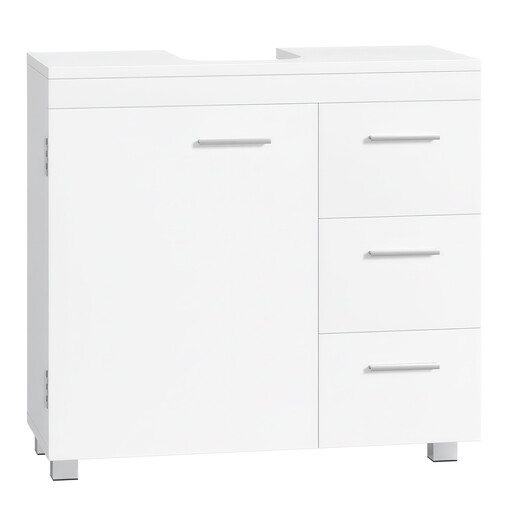
Why this product suits this profile: At 70 cm wide and 30 cm deep, it may be a good option for smaller bathrooms or areas beneath a washbasin. Three drawers and two compartments behind the door keep the storage space neatly organised.
The compact design reduces the risk of poor planning where floor space is limited. The product details also specify an adjustable shelf and an anti-tip kit.
Matte white surface, several separate storage areas and a stated maximum static load capacity of 36.2 kg.
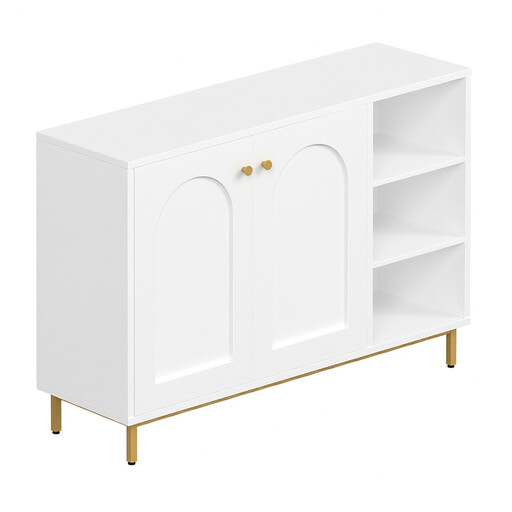
Why this product suits this profile: This model combines enclosed compartments with three open shelves. At approximately 100.5 cm wide and 35.5 cm deep, it is suitable for households that need more bathroom storage and want to keep different items separate.
Three adjustable shelf heights help accommodate bottles and boxes of different sizes. According to the product details, the raised base, with 12.5 cm of clearance, makes floor cleaning easier.
MDF or chipboard and metal according to the product details, three adjustable shelves, plus doors and open compartments in one unit.
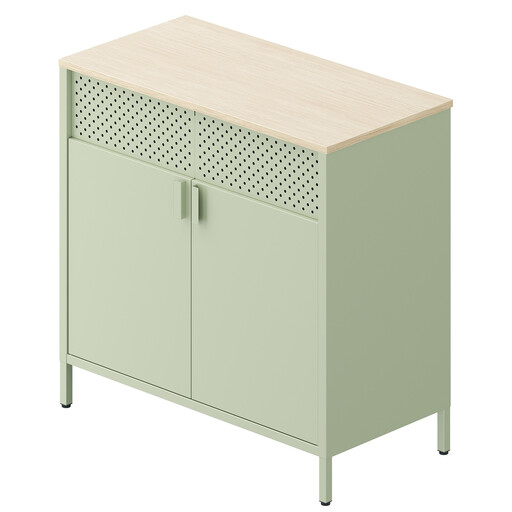
Why this product suits this profile: This freestanding steel cabinet may be a good choice for households with greater organisational needs. It is not marketed exclusively as a bathroom cabinet and, according to the product description, can also be used in other areas of the home.
The steel body is described in the product details as moisture-resistant and easy to care for. The adjustable shelf prevents the layout from being entirely fixed.
Dimensions of 40 × 80 × 76 cm, an adjustable shelf and a pegboard element for ventilation or attaching hooks.
We have put together a complete, regularly updated list of products that fully meet these strict selection criteria and the safety regulations applicable in the EU.
Before assembly, sort all parts according to the instructions. With furniture featuring doors or drawers, a level floor is important so that the fronts close evenly. An anti-tip kit should be used in accordance with the instructions. For rented homes, a freestanding bathroom cabinet with increased floor clearance can be a practical alternative, provided it is stable and secure.
Wipe away splashed water promptly and avoid leaving towels to dry directly on delicate edges. Open compartments should not be so full that air circulation is restricted. With a metal model, a pegboard can provide additional ventilation; with wood-based materials, exposed cut edges in particular should be protected from prolonged moisture.
Measure the available width, depth and height, including skirting boards and pipes. For a model beneath the washbasin, the trap, water connections and position of the washbasin must match the product dimensions and the intended cut-out.
Its service life depends on the quality of the materials, installation, load, cleaning and exposure to moisture. It is not possible to give a general lifespan. Dry surfaces, secure fixing and compliance with the maximum load capacity can help maintain its usability.
A standard bathroom cabinet does not incur ongoing electricity costs, as it does not require an electrical function. Possible additional costs include assembly accessories, wall fixings or replacement parts where necessary. The key consideration is therefore whether the dimensions, storage capacity and material are suitable for the intended use.