
Lieferung heute & morgen

Qualitätsgarantie

Willkommens-Angebote freischalten: KOSTENLOSE Lieferung | Bis zu 80 % RABATT | Kostenlose 30-Tage-JoyPlus-Testphase
App herunterladen
A bathroom cabinet should neatly store toiletries, towels, toilet paper and cleaning products without making the room feel unnecessarily smaller. Every centimetre counts, especially in a small bathroom or downstairs toilet. At the same time, some marketing claims can lead to disappointing purchases: a piece of furniture may be described as “space-saving”, but still not fit next to the washbasin because of the way its door opens. Other models may appear moisture-resistant but cannot withstand prolonged contact with standing water.
The most important pitfalls to watch out for before buying:
Measure the available area at three points: width, depth and clear height. With a narrow bathroom cabinet, it is also important to check whether the doors can open fully and whether the cabinet clears sockets, radiators and the washbasin.
Different designs suit different room layouts:
Adjustable shelves are useful in everyday life because bottles, baskets and folded towels require different amounts of space. Check the number of shelf positions, the adjustment range and whether the shelves can be removed. A bathroom shelving unit with adjustable shelves can therefore be used more flexibly than a model with fixed compartments only.
Load capacity should also be considered separately: the maximum load for the top panel does not automatically indicate the permitted load for every shelf or drawer. Where possible, store heavier supplies in the lower section.
Many bathroom cabinets are made from MDF or chipboard with a melamine or laminate coating. These surfaces are easy to care for and may be suitable as a moisture-resistant cabinet, provided the manufacturer expressly states this. Nevertheless, you should:
A material specification such as MDF E1 primarily describes the wood-based material used or its emissions class. It does not replace a statement about waterproofing.
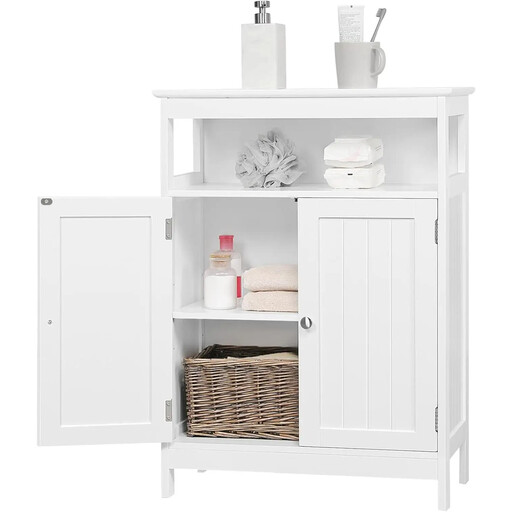
Why this product suits this profile: Measuring 60 × 30 × 80 cm, this freestanding model has a compact footprint for the bathroom, kitchen, bedroom or office.
The shelf can be adjusted to three different heights, so tall bottles do not have to be placed in unsuitable fixed compartments.
Water-repellent coating according to the product description, metal handles and separate load capacity specifications for the top panel, storage area and shelf.
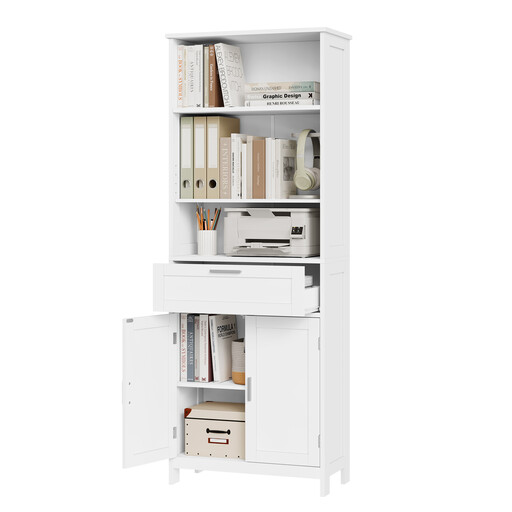
Why this product suits this profile: The combination of three open compartments, a drawer and a closed section helps organise a larger household with varied storage needs.
The upper shelves can be adjusted to five positions, while the internal divider has three positions or can be removed completely.
Dimensions of 60 × 30 × 160 cm, a melamine surface and an anti-tip device according to the product specifications.
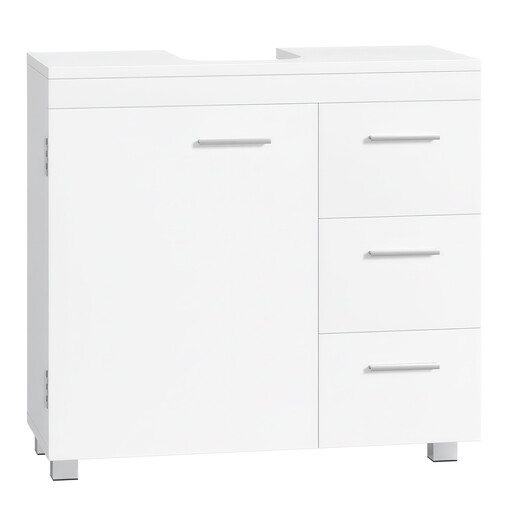
Why this product suits this profile: For households looking to organise the unused space beneath the washbasin, this model combines drawers with a cupboard compartment behind the door.
Before buying, check that the cut-out is compatible with your washbasin. The included anti-tip device also helps improve stability.
30 × 70 × 64 cm, three drawers, a door compartment with adjustable shelf and a stated maximum static load of 36.2 kg.
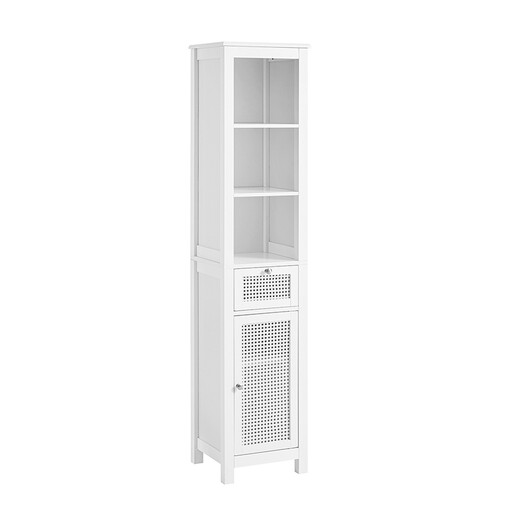
Why this product suits this profile: With a footprint of approximately 35 × 32 cm, this tall cabinet makes use of vertical space and is ideal for narrow alcoves next to the washbasin or shower.
The combination of three open shelves, a drawer and a slatted door prevents the entire storage area from consisting solely of difficult-to-access internal compartments.
35 × 161 × 32 cm, MDF E1 with a moisture-resistant surface according to the product description and a stated load capacity of up to 55 kg.
We have put together a complete, regularly updated list of products that fully meet these strict selection criteria and the safety regulations applicable in the EU.
Before placing your order, check whether assembly tools are included and how many people are needed to build the cabinet. Some models require a screwdriver or two people. Also check that the back panel, hinges and drawer runners are fitted correctly.
A tall bathroom cabinet should stand on a level floor and be secured to the wall using the supplied anti-tip fitting. Only use wall plugs and screws suitable for the type of wall. Electrical components, such as LED lighting on a sideboard with storage, must not come into contact with water.
For coated surfaces, a soft, slightly damp cloth is generally all that is needed for cleaning. The surface should then be wiped dry. Abrasive cleaning products can damage coatings and edges.
A narrow bathroom cabinet or a tall cabinet with a shallow depth is a sensible choice for compact spaces. Measure the available area beforehand and take door movement, skirting boards and the distance from water connections into account. Open compartments make items easier to reach, while closed sections create a neater appearance for toilet paper or cleaning products.
Its service life depends on the quality of the materials, assembly, load and moisture levels. A coated MDF or chipboard cabinet can remain usable for a long time if it is kept dry and protected from standing water. Protected edges, sturdy joints and correct wall mounting are particularly important. Without specific information from the manufacturer, it is not possible to give a reliable general lifespan.
A conventional cabinet does not incur any significant running costs. A model with LED lighting will use additional electricity, depending on its power consumption, daily operating time and electricity tariff. Timer functions can help reduce unnecessary operating time. Also check whether batteries for a remote control are required separately.