
Lieferung heute & morgen

Qualitätsgarantie

Willkommens-Angebote freischalten: KOSTENLOSE Lieferung | Bis zu 80 % RABATT | Kostenlose 30-Tage-JoyPlus-Testphase
App herunterladen
A new bathroom lighting set-up needs to brighten the room sufficiently, provide good visibility at the mirror and cope safely with moisture. In practice, however, it is not just design choices that lead to poor purchases. All too often, lights are bought on looks alone, while technical details such as IP rating, connection type or colour temperature are given too little attention.
With LED lights, wattage is primarily an indicator of energy consumption. For actual brightness, lumens are far more important. A modern LED bathroom light can produce ample illumination with a relatively low power draw. With lights that use an E27 fitting, brightness depends on the bulb or LED lamp you install.
Not every bathroom wall light is suitable for every installation location. Near the shower and bathtub, special requirements apply under DIN VDE 0100-701. The specific IP rating must match the installation zone. A decorative finish or a mention of moisture resistance is no replacement for a stated electrical protection class.
A bathroom mirror with an anti-fog function, touch switch or memory function can make daily life easier. However, it is important to check how it works: on some models, the anti-fog feature only operates when the mirror light is switched on. You should also confirm the wall connection, the position of the switch and the required mounting height before you buy.
Colour temperature is measured in Kelvin:
For the vanity area, even illumination is more important than a single very bright light source. A dimmable bathroom light offers more flexibility. With lights that use replaceable E27 bulbs, you need to check whether the bulb you want is dimmable and compatible with the dimmer you are using.
A bathroom mirror light should match the width of the mirror and the vanity unit. A light that is too short can cast shadows at the sides, while one that is too wide can visually overwhelm the mirror. With an illuminated bathroom mirror, you should also check:
If you are renting, you should also check whether a fixed wall connection is permitted. Work on the 230-volt mains should be carried out by a qualified electrician. Before installation, the power supply must be switched off at the fuse box.
Aluminium profiles, glass and coated metal can be easy to care for, depending on the finish. Even so, the light should not be sprayed directly with water. Cleaning is usually done with a soft, slightly damp cloth; abrasive products can damage coatings and mirror surfaces.
Also look out for:
The models below differ in design, operation and intended use. The deciding factor is therefore not a general verdict, but how well they match the conditions in your own bathroom.
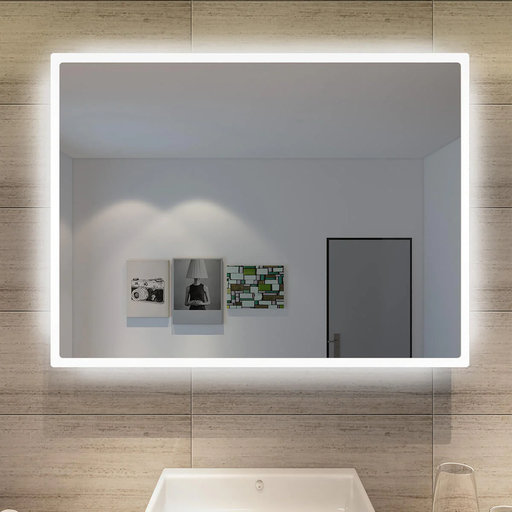
Why this product fits the profile: This LED bathroom mirror combines the mirror surface with integrated lighting. A wall switch allows classic operation without relying solely on touch controls.
The lighting is not just added decoratively around the edge but is integrated into the mirror. Before buying, you should check the actual external dimensions and fixing method against the product details and your available space.
Integrated LED lighting, aluminium profile and operation via a wall switch. Installation to the mains supply should be carried out by a qualified electrician.
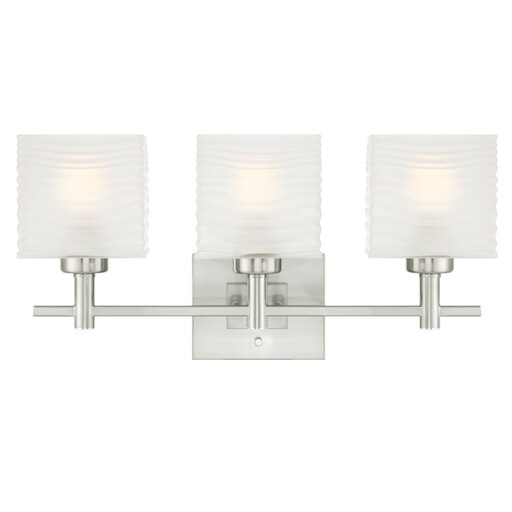
Why this product fits the profile: This three-light vanity light is aimed at buyers who prefer a visible metal-and-glass combination and replaceable bulbs.
The specification “3 x E27 up to 60 watts” makes the maximum load per fitting clear. Before installation, you should still check whether the LED bulbs you choose and the installation location are suitable for the bathroom.
Three glass shades, brushed nickel finish, 230-volt version and wall mounting. It is used with separately purchased E27 bulbs.
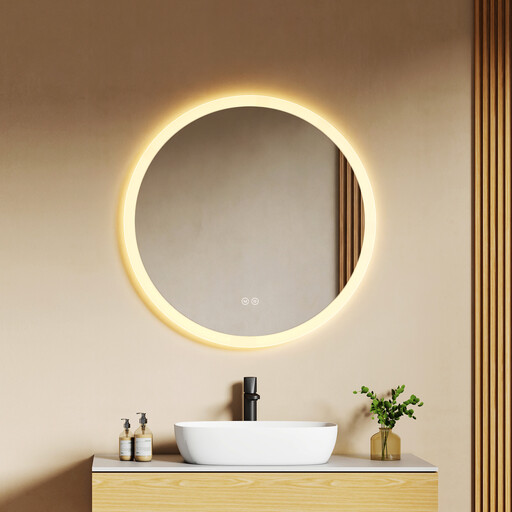
Why this product fits the profile: This round LED mirror offers three colour temperatures, brightness adjustment from 10 to 100 per cent, touch control and a stated anti-fog function.
The functional limits are clearly stated: the anti-fog function activates together with the lighting, and the mirror switches off automatically after three hours.
Round design with 70 cm diameter, memory function, wall and touch control, and included mounting accessories according to the product description.
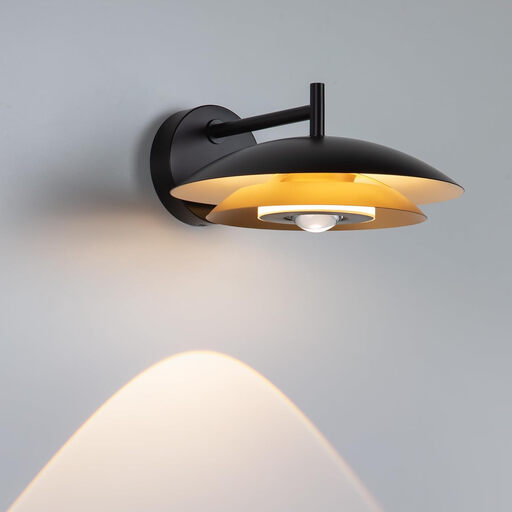
Why this product fits the profile: This spherical bathroom wall light is of interest to renovators who want a clear mid-century accent at the mirror alongside functional lighting.
The dimming function only works with a dimmable bulb and a compatible dimmer. You must also check before buying whether the specific installation location is suitable for damp rooms.
Clear glass, gold-coloured metal finish, hardwired connection and mounting as a wall or ceiling light according to the product description.
We have put together a full, regularly updated list of products that fully meet these strict selection criteria and the safety regulations in force in the EU.
For the mirror, neutral white is often chosen because it supports a clear, objective view. Warm white can feel more pleasant for general room lighting. With an LED bathroom mirror that offers three colour temperatures, you can adjust the setting depending on how you are using it.
The lifespan depends on factors such as operating hours, heat dissipation, mains quality and moisture at the installation location. Look at the manufacturer's specific figure for LED lifespan and whether the bulb is replaceable. With permanently integrated LEDs, a fault may mean replacing the entire light unit.
The running costs depend on the wattage, daily usage time and your electricity tariff. The calculation is: power in kilowatts × operating hours × electricity price. A 10-watt light used for one hour a day consumes 3.65 kilowatt-hours per year in theory. If you have multiple light sources and an anti-fog function, you should include their respective power consumption in your calculation.